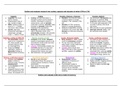
Outline and evaluate research into coding, capacity and duration of either STM or LTM.
Capacity Coding Duration, Peterson + Peterson Duration, Bahrick
● Capacity: how much ● Coding: the way information is ● Duration: how long info stays in ● 392 Americans: Recognition test,
held in memory. changed so that it can be stored in a memory before no longer 50 photos in yearbook. Free
● Represented in bits of memory. Information is stored in available. LTM: unlimited, STM: recall test, listing names of class.
info, number of digits various forms, such as episodic 18s ● Ps 48 years after graduation 70%
● Miller: looked at span of codes (like a picture), acoustic codes ● Duration of STM, nonsense accurate in photos, free-recall
items is 7+- 2. People (sounds) or semantic codes (the trigram & counting backwards was worse.
can count 7 dots, chunks meaning of the experience). ● Students recalled 80% correctly, ● 90% accurate 10 years graduated
● Jacobs, digit span. ● Baddeley: acoustically similar (cat, recall fell to 3% correct after 18s. ● Had high external validity, real
Researcher read digits, P cab) vs dissimilar words, STM Duration of STM w/out rehearsal life memories were studied.
repeat back, average acoustically encoded. LTM semantic is 18-30s.
recall = 7 letters / 9 num (large, big). Recall after 10 mins.
Baddeley, coding of STM/LTM Bahrick, duration of LTM Jacobs, Historical Validity Cowan, conflicting research
● No meaningful material ● Compare to lab studies, Shepard ● Early research in 1800s, lacked ● He looked at other research on
used for Ps, compared to looked at meaningless pictures to be control of extraneous variables. capacity of STM, found STM
IRL where people use remembered, found recall was lower. ● Ps may have been distracted limited to 4 chunks. Suggests
semantic doing in STM High ecological validity. while tested, results invalid due to lower end of Miller’s research (5
for meaningful info. ● Counter: Confounding variables not confounding variables. items) is more appropriate.
● Study has limited controlled, Bahrick’s Ps may have ● Counter: these results have ● Artificial study doesn’t reflect real
application, caution to looked at their yearbook photos + been confirmed in other research, life, where we remember
generalize findings to rehearsed their names over years. eg Miller, supports its validity. meaningful info. Lacks ec validity
different kinds of memory ● 392 Americans, can’t generalise. ● Counter: we do remember some
tasks. meaningless things, phone nos.
Reitman, conflicting research Real World Application Reductionist Biological Approach
● Reitman used auditory ● We do try and remember ● Reductionist, reduces ● Links to biological approach
tones vs letters in meaningless things, like groups of explanation of memory to 3 ● Highly scientific, mapping memory
Peterson study. Prevents numbers (phone numbers) or letters different stores. to different stores in brain.
displacement. (postcodes). ● Psychologists unable to ● Based on highly controlled lab
● Found duration of STM ● Each study does have some determine whether long-term studies.
was longer. relevance to everyday life. memory has an unlimited
● Suggests Peterson study duration, doesn’t actually explain
due to displacement, not anything.
decay. Not actually STM
Outline and evaluate multi store model of memory.
Capacity Coding Duration, Peterson + Peterson Duration, Bahrick
● Capacity: how much ● Coding: the way information is ● Duration: how long info stays in ● 392 Americans: Recognition test,
held in memory. changed so that it can be stored in a memory before no longer 50 photos in yearbook. Free
● Represented in bits of memory. Information is stored in available. LTM: unlimited, STM: recall test, listing names of class.
info, number of digits various forms, such as episodic 18s ● Ps 48 years after graduation 70%
● Miller: looked at span of codes (like a picture), acoustic codes ● Duration of STM, nonsense accurate in photos, free-recall
items is 7+- 2. People (sounds) or semantic codes (the trigram & counting backwards was worse.
can count 7 dots, chunks meaning of the experience). ● Students recalled 80% correctly, ● 90% accurate 10 years graduated
● Jacobs, digit span. ● Baddeley: acoustically similar (cat, recall fell to 3% correct after 18s. ● Had high external validity, real
Researcher read digits, P cab) vs dissimilar words, STM Duration of STM w/out rehearsal life memories were studied.
repeat back, average acoustically encoded. LTM semantic is 18-30s.
recall = 7 letters / 9 num (large, big). Recall after 10 mins.
Baddeley, coding of STM/LTM Bahrick, duration of LTM Jacobs, Historical Validity Cowan, conflicting research
● No meaningful material ● Compare to lab studies, Shepard ● Early research in 1800s, lacked ● He looked at other research on
used for Ps, compared to looked at meaningless pictures to be control of extraneous variables. capacity of STM, found STM
IRL where people use remembered, found recall was lower. ● Ps may have been distracted limited to 4 chunks. Suggests
semantic doing in STM High ecological validity. while tested, results invalid due to lower end of Miller’s research (5
for meaningful info. ● Counter: Confounding variables not confounding variables. items) is more appropriate.
● Study has limited controlled, Bahrick’s Ps may have ● Counter: these results have ● Artificial study doesn’t reflect real
application, caution to looked at their yearbook photos + been confirmed in other research, life, where we remember
generalize findings to rehearsed their names over years. eg Miller, supports its validity. meaningful info. Lacks ec validity
different kinds of memory ● 392 Americans, can’t generalise. ● Counter: we do remember some
tasks. meaningless things, phone nos.
Reitman, conflicting research Real World Application Reductionist Biological Approach
● Reitman used auditory ● We do try and remember ● Reductionist, reduces ● Links to biological approach
tones vs letters in meaningless things, like groups of explanation of memory to 3 ● Highly scientific, mapping memory
Peterson study. Prevents numbers (phone numbers) or letters different stores. to different stores in brain.
displacement. (postcodes). ● Psychologists unable to ● Based on highly controlled lab
● Found duration of STM ● Each study does have some determine whether long-term studies.
was longer. relevance to everyday life. memory has an unlimited
● Suggests Peterson study duration, doesn’t actually explain
due to displacement, not anything.
decay. Not actually STM
Outline and evaluate multi store model of memory.