

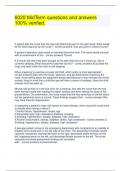
6020 MidTerm questions and answers 100% verified.
6020 MidTerm questions and answers 100% verified. A patient tells the nurse that she has had abdominal pain for the past week. What would be the best response by the nurse? - correct answers."Can you point to where it hurts?" A patient's laboratory data reveal an elevated thyroxine level. The nurse would proceed with an examination of the: - correct answers.Thyroid A 6-month-old infant has been brought to the well-child clinic for a check-up. She is currently sleeping. What should the examiner do first? - correct answers.Auscultate the lungs and heart while the infant is still sleeping When preparing to examine a 6-year-old child, which action is most appropriate? - correct answers.Start with the thorax, abdomen, and genitalia before examining the head. Avoid talking about the equipment being used because it may increase the child's anxiety. Keep in mind that a child this age will have a sense of modesty. Have the child undress from the waist up. 68-year-old woman is in the eye clinic for a checkup. She tells the nurse that she has been having trouble with reading the paper, sewing, and even seeing the faces of her grandchildren. On examination, the nurse notes that she has some loss of central vision but her peripheral vision is normal. These findings suggest that: - correct answers.She may have macular degeneration In assessing a patient's major risk factors for heart disease, which would the nurse want to include when taking a history? 1.Family history, hypertension, stress, age 2.Personality type, high cholesterol, diabetes, smoking 3.Smoking, hypertension, obesity, diabetes, high cholesterol 4.Alcohol consumption, obesity, diabetes, stress, high cholesterol - correct answers.3. Smoking, hypertension, obesity, diabetes, high cholesterol A teenage patient comes to the emergency department with complaints of an inability to breathe and a sharp pain in the left side of his chest. The assessment findings include cyanosis, tachypnea, tracheal deviation to the right, decreased tactile fremitus on the left, hyperresonance on the left, and decreased breath sounds on the left. The nurse interprets that these assessment findings are consistent with: - correct answers.a pneumothorax
Document information
- Uploaded on
- January 30, 2024
- Number of pages
- 8
- Written in
- 2023/2024
- Type
- Exam (elaborations)
- Contains
- Questions & answers


