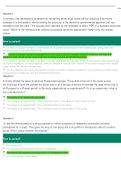
Week 7 Genitourinary, Electrolyte imbalance, and prostate disorders Board vitals quiz
Week 7 Genitourinary, Electrolyte imbalance, and prostate disorders Board vitals quiz 1. Which of the following antimicrobial agents is recommended as first-line treatment for acute uncomplicated cystitis in women? Trimethoprim-sulfamethoxaxole 2. In a woman without risk factors, at what age is bone density screening with DEXA recommended? 65 years 3. A 43-year-old pre-menopausal woman comes to your office complaining about recurrent urinary tract infections (UTI). Over the past three years, she has had up to seven infections per year. Her primary care doctor completed testing and she does not have urinary calculi or urinary tract abnormalities. She has tried different soaps, changing behaviors, and changing contraceptives. She is asking if anything can be done to prevent future infections. What would be the best treatment choice for this woman to significantly reduce the number of UTI’s she is experiencing? Continue antibiotic therapy with trimethoprim-sulfamethoxazole nightly for six months 4. A 12-year-old make presents with sudden onset of a painful testicle. What are the most likely physical exam findings for testicular torsion? High-riding testicle, scrotal edema, abnormal cremasteric reflex 5. A 42-year-old woman presents to your office with urinary complaints. She states she has been experiencing urinary urgency and frequency for months. She also describes having significant discomfort with urination, both dysuria and suprapubic pain. She occasionally has nocturia as well. She has gone to several urgent care facilities, where she was treated with antibiotics without improvement, and had two cultures which showed sterile urine. She is not having any vaginal discharge, itching, or rash. She is never-smoker. What would be the most appropriate diagnosis at this time? Interstitial cystitis 6. A 63-year-old woman presents to your office with the complaint of urinary urge incontinence. She feels like this bas been worsening for the last several years. You do a physical exam which does not demonstrate any pelvic organ prolapse. She is healthy weight. What is the first-line recommended treatment? Pelvic floor therapy/exercises 7. Which urinalysis findings suggest a urinary tract infection (UTI)? Alkaline Ph and positive nitrite and leukocyte esterase 8. In which of the following groups should asymptomatic bacteriuria be treated? Pregnant women 9. Which of the following is not a criterion in the diagnosis of polycystic ovary syndrome? Acanthosis nigricans 10. A 40-year-old woman with stage 3 chronic kidney disease secondary to hypertension presents complaining of dysuria and frequency for 3 days. She denies fever or hematuria. On exam, her temperature is 98.9 f. Heart rate is 88, and blood pressure is 140/80. Examination is unremarkable except for suprapubic tenderness. Urinalysis reveals cloudy urine with positive leukocyte esterase, nitrites, and protein. Cultures are pending. What is the correct medication therapy for this patient? Oral trimethoprim-sulfamethoxazole 11. A 14-year-old afebrile male presents to clinic with sudden onset of a painful and swollen testicle that appears to lie transversely. The pain began 6 hours ago, has been persistent, and does not fluctuate with activity. He denies any dysuria or sexual activity. Which of the following is the most appropriate next step in management? Immediate urology consult for surgery 12. The nurse practitioner is evaluating results of serum blood studies for a client who is experiencing a slight increase in blood pressure. The client has no history of high BP and
Written for
- Institution
-
Walden University
- Course
-
NURS6531
Document information
- Uploaded on
- January 24, 2024
- Number of pages
- 5
- Written in
- 2023/2024
- Type
- Exam (elaborations)
- Contains
- Questions & answers
Subjects
-
week 7 genitourinary electrolyte imbalance an