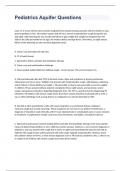
Pediatrics Aquifer Questions and answers graded A+ 2023/2024
Pediatrics Aquifer Questions Case 13: A 4-year-old boy who recently emigrated from eastern Europe presents with his mother to your general pediatrics clinic. His mother reports that he has a chronic nonproductive cough during the day and night, mild wheezing for one month and failure to gain weight (his weight has dropped from the 50th to the 10th percentile for his age). His mother denies any high fevers, rhinorrhea, or night sweats. Which of the following are the next best diagnostic tests? A. Chest x-ray and tuberculin skin test B. CT of nasal sinuses C. Spirometry, before and after bronchodilator therapy D. Chest x-ray and methacholine challenge E. None needed, patient likely has habitual cough - correct answer .The correct answer is A. A. CXR and tuberculin skin test (TST) is the best choice. Signs and symptoms of primary pulmonary tuberculosis are few to none. Toddlers may present with nonproductive cough, mild dyspnea, wheezing, and/or failure to thrive (defined as weight < 5th percentile or drop in two percentile curves for weight). In children, TB can present without systemic complaints (fever, night sweats, and anorexia), severe cough, and sputum production. Regarding diagnostic tests, the TST is a practical tool for diagnosing TB infections. All children with chronic cough (more than three weeks) should be evaluated with a chest x-ray, as other pathology-such as lung abscess or malignancy-can also be detected on CXR. B. Sinusitis is often preceded by a URI, with nasal congestion as a prominent feature, leading to nocturnal cough due to post-nasal drip. These symptoms are not seen in our patient. Furthermore, a diagnosis of sinusitis is made clinically, with CT scan obtained only in complicated cases or cases resistant to treatment. Complications include cavernous sinus thrombosis, meningitis, and epidural abscess. C. Spirometry (pulmonary function testing) before and after bronchodilator therapy is the most specific means of determining whether or not a child has reactive airways. Asthma is a very common diagnosis in pediatrics, and may present with cough that is worse at night and exacerbated by exercise and cold air. Patients with cough-variant asthma present with only cough, typically nonproductive. However, given this patient's failure to thrive, a more serious diagnosis such as TB must be considered. Also, a chest x-ray is needed in all children with chronic cough (more than three weeks). D. Although a chest x-ray is appropriate in all children with chronic cough, a methacholine challenge (for asthma) would be Case 13: An 11-year old boy presents to clinic with wheezing. Mom states that in the past he has used inhaled albuterol and it has helped with wheezing and shortness of breath. On further history you find out that the patient experiences shortness of breath three times a week and is awakened at night by these symptoms once a week. What is the most appropriate outpatient therapy? A. Only rescue inhaler PRN B. Low dose inhaled corticosteroids C. Medium dose inhaled corticosteroids and course of oral corticosteroids D. Medium dose inhaled corticosteroids, LABA, and course of oral corticosteroids E. Course of oral corticosteroids - correct answer .The correct answer is B. A. Rescue inhaler (a short-acting beta agonist) i PRN is incorrect because this treatment is indicated in patients with intermittent asthma and have symptoms fewer than two days a week or two nights a month B. Low dose inhaled corticosteroid is correct because this patient has mild persistent asthma. His symptoms occur 3-6 days/week and 3-4 nights/month. C. Medium dose inhaled corticosteroids with a course of oral corticosteroids is incorrect, because it would be indicated in a patient with moderate persistent asthma when symptoms occur daily and more than one night per week. D. Medium dose inhaled corticosteroids, LABA, and oral corticosteroids is incorrect because this patient does not have severe persistent asthma. E. A course of oral corticosteroids alone is incorrect. Asthma needs to be managed long term to prevent exacerbations. An inhaled corticosteroid is indicated. Case 14: An 18-month-old girl presents to the clinic with nasal congestion and fever for three days. She is previously healthy. She is receiving acetaminophen for fever. Temperature is 101.2 F (38.4 C), pulse is 100 beats/minute, respirations are 24 breaths per minute. Oxygen saturations are 98% on room air. She is alert and well perfused with clear mucus coming from both nostrils and no increased work of breathing. Both turbinates show erythema. Her oropharynx is erythematous. No crackles or wheezing are heard. Her immunizations are up to date. Which of the following diagnoses is most consistent with this patient's presentation? A. Strep pnuemoniae B. Group A Strep C. Rhinovirus D. Hemophilus Influenzae type B E. Pertussis - correct answer The correct answer is C. A. Her symptoms do not fit a diagnosis of pneumonia, as she does not have significant fever, increased respiratory rate, crackles, or rales. B. Group A Strep is rarely a cause of pharyngitis in young children and notably does not cause the feared sequelae (rheumatic fever) in those < 3 years. C. Rhinovirus causes the common cold and is the most reasonable diagnosis. Rhinovirus is a very common cause of congestion and other cold-like symptoms. She presents with slightly elevated temperature, slight tachypnea, and inflamed turbinates and oral mucosa. Her symptoms all correlate with the common cold. D. Hemophilus Influenzae type B causes pneumonia and epiglottitis. She does not have the typical symptoms of epiglottitis that include difficulty breathing, high fever and drooling. With the advent of vaccinations, Hib infections have decreased significantly. E. The catarrhal phase of pertussis can be indistinguishable from the common cold, but quickly develops into the paroxysmal phase. The paroxysmal phase is characterized by coughing fits and post-tussive emesis, which again she does not have. It typically does not have associated fever. Case 14: A 14-month-old female presents to clinic with fever to 39.2 C and irritability. According to mom, the patient was initially sick one week ago with a runny nose and cough, but these symptoms had resolved. She started pulling at her ear and becoming increasingly irritable last night. She has had several
Written for
- Institution
- Aquifer
- Course
- Aquifer
Document information
- Uploaded on
- December 7, 2023
- Number of pages
- 64
- Written in
- 2023/2024
- Type
- Exam (elaborations)
- Contains
- Questions & answers
Subjects
-
pediatrics aquifer questions

Also available in package deal