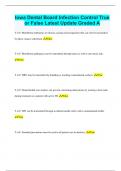
Iowa Dental Board Infection Control True or False Latest Update Graded A
Iowa Dental Board Infection Control True or False Latest Update Graded A T or F: Bloodborne pathogens are disease-causing microorganisms that can only be transmitted by direct contact with blood. False T or F: Bloodborne pathogens may be transmitted through intact as well as non-intact skin. False T or F: HBV may be transmitted by handling or touching contaminated surfaces. True T or F: Dental health care workers can prevent contracting tuberculosis by wearing a face mask during treatment on a patient with active TB. False T or F: HIV can be transmitted through accidental needle sticks with a contaminated needle. True T or F: Standard precautions must be used in all patient care in dentistry. True T or F: A container holding contaminated laundry should be labeled with a biohazard label. True T or F: Protective clothing and equipment (e.g. gowns lab coats, gloves, masks and protective eyewear or face shield) should be worn to prevent contamination of street clothing and to protect the skin of health care personnel from exposure to blood and body substances. True T or F: Dental assistants can eat or drink in the sterilization area of the dental office if there are no contaminated instruments on the counter. False T or F: Needles should be bent or broken before being discarded. False T or F: Overgloves are not acceptable alone as a glove during patient treatment. True T or F: Protective eyewear should have protective side shields. True T or F: If you wear contact lenses you do not need additional eye protection. False T or F: Training on OSHA bloodborne pathogens regulations must be provided annually. True T or F: It is the employee's responsibility to seek appropriate training on bloodborne pathogens. False T or F: An employer may decide not to provide training if it is not cost effective. False T or F: Additional training is required if there is a change in the tasks or procedures that affect employee occupational exposure. True T or F: Training must be performed during regular work hours. True T or F: The training program must include information on what to do in the event of an occupational exposure to bloodborne pathogens. True T or F: After training, employees should be familiar with the symptoms of bloodborne disease. True T or F: If an antiseptic hand cleanser or antiseptic towelette is used for hand washing, you must wash with soap and water as soon as possible. True T or F: While cleaning a spill of blood or other potentially infectious materials, gloves are not needed because of the cleaning solution used. False T or F: Disposable sharps must be placed in some type of biohazard bag or container. The type of bag or container is unimportant as long as it says biohazard. False T or F: Persons handling regulated laundry should practice standard precautions. This would include the wearing of latex gloves. True T or F: Sterilization is the process by which all life forms are destroyed. True T or F: There is only one perfect disinfectant. False T or F: Glutaraldehydes are EPA-registered chemical/sterilants. True T or F: Chlorine dioxide containing products can be used as surface disinfectants or chemical sterilants depending on the exposure time. True T or F: Sodium hypochlorite, when used as a surface disinfectant, should be mixed in a 1:10 dilution. True T or F: Dental handpieces and associated attachments, including low-speed motors and reused prophylaxis angles, should always be heat sterilized between patients and not high-level or surface disinfected. True T or F: If contaminated instruments cannot be cleaned immediately following the procedure, they should be placed in a holding solution. True T or F: Surfaces that are difficult to disinfect (e.g. chair buttons, control buttons on the air-water syringe, switches on the unit, light handles, hoses, and handpiece and air-water syringe holders) should be covered with a material impervious to water and should be replaced between each patient. True T or F: Wear a mask when cleaning and disinfecting to prevent inhalation or direct mucous-membrane contamination from splatter. True T or F: For surface disinfection, water, rather than alcohol, must be used to dilute agents that require dilution before use. True T or F: An EPA-registered hospital disinfectant should be used for both the cleaning and disinfectant step for uncovered surfaces to provide dual purposes. True
Written for
- Institution
- Iowa Dental Board Infection Control
- Course
- Iowa Dental Board Infection Control
Document information
- Uploaded on
- January 23, 2024
- Number of pages
- 6
- Written in
- 2023/2024
- Type
- Exam (elaborations)
- Contains
- Questions & answers
Subjects
-
iowa dental board infection control true or false

Also available in package deal