

QUICK TEST BANK PHARMACOLOGY A PATIENT-CENTERED NURSING PROCESS APPROACH 2024-UPLOADED
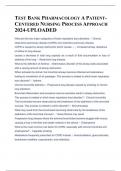
QUICK TEST BANK PHARMACOLOGY A PATIENT-CENTERED NURSING PROCESS APPROACH 2024-UPLOADED What are the two major categories of lower respiratory tract disorders. - Chronic obstructive pulmonary disease (COPD) and restrictive pulmonary disease COPD is caused by airway obstruction which causes.... - increased airway resistance of airflow to lung tissues. causes a decrease in total lung capacity as a result of fluid accumulation or loss of elasticity of the lung. - Restrictive lung disease What is the definition of Asthma - inflammatory disorder of the airway walls associated with a varying amount of airway obstruction When activated by stimuli, the bronchial airways become inflamed and edematous, leading to constriction of air passages. This process is related to which lower respiratory tract disorder? - Asthma Chronic bronchitis definition - Progressive lung disease caused by smoking or chronic lung infections Bronchial inflammation and excessive mucous secretion result in airway obstruction. This process is related to which lower respiratory tract disorder? - Chronic bronchitis The bronchioles become obstructed by the breakdown of the epithelium of the bronchial mucosa. This process is related to which disorder? - Bronchiectasis What may result from the bronchioles becoming obstructed by the breakdown of the epithelium of the bronchial mucosa? - Tissue fibrosis may result Progressive lung disease where the terminal bronchioles become plugged with mucus, causing a loss in the fiber and elastin network in the alveoli. - Emphysema What is the most common risk factor for COPD, especially with chronic bronchitis and emphysema? - Cigarette smoking Medications frequently prescribed for COPD include: - bronchodilators, glucocorticoids, leukotriene modifiers, expectorants, and antibiotics. Chronic Obstructive Pulmonary Disease characterized by periods of bronchospasm resulting in wheezing and difficulty breathing. - Bronchial Asthma Results when the lung tissue is exposed to extrinsic or intrinsic factors that stimulate a bronchoconstrictive response. - Bronchospasm Cells found in connective tissue throughout the body are directly involved in the asthmatic response, particularly to extrinsic factors. - Mast cells (Allergens attach themselves to mast cells and basophils, resulting in an antigen-antibody reaction on the mast cells in the lung; the mast cells stimulate the release of chemical mediators such as histamines, cytokines, serotonin, eosinophil chemotactic factor of anaphylaxis (ECF-A), and leukotrienes) Exposure to an allergen results in... - bronchial hyper-responsiveness, epithelial shedding of the bronchial wall, mucous gland hyperplasia and hypersecretion, leakage of plasma that leads to swelling, and bronchoconstriction Increase cAMP, causing dilation of the bronchioles - Sympathomimetics In ______________________ the nonselective sympathomimetic epinephrine is given subcutaneously to promote bronchodilation and elevate blood pressure. - an acute bronchospasm caused by anaphylaxis from an allergic reaction, Selective beta2-adrenergic agonists are given by aerosol for... - bronchospasm associated with chronic asthma or COPD, These drugs act primarily on the beta2 receptors; therefore, the side effects are less severe - Selective beta2-adrenergic agonists If the beta2 agonist is given by a metered-dose inhaler (MDI) what is important to include in patient education? - Proper use of a spacer device may be attached to the inhaler to improve drug delivery to the lung with less deposition in the mouth - Spacer The side effects and adverse reactions of epinephrine include: - tremors, dizziness, hypertension, tachycardia, heart palpitations, cardiac dysrhythmias, and angina. The patient needs to be closely monitored when the medication is administered. The side effects associated with beta2-adrenergic drugs include: - tremors, headaches, nervousness, increased pulse rate, and palpitations.
Document information
- Uploaded on
- January 21, 2024
- Number of pages
- 5
- Written in
- 2023/2024
- Type
- Exam (elaborations)
- Contains
- Questions & answers


