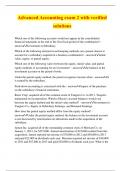
Advanced Accounting exam 2 with verified solutions
Advanced Accounting exam 2 with verified solutions Which one of the following accounts would not appear in the consolidated financial statements at the end of the first fiscal period of the combination? - answerInvestment in Subsidiary Which of the following internal record-keeping methods can a parent choose to account for a subsidiary acquired in a business combination? - answerinitial value, equity, or partial equity. Which one of the following varies between the equity, initial value, and partial equity methods of accounting for an investment? - answerthe balance in the investment account on the parent's books. Under the partial equity method, the parent recognizes income when - answerit is earned by the subsidiary. Push-down accounting is concerned with the - answerimpact of the purchase on the subsidiary's financial statements. Racer Corp. acquired all of the common stock of Tangiers Co. in 2011. Tangiers maintained its incorporation. Which of Racer's account balances would vary between the equity method and the initial value method? - answerInvestment in Tangiers Co., Equity in Subsidiary Earnings, and Retained Earnings. How does the partial equity method differ from the equity method? - answerUnder the partial equity method, the balance in the investment account is not decreased by amortization on allocations made in the acquisition of the subsidiary. Jansen Inc. acquired all of the outstanding common stock of Merriam Co. on January 1, 2012, for $257,000. Annual amortization of $19,000 resulted from this acquisition. Jansen reported net income of $70,000 in 2012 and $50,000 in 2013 and paid $22,000 in dividends each year. Merriam reported net income of $40,000 in 2012 and $47,000 in 2013 and paid $10,000 in dividends each year. What is the Investment in Merriam Co. balance on Jansen's books as of December 31, 2013, if the equity method has been applied? - answer$286,000. Explanation: $257,000 + $40,000 + $47,000 - $10,000 - $19,000 - $10,000 - $19,000 = $286,000 Velway Corp. acquired Joker Inc. on January 1, 2012. The parent paid more than the fair value of the subsidiary's net assets. On that date, Velway had equipment with a book value of $500,000 and a fair value of $640,000. Joker had equipment with a book value of $400,000 and a fair value of $470,000. Joker decided to use push-down accounting. Immediately after the acquisition, what Equipment amount would appear on Joker's separate balance sheet and on Velway's consolidated balance sheet, respectively? - answer$470,000 and $970,000 Explanation: FV of EQ = $470,000 for Joker B/S; Consolidated B/S = BV of Parent EQ $500,000 + FV of Sub EQ $470,000 = $970,000 Parrett Corp. acquired one hundred percent of Jones Inc. on January 1, 2011, at a price in excess of the subsidiary's fair value. On that date, Parrett's equipment (ten- year life) had a book value of $360,000 but a fair value of $480,000. Jones had equipment (ten-year life) with a book value of $240,000 and a fair value of $350,000. Parrett used the partial equity method to record its investment in Jones. On December 31, 2013, Parrett had equipment with a book value of $250,000 and a fair value of $400,000. Jones had equipment with a book value of $170,000 and a fair value of $320,000. What is the consolidated balance for the Equipment account as of December 31, 2013? - answer$497,000. Explanation Excess of Sub's FV = $110,000 + Parent's BV $250,000 + Sub's BV $170,000 - Excess Amortization ($11,000 × 3yrs) = $497,000 On January 1, 2012, Cale Corp. paid $1,020,000 to acquire Kaltop Co. Kaltop maintained separate incorporation. Cale used the equity method to account for the investment. The following information is available for Kaltop's assets, liabilities, and stockholders' equity accounts on January 1, 2012: (Chart) Kaltop earned net income for 2012 of $126,000 and paid dividends of $48,000 during the year. The 2012 total amortization of allocations is calculated to be - answer$(1,000). Explanation: Building = FV $268,000 - BV $240,000 = $28,000/20 yrs = $1,400 Equipment = FV $516,000 - BV $540,000 = ($24,000)/10 yrs = ($2,400) ($2,400) + $1,400 = ($1,000) On January 1, 2012, Cale Corp. paid $1,020,000 to acquire Kaltop Co. Kaltop maintained separate incorporation. Cale used the equity method to account for the investment. The following information is available for Kaltop's assets, liabilities, and stockholders' equity accounts on January 1, 2012: (Chart) Kaltop earned net income for 2012 of $126,000 and paid dividends of $48,000 during the year. In Cale's accounting records, what amount would appear on December 31, 2012 for equity in subsidiary earnings? - answer$127,00
Written for
- Institution
- Advanced Accounting
- Course
- Advanced Accounting
Document information
- Uploaded on
- January 20, 2024
- Number of pages
- 60
- Written in
- 2023/2024
- Type
- Exam (elaborations)
- Contains
- Questions & answers
Subjects
-
advanced accounting exam 2 with verified solutions

Also available in package deal