

Cornell notes template
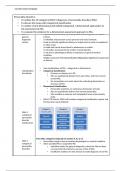
Personality disorders:
- DSM-5 - “A personality disorder is an enduring pattern of inner experience and
• To outline the 10 categorical DSM-5 diagnoses of personality disorders (PDs).
general behavior that deviates markedly from the expectations of the individual’s
• To discuss the issues with
definition categorical
culture, classification.
is pervasive and inflexible, has an onset in adolescence or in early
• To outline recent dimensional and hybrid (categorical
adulthood, is stable over + dimensional)
time, and leads approaches to
to impairment.”
the assessment of PDs.
• To evaluate the evidence
- Thefor a dimensional
pattern assessment
of inner experience approach
is manifested via to
twoPDs.
or more of: (1)
- DSM-5 cognitions, (2) affectivity, (3) interpersonal functioning and (4) impulse
general control.
diagnostic - Is inflexible and pervasive across personal and social contexts.
criteria - Leads to clinically significant distress or impairment in social, occupational
or other areas.
- Is stable and can be traced back to adolescence or earlier.
- Is not better accounted for by another mental disorder.
- Is not due to physiological effects of substance or general medical
condition.
- Helpful mnemonic: Persisting Inflexible Maladaptive Significant impairment
or distress
• Two classifications of PDs – categorical or dimensional.
- Classification: • Categorical classification:
the debate • Presence or absence of a PD.
• PDs are qualitatively distinct from each other, and from normal
personality.
• No assumptions are made about the underlying dimensions or
structure of PDs.
• Dimensional classification:
• Personality manifests on continuous dimensions of traits.
• PDs are quantitively distinct from normal personality.
• PDs manifest as extreme and maladaptive levels of personality
traits.
• DSM-5-TR (March, 2022) still contains categorical classification system, but
this has been much debated!
- DSM-5
categorical
personality
disorder
classification
Two other categories (separate to clusters A, B, or C):
- DSM-5 • Personality change is due to another physiological or medical condition.
categorical • Other specified PD or unspecified PD:
personality • Individual meets the general diagnostic criteria for PDs but does
disorders not meet the full criteria for any one of the 10 PDs.
• Insufficient evidence for the clinician to make diagnosis of one PD.
, Cornell notes template
- CLUSTER A
- CLUSTER A –
SIMILARITIES
Less apparent and obvious surface similarities between PDs in cluster B.
- CLUSTER A –
differences
- Experience of high intensity emotions.
- Display of erratic (impulsive) or provocative behaviours.
- Altered perceptions of others - reduced concern with others feelings, need
for admiration, or fear of abandonment.
- Differences
in CLUSTER B
Personality disorders:
- DSM-5 - “A personality disorder is an enduring pattern of inner experience and
• To outline the 10 categorical DSM-5 diagnoses of personality disorders (PDs).
general behavior that deviates markedly from the expectations of the individual’s
• To discuss the issues with
definition categorical
culture, classification.
is pervasive and inflexible, has an onset in adolescence or in early
• To outline recent dimensional and hybrid (categorical
adulthood, is stable over + dimensional)
time, and leads approaches to
to impairment.”
the assessment of PDs.
• To evaluate the evidence
- Thefor a dimensional
pattern assessment
of inner experience approach
is manifested via to
twoPDs.
or more of: (1)
- DSM-5 cognitions, (2) affectivity, (3) interpersonal functioning and (4) impulse
general control.
diagnostic - Is inflexible and pervasive across personal and social contexts.
criteria - Leads to clinically significant distress or impairment in social, occupational
or other areas.
- Is stable and can be traced back to adolescence or earlier.
- Is not better accounted for by another mental disorder.
- Is not due to physiological effects of substance or general medical
condition.
- Helpful mnemonic: Persisting Inflexible Maladaptive Significant impairment
or distress
• Two classifications of PDs – categorical or dimensional.
- Classification: • Categorical classification:
the debate • Presence or absence of a PD.
• PDs are qualitatively distinct from each other, and from normal
personality.
• No assumptions are made about the underlying dimensions or
structure of PDs.
• Dimensional classification:
• Personality manifests on continuous dimensions of traits.
• PDs are quantitively distinct from normal personality.
• PDs manifest as extreme and maladaptive levels of personality
traits.
• DSM-5-TR (March, 2022) still contains categorical classification system, but
this has been much debated!
- DSM-5
categorical
personality
disorder
classification
Two other categories (separate to clusters A, B, or C):
- DSM-5 • Personality change is due to another physiological or medical condition.
categorical • Other specified PD or unspecified PD:
personality • Individual meets the general diagnostic criteria for PDs but does
disorders not meet the full criteria for any one of the 10 PDs.
• Insufficient evidence for the clinician to make diagnosis of one PD.
, Cornell notes template
- CLUSTER A
- CLUSTER A –
SIMILARITIES
Less apparent and obvious surface similarities between PDs in cluster B.
- CLUSTER A –
differences
- Experience of high intensity emotions.
- Display of erratic (impulsive) or provocative behaviours.
- Altered perceptions of others - reduced concern with others feelings, need
for admiration, or fear of abandonment.
- Differences
in CLUSTER B


