

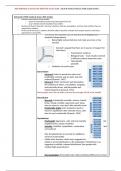
RED WRITING IS NOTES IVE WRITTEN IN LECTURE | BLACK NOTES FOR LECTURE SLIDE NOTES
o Eyesenck’s
Eyesenck’s PEN model & Gray’s - RSTEysenck’s
model theory assumes that there are three personality domains:
• PEN theory
Introduce o Psychoticism (P) – divided into agreeableness and
two theories of personality:
conscientiousness
– Eysenck’s Psychoticism-Extraversion-Neuroticism (P-E-N)
– Gray’s Reinforcement-Sensitivity Theory (RST) (E)
o Extraversion
• Examine the basis of Eysenck’s and Gray’s theories, their(N)
o Neuroticism key assumptions, and how (and whether) they are
supported by evidence.
• - These
At the end of the lecture, students domains
should be ableare used toevaluate
to describe, describe the
and entire Eysenck’s
compare populationand (not just
Gray’s
approaches to personality. clinical)
- The theory also assumes that the domains are orthogonal (i.e.,
statistical independence)
o Being highly extraverted does not make you more or less
neurotic
Eysenck’s argued that there are 4 sources of support for
the theory:
o Psychometric evidence
o Biological basis – brain circuits involved
in different actions determine traits
o Theoretically
plausible
o Predictive of social issues
Extraversion
- Introvert: Prefer to spend time alone and
predictable contexts and are quiet and well-
ordered (Eysenck, 1967)
- Extravert: Prefer excitement and stimulation,
the company of others, are talkative, outgoing
and externally driven, and like parties and
friends (Eysenck & Eysenck, 1975)
Most people won’t be on either end and the average will sit in the middle
Neuroticism
- Neurotic: Emotionally unstable, anxious, fearful,
tense, moody, irritable, depressed, poor sleep,
slow to return to ‘even keel’ after stressful event
- Emotionally stable: Even-tempered, quick to
return to equilibrium after stressful event, calm,
slow to react emotionally (Eysenck, 1965)
Psychoticism
- Psychopath: Aggressive, cold, and lack empathy (all
negative facets, except creativity)
- Sociable: Unselfish, sympathetic, cooperative, and
conventional
- Was developed later to account for additional
variance in personality.
- Unlike other domains, which were suggested to
exhibit a normal distribution in the population, Psychoticism was
suggested to exhibit a skewed distribution (few people with
medium/high psychoticism)
- Key Assumption: Personality traits reflect individual differences in brain
, RED WRITING IS NOTES IVE WRITTEN IN LECTURE | BLACK NOTES FOR LECTURE SLIDE NOTES
structure / function
o Biological basis
of PEN
-
Mapping brain circuits to traits: Two arousal systems
- Reticulo–cortical circuit: Extraversion
Controls the cortical arousal generated by incoming stimuli.
This system is typically more aroused in introverts than extraverts.
- The Ascending Reticular Activating System (ARAS) acts as a gate and
controls the overall level of arousal in the cortex
- People low in extraversion (i.e., introverts) display higher levels of
activity in the ARAS (i.e., too much arousal is let in), which causes them
to seek situations with low stimulation
- People high in extraversion, on the other hand, display lower levels of
activity in the ARAS (i.e., too little arousal is let in), which causes them
to seek situations with high stimulation.
- Performance and Arousal
- The relations between performance and arousal can be represented as
an inverted U-shape:
- Performance improves as arousal increases, but it deteriorates when
arousal levels become too high (Yerkes & Dodson, 1908)
- Arousal therefore has an optimal level, which
can be different for different tasks and for
different people
-
- Limbic system: Neuroticism
Controls response to emotional stimuli.
This system is more aroused in stable individuals when
facing emotion-inducing stimulation
- The limbic system regulates the sympathetic nervous system (SNS)
which is part of the autonomic nervous system (ANS) that produces
involuntary responses.
- The SNS is in charge of the body’s “Fight or Flight” response to
threatening situations, but also remains constantly active at a basic
level to maintain homeostasis.
- According to Eysenck, people high in neuroticism display
hypersensitivity in the SNS, which causes them to react more strongly
to potentially threatening situations.
- Increased activation of the limbic system is then needed to regulate
their response.
Fight or flight responses such as pupil dilation, increased heart rate
High in neuroticism – react stronger to threatening situations and the limbic
system’s job is to regulate the response
o Eyesenck’s
Eyesenck’s PEN model & Gray’s - RSTEysenck’s
model theory assumes that there are three personality domains:
• PEN theory
Introduce o Psychoticism (P) – divided into agreeableness and
two theories of personality:
conscientiousness
– Eysenck’s Psychoticism-Extraversion-Neuroticism (P-E-N)
– Gray’s Reinforcement-Sensitivity Theory (RST) (E)
o Extraversion
• Examine the basis of Eysenck’s and Gray’s theories, their(N)
o Neuroticism key assumptions, and how (and whether) they are
supported by evidence.
• - These
At the end of the lecture, students domains
should be ableare used toevaluate
to describe, describe the
and entire Eysenck’s
compare populationand (not just
Gray’s
approaches to personality. clinical)
- The theory also assumes that the domains are orthogonal (i.e.,
statistical independence)
o Being highly extraverted does not make you more or less
neurotic
Eysenck’s argued that there are 4 sources of support for
the theory:
o Psychometric evidence
o Biological basis – brain circuits involved
in different actions determine traits
o Theoretically
plausible
o Predictive of social issues
Extraversion
- Introvert: Prefer to spend time alone and
predictable contexts and are quiet and well-
ordered (Eysenck, 1967)
- Extravert: Prefer excitement and stimulation,
the company of others, are talkative, outgoing
and externally driven, and like parties and
friends (Eysenck & Eysenck, 1975)
Most people won’t be on either end and the average will sit in the middle
Neuroticism
- Neurotic: Emotionally unstable, anxious, fearful,
tense, moody, irritable, depressed, poor sleep,
slow to return to ‘even keel’ after stressful event
- Emotionally stable: Even-tempered, quick to
return to equilibrium after stressful event, calm,
slow to react emotionally (Eysenck, 1965)
Psychoticism
- Psychopath: Aggressive, cold, and lack empathy (all
negative facets, except creativity)
- Sociable: Unselfish, sympathetic, cooperative, and
conventional
- Was developed later to account for additional
variance in personality.
- Unlike other domains, which were suggested to
exhibit a normal distribution in the population, Psychoticism was
suggested to exhibit a skewed distribution (few people with
medium/high psychoticism)
- Key Assumption: Personality traits reflect individual differences in brain
, RED WRITING IS NOTES IVE WRITTEN IN LECTURE | BLACK NOTES FOR LECTURE SLIDE NOTES
structure / function
o Biological basis
of PEN
-
Mapping brain circuits to traits: Two arousal systems
- Reticulo–cortical circuit: Extraversion
Controls the cortical arousal generated by incoming stimuli.
This system is typically more aroused in introverts than extraverts.
- The Ascending Reticular Activating System (ARAS) acts as a gate and
controls the overall level of arousal in the cortex
- People low in extraversion (i.e., introverts) display higher levels of
activity in the ARAS (i.e., too much arousal is let in), which causes them
to seek situations with low stimulation
- People high in extraversion, on the other hand, display lower levels of
activity in the ARAS (i.e., too little arousal is let in), which causes them
to seek situations with high stimulation.
- Performance and Arousal
- The relations between performance and arousal can be represented as
an inverted U-shape:
- Performance improves as arousal increases, but it deteriorates when
arousal levels become too high (Yerkes & Dodson, 1908)
- Arousal therefore has an optimal level, which
can be different for different tasks and for
different people
-
- Limbic system: Neuroticism
Controls response to emotional stimuli.
This system is more aroused in stable individuals when
facing emotion-inducing stimulation
- The limbic system regulates the sympathetic nervous system (SNS)
which is part of the autonomic nervous system (ANS) that produces
involuntary responses.
- The SNS is in charge of the body’s “Fight or Flight” response to
threatening situations, but also remains constantly active at a basic
level to maintain homeostasis.
- According to Eysenck, people high in neuroticism display
hypersensitivity in the SNS, which causes them to react more strongly
to potentially threatening situations.
- Increased activation of the limbic system is then needed to regulate
their response.
Fight or flight responses such as pupil dilation, increased heart rate
High in neuroticism – react stronger to threatening situations and the limbic
system’s job is to regulate the response


