APEA 3P EXAM PREP7 -PROFESSIONAL ISSUES WITH RATIONALE
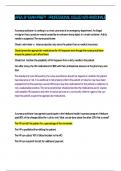
APEA 3P EXAM PREP7 -PROFESSIONAL ISSUES WITH RATIONALE A nurse practitioner is working in a minor care area of an emergency department. An illegal immigrant has a puncture wound caused by an unknown sharp object in a trash container. A dirty needle is suspected. The nurse practitioner: Should administer a tetanus injection only since the patient has no medical insurance. Should prescribe appropriate medications for HIV exposure even though the nurse practitioner knows the patient can’t afford them. Should not mention the possibility of HIV exposure from a dirty needle to the patient. Can offer to buy the HIV medications for $50 with their professional discount at the pharmacy next door. The standard of care followed by the nurse practitioner should not depend on whether the patient has insurance or not. It is unethical to not properly inform the patient of risks he may have been exposed to from the puncture wound. Offering to buy the medications for the patient is noble but is not a sustainable practice. The nurse practitioner should prescribe the medications as for anyone with possible HIV exposure and refer to social services or a community referral agency that can help this patient acquire the appropriate medications. A nurse practitioner has agreed to participate in the Medicare health insurance program. Medicare paid 80% of the charges billed for a clinic visit. What can be done about the other 20% that is owed? The NP can bill the patient for a percentage of the remainder. The NP is prohibited from billing the patient. The NP can collect 90% if billed incident to the MD. The NP can resubmit the bill for additional payment. The NP is a “participating” provider because he agreed to accept assignments. An assignment is an agreement between Medicare and the NP to accept the Medicare Approved Amount (MAA) as payment in full and not charge Medicare recipients a higher rate. The NP can bill the patient for a percentage of the remaining bill that was not paid by Medicare. The NP may opt out of participating. The NP can be reimbursed 100% if billed incident to the MD. The name given to subjects in a research study who do not have the disease or condition being studied, but who are included in the study for comparison are: studied subjects. controls. case series. cross sectionals. Studied subjects are those members of a study who have a specific disease or condition of interest or who are receiving a specific treatment. Case series may refer to an observational study in which a group of patients with interesting characteristics are studied. Cross sectional is a type of observational study in which a particular characteristic is studied at one time rather than over time. Controls are commonly employed in many types of research studies. The research design that provides the strongest evidence for concluding causation is: randomized controlled trials. cohort studies. case control studies. prospective studies. A randomized clinical trial (RCT) is the epitome of all research designs. Subjects are randomly assigned to treatment groups. This type study provides the best evidence that the results were due to the intervention and not something else. A RCT is an experimental design, not an observational one. An older adult male with moderately severe dementia presents with his caregiver daughter. His BMI is 18. His clothes have food stains on them and he looks as though he hasn’t been bathed in days. How should the nurse practitioner handle this? The NP should comment to the daughter about his poor care. The NP should report this as potential elder abuse. The patient should be asked about his care. The daughter should be asked about the type of care he receives. This patient presents as though he is being poorly cared for and mistreated. This occurs in about 3- 8% of the adult population in the United States. There is no evidence that the patient has been physically abused, but he obviously suffers from neglect. This is a form of elder abuse, just as physical, sexual, psychological, or financial abuse is. Older adults with dementia often suffer abuse most frequently. A nurse practitioner is working in a minor care clinic. She realizes that a patient with a minor laceration does not have insurance and is using his brother’s insurance information today so that his visit will be covered. How should she proceed? She should let him know that she knows what he is doing. She should ignore this and proceed to suture his wound. She should let the clinic's business office know what is happening. She should not suture his wound and ask him to leave. The nurse practitioner cannot ignore the fact that this patient is attempting to defraud the clinic and insurance company in order to receive free care. If she does not let the business office know, she is a party to the fraud. She should let the business office know what is happening and have the patient present documents verifying that he is who he states that he is. If he cannot, he can still receive care if he is willing to pay for it. An alternative care site should be offered to him. Which study listed below is considered an experimental study? Case series Cross-sectional study Cohort study Meta-analysis Observational studies are studies in which subjects are observed. No intervention takes place with them. Examples of these are found in the first three choices. A meta-analysis takes published information from other studies and combines the information to arrive at a conclusion. Although a meta-analysis can use observational studies, these should be reported separately. A nurse practitioner examined a patient who had been injured by a cat. A 4-centimeter gaping laceration was present on the patient’s forearm. The nurse practitioner sutured the laceration. The patient subsequently became infected, needed hospital admission, and required IV antibiotics with incision and drainage. How can this situation be characterized? This is a clinical judgment with an unexpected complication. The nurse practitioner’s actions followed the standard of care. The act of suturing this type of wound represents malpractice. This is poor judgment, but not malpractice. This is malpractice. Cat bites, known to be dirty bites with a high probability of infection, should not be sutured. Malpractice is usually described as having multiple elements that all must be satisfied for malpractice to occur. There must be a duty, a breach of the duty, and subsequent injury due to the breach. Comparison of performance is based on the standard of care delivered by nurse practitioners. The Medicaid health program is: funded with premiums from participants. covers an unlimited number of adult visits. funded by both state and federal governments. basically the same from state to state. Medicaid is state-run and specific to each state. The state programs are funded by a combination of state and federal funds. Most states have limits on the number of adult visits. Some states have no limits on visits for children. Participants generally do not pay premiums like Medicare recipients pay. A liability policy that pays claims only during the period that the policy is active is termed: claims made policy. tail coverage. liability protection. bobtail coverage. Liability insurance that covers the holder only during the time of the active policy is known as a claims made policy. This kind of policy is usually less expensive than other policies that will protect the policyholder against claims not known about at the end of the policy period. Tail coverage is more expensive than other policies because it protects the healthcare provider for an extended period of time after the incident
Written for
- Institution
- APEA 3P PREP7 -PROFESSIONAL ISSUES WITH RATIO
- Course
- APEA 3P PREP7 -PROFESSIONAL ISSUES WITH RATIO
Document information
- Uploaded on
- January 18, 2024
- Number of pages
- 15
- Written in
- 2023/2024
- Type
- Exam (elaborations)
- Contains
- Questions & answers
Subjects
- apea 3p exam prep7
- apea 3p exam
- apea 3p
-
apea 3p exam prep7 professional issues with ratio
-
apea 3p exam prep7 professional issues

Also available in package deal