

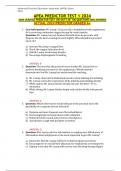
APEA PREDICTOR TEST % VERIFIED PREDICTOR TEST 100 OUTT OF 100 QUESTIONS AND ANSWERS ACTUAL 2024 PREDICTOR GRADED A+
APEA PREDICTOR TEST 1 2024 100% VERIFIED PREDICTOR TEST 100 OUTT OF 100 QUESTIONS AND ANSWERS ACTUAL 2024 PREDICTOR GRADED A+ 1. Case Information: Mr. Lamay- 62 years old, is hospitalized with emphysema. He is receiving continuous oxygen therapy by nasal cannula. Question: Mr. Lamay has just finished his bath when he presents with dyspnea. He sits down, leaning forward slightly. What should the practical nurse do? a) Increase Mr.Lamay’s oxygen flow. b) Check the oxygen Saturation level c) Ask Mr. Lamay to take deep breaths d) Encourage diaphragmatic breathing ANSWER: B 2. Question: The next day, the practical nurse teaches Mr. Lamay how to perform breathing exercises for his emphysema. Which behavior demonstrates that Mr. Lamay has understood the teaching. a) Mr. Lamay observes his abdominal muscles when inhaling and exhaling b) Mr. Lamay counts his respirations while inhaling and exhaling silently c) While supine, Mr. Lamay inhales deeply and says the letter “O” on exhalation d) While sitting, Mr. Lamay inhales deeply and exhales slowly with pursed Lips ANSWER: D 3. Question: Which observation would indicate to the practical nurse the possibility of a respiratory tract infection? a) Dyspnea and more frequent use of bronchodilators b) Increasingly labored respirations with exhalation c) Reduced breath sounds and presence of tachypnea d) A productive cough with purulent secretions ANSWER: D 4. Question: Mrs. Lamay asks for information on emphysema. Which piece of information about emphysema is the most important to give Mr. Lamay? a) Inform her that Mr. Lamay will have to limit his physical exertion b) Encourage her to consult their physician for emphysema screening tests c) Explain to her that Mr. Lamay will recover once the drug therapy begins d) Let her know that his lung tissue might regenerate if he were to stop smoking ANSWER: A 5. Question: Mrs. Lamay is Aboriginal. She informs the practical nurse that she and her husband have asked an Aboriginal healer to visit Mr. Lamay. What should the practical nurse do? a) Inform them it is preferable that only one style of therapy be used at a time b) Suggest a meeting between the attending physician and the healer c) Discuss with the health-care team how to accommodate the visit d) Read about traditional Aboriginal beliefs ANSWER: C 6. Case Information: Mr. Johanson, 68 years old, has pneumonia and is orthopneic. Question: The practical nurse is asked to collect a sputum specimen form Mr. Johanson. What is the most appropriate collection time? a) After providing mouth care b) Immediately following morning care c) At bedtime d) Before breakfast ANSWER: D 7. Question: The practical nurse is asked to monitor Mr. Johanson’s urinary output. What amount of urine output per hour should the practical nurse report immediately? a) 15ml b) 45ml c) 60ml d) 70ml ANSWER: A 8. Question: The physician has ordered Mr. Johanson to ambulate to the bathroom. Which finding would indicate to the practical nurse that Mr. Johanson is not tolerating the increase in activity? 9. a) He becomes flushed b) His heart rate is lower c) He becomes agitated d) His respiratory rate decreases ANSWER: C 10. Question: Mr. Johanson tells the practical nurse, “ No one took the time to answer my call light last night.” Which response by the practical nurse would be most appropriate? a) We were really short-staffed last night. I’m sorry you felt alone. b) It sounds like you had a particularly difficult night last night c) Were you aware that the client in the next room was very sick last night d) I’m sorry. I know how it feels when no-one takes the time to respond ANSWER: B 11. Case Information: Mr. Robertson, 30 years old, was diagnosed 5 years ago with rapidly progressing multiple sclerosis. He has been married for 8 years and has two children 7 and 5. He has recently been admitted to a long-term care facility because his wife can no longer care for him at home. Question: What behavior would indicate to the practical nurse that the disease has progressed beyond its early stages? a) Choking on solid food b) Ataxic gait c) Report tingling in extremities d) Having periodic tremors in extremities ANSWER: A 12. Question: What procedure should the practical nurse implement when using a mechanical sling lift to move Mr. Robertson from his bed to a wheelchair? a) Instruct him to hold onto the swivel bar during transfer b) Position the wheelchair perpendicular to the lift c) Place the bed in the lowest position d) Ask a co-worker to assist in the transfer ANSWER: D 13. Question: Mr. Robertson’s two sons visit frequently. Which response should the practical nurse give when the 7 year old son asks what is wrong with his dad? a) Your dad has a disease called multiple sclerosis, which is a disease of the nervous system b) Your dad has a problem with the way messages are sent from his brain to different parts of his body c) That’s a very good question. You should ask your dad d) Can you tell me what your mom or dad have told you about his illness? ANSWER: D 14. Question: Which response by the practical nurse would be the most encouraging when Mr. Robertson indicates his desire to be more involved in his care? a) Would you like to wash and shave yourself daily b) We can help you with the goals that you set for yourself c) You can decide how long you would like to stay up in the wheelchair d) I am glad you want to participate in your care ANSWER: B 15. Case Information: Sean is an 8 month old who is fed via a gastrostomy tube. He is brought to the hospital with diarrhea and dehydration. Question: Sean’s diarrhea has increased. Which sign exhibited by Sean should the practical nurse report immediately? a) Depressed fontanel b) Flushed face c) Heart rate of 110 beats/min d) Respiratory rate of 34 breaths/min ANSWER: A 16. Question: What should the practical nurse do to maintain Sean’s fluid intake? a) Administer the ordered electrolyte solution b) Give high glucose juices frequently c) Administer larger quantities of the usual tube feeding solution d) Give small amounts of milk atleast once every hour ANSWER: A 17. Question: Sean’s rectal temperature is 37.5(C) He has developed an irriated rectal area. What should the practical nurse consider when planning Sean’s morning bath? a) A tub bath would soothe his irritated skin b) A bed bath should be performed to maintain the gastrostomy tube patency c) A tepid sponge bath would decrease his temperature d) A bed bath should be performed to maintain medical asepsis ANSWER: A 18. Question: Sean’s gastrostomy tube site is leaking gastric contents. What should the practical nurse do to prevent irritation of the skin at the tube site. a) Apply minimal traction to the tube to prevent leakage b) Maintain a central position of the tube in the opening c) Protect the surrounding skin form drainage d) Cleanse the skin surrounding the tube daily ANSWER: C 19. Question: Sean’s mother is unable to visit for long periods and Sean cries when she is not there. What should the practical nurse do to best communicate care and concern to Sean? a) Provide Sean with a cuddly teddy bear b) Distract Sean with a colorful mobile c) Stroke Sean’s head and upper back d) Ask a volunteer to sit with Sean ANSWER: C 20. Question: Sean is having fewer stools per day, and his hydration status is improving. Which documentation by the practical nurse would best indicate Sean’s progress? a) Two formed yellow stools, mucous membranes moist b) Less frequent stools, turgor improved over yesterday c) Stools small and partially formed, mucous membranes intact d) Three less stools today, skin returns immediately after pinching ANSWER: A 21. Case Information: Mr. Whitney, 53 years old, is admitted to a surgical unit following an open reduction of a fractured right tibia resulting from a motor vehicle collision. Question: Mr. Whitney is 1 day post operative and has a right leg cast. What priority postoperative assessments should the practical nurse perform? a) Pain, level of consciousness, intake and output, peripheral neurovascular status b) Vital signs, pain, intake and output, chest assessment, bowel sounds c) Pain, bowel sounds, level of consciousness, vital signs d) Vital signs, pain, chest assessment, peripheral neurovascular status ANSWER: D 22. Question: The practical nurse notices from the preoperative records that Mr. Whitney smokes. He is receiving narcotic analgesia. Which postoperative teaching would be most important? a) Range-of-motion exercises b) Incentive spirometry
Document information
- Uploaded on
- January 17, 2024
- Number of pages
- 53
- Written in
- 2023/2024
- Type
- Exam (elaborations)
- Contains
- Questions & answers


