

COM 207-Introduction to Communication Inquiry Exam #1 Review
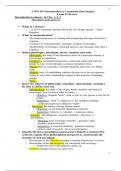
COM 207-Introduction to Communication Inquiry Exam #1 Review Introduction to theory & Chs. 1, 2, 3 Questions and answers • What is a theory? o “A set of systematic hunches about the way things operate” –Judee Burgoon • What is communication? o The relational process of creating and interpreting messages that elicit a response. o 5 features of communication: messages, creation of messages, interpretation of messages, relational process, and messages that elicit a response. • Define philosophy, paradigm, theory, method, and tools o Philosophy: the study of the theoretical basis of a particular branch of knowledge or experience. o Paradigm: a conceptual framework; a universal model that calls for people to view events through a common interpretive lens. o Theory: Sets of systematic, informed hunches about the way things work. o Method: ways of establishing whether theories do or do not represent reality in ways that command the respect of the majority of thinking people. o Tools: • Know the aspects of philosophy (ontology, epistemology, axiology). Be able to define each one. o Epistemology- the study of the origin, nature, method, and limits of knowledge / how we know what we know. ▪ Objective: Singular “truth”, what is true for one person is true for all people. ▪ Interpretive: “truth” is subjective, it has multiple meanings / different people have different “truths” o Ontology- the nature of being human nature ▪ Objective: an environment determines behavior ▪ Interpretive: behavior is voluntary / conscious choice. o Axiology: value judgments / researcher neutrality / objectivity vs. emancipation o Objective: total researcher neutrality / personal values shouldn’t distract research. o Interpretive: no research neutrality / personal values are intrinsic part of research / focus on participation. • Identify the three paradigms (social science/objective, interpretive, critical), explain their philosophical perspectives, understand the benefits of each paradigm: o Researchers in the objective paradigm consider themselves scientists. o Researchers in the interpretative are concerned with meanings. ▪ People have free will, purposes, goals, etc. o Critical paradigm focuses on oppression. ▪ Believe it is necessary to understand the lived experience of real people in context. • Criteria for good objective /interpretive theories
Document information
- Uploaded on
- January 17, 2024
- Number of pages
- 7
- Written in
- 2023/2024
- Type
- Exam (elaborations)
- Contains
- Questions & answers


