PC707-module 5-Pain Exam Questions and Answers
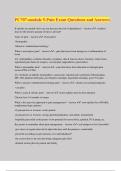
PC707-module 5-Pain Exam Questions and Answers If opioids are needed--how can you decrease the risk of dependence? - Answer ️️ --smallest dose for the shortest amount of time is advised* Types of pain: - Answer ️️ --Nociceptive -Neuropathic -Mixed or "undetermined etiology" What is nociceptive pain? - Answer ️️ -- pain that arises from damage to or inflammation of tissue -Ex: arthropathies, ischemic disorders, myalgias, skin & mucous ulcers, fractures, renal stones, superficial pain (burns & scrapes), visceral pain (appendicitis, pancreatitis) What is neuropathic pain? - Answer ️️ -- pain that arises from abnormal or damaged pain nerves (PNS or CNS) -Ex: alcoholic or diabetic neuropathies, cancer pain, regional pain syndromes (fibromyalgia), HIV, MS, phantom limb pain, post herpetic neuralgia, trigeminal neuralgia, post CVA pain What is mixed or undetermined etiology pain? - Answer ️️ --chronic reoccurring headaches -vasculitis What is acute & chronic pain? - Answer ️️ -Acute-sudden onset & short duration Chronic-lasts 3-6 months or longer What is the step-wise approach to pain management? - Answer ️️ --non-opioids first (NSAIDs, nonpharmacologic options) -if pain persists or worsens--weak opioids -if pain persists or worsens--strong opioids(mathadone, oral admin, transdermal) -hopefully pain relief at this point--if not potential for nerve block, epidural, PCA pump, etc. Key points to remember about pain management: - Answer ️️ --oral analgesics first if possible* -give doses at regular intervals & adjust the dose until the patient is comfortable -prescribe according to pain intensity--it is individualized* -the correct dose is the one that brings adequate pain relief -detailed written plan for patient and family What is an opioid? - Answer ️️ --used for pain relief -binds to opioid receptors primarily in the CNS, spinal cord, GI tract -binds primarily to MU receptors and to some extent the KAPPA receptors* What are the 4 types of pain receptors? - Answer ️️ --MU -KAPPA -Delta -Sigma What does the binding to MU receptors cause? What drugs bind primarily to these receptors? - Answer ️️ --Analgesia* -Respiratory depression* -Euphoria* -Ex: morphine (Kadian), meperidine (Demerol), fentanyl (Sublimaze), hydromorphone hydrochloride (Dilaudid) etc. What does the binding to KAPPA receptors cause? What drugs bind primarily to these receptors? - Answer ️️ --Analgesia* -Sedation* -Ex: nalbuphine (Nubain) & butorphanol (Stadol) What role do delta & sigma pain receptors play? - Answer ️️ --it is not exactly known -cause dysphoria & hallucinations* Why do drugs that bind to primarily MU receptors also cause sedation? - Answer ️️ --they also bind to KAPPA receptors to some extent--which causes sedation* Full opioid agonists: - Answer ️️ --bind to MU receptors in the brain -produces endorphins which causes the euphoric feeling-which provides pain relief Partial opioid agonists: - Answer ️️ --bind to MU receptors in the brain partially -antagonizes kappa receptors -produces endorphins but less than a full agonist* -these are harder to abuse* -higher affinity than full agonist -can trigger withdrawal if pt taking full ago
Written for
- Institution
- PC707
- Course
- PC707
Document information
- Uploaded on
- January 16, 2024
- Number of pages
- 23
- Written in
- 2023/2024
- Type
- Exam (elaborations)
- Contains
- Questions & answers
Subjects
-
pc707 module 5 pain exam questions and answers

Also available in package deal