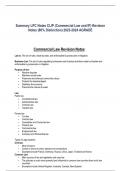
Summary LPC Notes CLIP
Summary LPC Notes CLIP (Commercial Law and IP) Revision Notes (80% Distinction) AGRADE Commercial Law Revision Notes Law is: The set of rules, made by state, and enforceable by prosecution or litigation. Business Law: The set of rules regulating businesses and business activities made by thestate and enforceable by prosecution or litigation. Purpose of law: • Resolve disputes • Maintains social order • Preserves and enforces community values • Protects the disadvantaged • Stabilizes the economy • Prevents the misuse of power Law Public law • Constitutional law • Administrative law • Criminal Law • Taxation law Private law • Tort law • Contract law • Competition and Consumer law • Property law • Commercial law • Employment law • Company and Partnership law Types of Legal systems Civil law: • Most Common • Comes in forms of codes, statutes and constitutions • Examples include France, Germany, Russia, China, Japan, Thailand and Korea Common Law • Main sources of law are legislation and case law • The judiciary is much more powerful and influential in common law countries than incivil law countries • Examples include United Kingdom, Australia, Canada, New Zealand Australian Legal System 6 characteristics • Liberal democracy: Laws are made by, the executive government consists of, elected representatives who exercise their power subject to the rule of law and to the various federal and state constitutions • Common Law legal system: Our legal system is based on the British legal system, andcan be contrasted with other forms of legal systems such as civil law legal system. • Constitutional monarchy: The head of state is Elizabeth 2 Queen of Australia • Federation: In addition to the commonwealth government there are various state governments that are not subordinate to the federal government • Separation of power: Laws are made by a parliament administered by an Executive council or government in Council, and interpreted and applied to particular cases bya court system. • Responsible Government: The ministers comprising the executive are elected representatives who are also members of an are answerable to the legislature. History: • The British settled Australia rather than conquered it because they did not recognizethe indigenous laws in place • !901 Commonwealth of Australia came into existence each state giving certain powers to the federal government and at the same time retained their individualidentities and legislative authority • Today Federal, State and territory government are free from interference from Britishparliament • The final step is to become a republic Exclusive Powers: (Powers only exercised by Federal parliament/government) Federal parliament only, examples include customs, defense, currency and territories. Concurrent Powers: (Most of the powers granted to Federal under the constitution) Federal and state parliaments, examples include Taxation, Marriage, Banking and externalaffairs. Residual Powers: (Not expressed in constitution so state parliament) State Parliament only, examples include education, Property, Crime and Health. Federal/State Relations • If Federal parliament has not legislated in relation to any matters listed in s51, thenthe matter remains within the authority of the state. • If the state parliament has made a law in relations to one of these matters and thefederal parliament makes a law on the same matter then s109, Australian constitution provides that the latter shall prevail and the former shall be invalid. Changing the Constitution • The proposed amendment must: o Be passed by an absolute majority of both houses of parliament and o Be put to the Australian voters in the form of a referendum and passers by ▪ A majority of voters ▪ A majority of states o 40 attempts only 8 have been successful The legislature: • Legislative power is the power to make law, and in Australia is exercised by thefederal parliament and the various state and territory parliament • Parliament means that it is the ‘sovereign lawmaker’ within Australia Federal Government: Crown: Governor General Upper house: Senate Lower house: House of Representatives State Parliament Crown: Governor Upper house: Legislative council Lower house: Legislative assembly Territory parliament Crown: Administer Upper house: NONE Lower house: Legislative assembly Lower house- Federal Parliament: • House of representatives is the ‘peoples house’ providing equal representation forthe people of Australia • Australia is divided into electorates about 150, with roughly equal numbers of voters,each of which elects a representative • The political party with the majority of members in the House of Representativesform executive government • The prime minister is traditionally a member of the lower house Upper House- Federal Parliament: • The senate is the ‘states house’ if protects the rights of the states • There is an equal number of Senators from each state (12) in order to protect the interests of the less populous states: The territories are represented by 2 senatorseach.
Document information
- Uploaded on
- January 15, 2024
- Number of pages
- 40
- Written in
- 2023/2024
- Type
- Summary