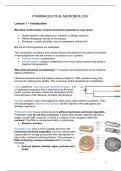
Pharmaceutical Microbiology
Introduction
Microbial contamination of pharmaceutical preparations may cause a health hazard. Pharmaceutical
microbiology focusses on research and development of anti-infective agents like, antibiotics and the
way microorganisms are used in the manufacture of pharmaceutical products.
Archea contain many microorganisms which
grow under extreme conditions and are not
pathogenic. Bacteria and eukaryotes are the
majority of the pathogenic and spoilage
organisms. Two major classes of cells;
prokaryotes and eukaryotes. All of the cells have a permeable barrier, ribosomes, a DNA genome and
some cells have a cell wall. Cells can metabolise, evolve but some can also differentiate,
communicate show genetic exchange and can show motility.
Bacteria have no nucleus and
can be aerobic or anaerobic.
Bacteria can show extremely
fast. Different morphologies of
the bacteria should be known.
Only a few of the bacteria are
pathogenic, this is either a
strict pathogenic species or by opportunistic pathogen, causing a human bacterial infection. When
these bacteria cause an infection this can be a wide variety of infections that can occur. Bacteria can
form spores, these are highly differentiated cells that are extremely resistant to heat, harsh
chemicals and radiation, its function is to survive. Mycoplasmas are the smallest free-living
prokaryotic organisms, lack a cell wall and are relatively resistant to osmotic lysis due to sterols in the
cell membrane. Fungi are what you find on bread, caused by contamination and spoilage. Viruses
need a host to transfer their virus. Prions are proteins that are very stable, they can therefore lead to
disorders mainly in the brain.
Biological contamination can cause a hazard to the patient. LPS is a gram negative with the lipid A
which is toxic. Before biological contamination takes place a natural barrier needs to be passed.
Cell wall, media and growth
, All cells have a permeable
barrier, the cytoplasmic
membrane this membrane
separates the inside of the cell
from the outside of the cell. Not
all cells have a cell wall, such a
cell wall lends structural strength to the cell. In the
cell wall there are gatekeepers for the entrance
and exit of dissolved substances. The cell wall
confers structural strength on the cell so that it
does not burst from osmotic pressure. Eukaryotic
cells have a nucleus whilst prokaryotic cells do not
have a nucleus. There is selective permeability causing nutrients to flow inwards and waste products
to flow outwards. This transport is facilitated by proteins. The phospholipid bilayer contains
embedded proteins, the bilayer also contains fatty acids and glycerol, the tail are the fatty acids and
these are hydrophilic and the glycerol is hydrophobic. In general there are 3 main functions for the
cytoplasmic membrane; the permeability of the barrier, the anchor for proteins and the energy
conservation and consumption. The permeability of the barrier; the barrier is only permeable for
certain substances not for all, this can happen via diffusion or via transport proteins. Transport
proteins can cause a catalysation of key functions in the cell. Energy production happens via light or
via chemicals, this all leads to the production of ATP. Bacteria do not have mitochondria but they
have their own mechanism to produce ATP.
Bacterial cell walls are present to withstand pressure
and prevent bursting of the cells, they confer shape
and rigidity on the cell. Knowledge of the cell walls is
important to understand antibiotics. There are two
types of bacterial cell walls, there are gram positive
and gram negative bacteria. The gram negative
bacteria have a small layer of peptidoglycan. Penicillin
works best for gram positive bacteria because it can
directly reach the peptidoglycan layer, with gram
negative bacteria the peptidoglycan layer can only be
reached after the outer membrane has been passed.
The cell wall is a polymer of amino acids. Lysozyme is
present in human secretion in the form of tears, saliva and other body fluids. Penicillin inhibits
peptidoglycan synthesis
The gram positive cell wall consists of 90% of peptidoglycan it forms many layers stacked up one
another. Teichoic acid is responsible for the flexibility of the gram positive cell wall. By targeting
teichoic acids resistance to the antibiotics can be circumvented. Mycoplasmas are related to gram
positive bacteria but have a lack of a cell wall, they are pathogenic and can cause a variety of
infectious diseases. Lipopolysaccharides is in the outer membrane of the gram negative bacteria, its
structure can vary because of the polysaccharide chain. Gram negative pathogens for humans
include species of Salmonella,
Shigella and Escherichia. Endotoxin
refers to the toxic component of LPS.
Endotoxins can cause fever, diarrhea
and increased heart rate can lead to a
Introduction
Microbial contamination of pharmaceutical preparations may cause a health hazard. Pharmaceutical
microbiology focusses on research and development of anti-infective agents like, antibiotics and the
way microorganisms are used in the manufacture of pharmaceutical products.
Archea contain many microorganisms which
grow under extreme conditions and are not
pathogenic. Bacteria and eukaryotes are the
majority of the pathogenic and spoilage
organisms. Two major classes of cells;
prokaryotes and eukaryotes. All of the cells have a permeable barrier, ribosomes, a DNA genome and
some cells have a cell wall. Cells can metabolise, evolve but some can also differentiate,
communicate show genetic exchange and can show motility.
Bacteria have no nucleus and
can be aerobic or anaerobic.
Bacteria can show extremely
fast. Different morphologies of
the bacteria should be known.
Only a few of the bacteria are
pathogenic, this is either a
strict pathogenic species or by opportunistic pathogen, causing a human bacterial infection. When
these bacteria cause an infection this can be a wide variety of infections that can occur. Bacteria can
form spores, these are highly differentiated cells that are extremely resistant to heat, harsh
chemicals and radiation, its function is to survive. Mycoplasmas are the smallest free-living
prokaryotic organisms, lack a cell wall and are relatively resistant to osmotic lysis due to sterols in the
cell membrane. Fungi are what you find on bread, caused by contamination and spoilage. Viruses
need a host to transfer their virus. Prions are proteins that are very stable, they can therefore lead to
disorders mainly in the brain.
Biological contamination can cause a hazard to the patient. LPS is a gram negative with the lipid A
which is toxic. Before biological contamination takes place a natural barrier needs to be passed.
Cell wall, media and growth
, All cells have a permeable
barrier, the cytoplasmic
membrane this membrane
separates the inside of the cell
from the outside of the cell. Not
all cells have a cell wall, such a
cell wall lends structural strength to the cell. In the
cell wall there are gatekeepers for the entrance
and exit of dissolved substances. The cell wall
confers structural strength on the cell so that it
does not burst from osmotic pressure. Eukaryotic
cells have a nucleus whilst prokaryotic cells do not
have a nucleus. There is selective permeability causing nutrients to flow inwards and waste products
to flow outwards. This transport is facilitated by proteins. The phospholipid bilayer contains
embedded proteins, the bilayer also contains fatty acids and glycerol, the tail are the fatty acids and
these are hydrophilic and the glycerol is hydrophobic. In general there are 3 main functions for the
cytoplasmic membrane; the permeability of the barrier, the anchor for proteins and the energy
conservation and consumption. The permeability of the barrier; the barrier is only permeable for
certain substances not for all, this can happen via diffusion or via transport proteins. Transport
proteins can cause a catalysation of key functions in the cell. Energy production happens via light or
via chemicals, this all leads to the production of ATP. Bacteria do not have mitochondria but they
have their own mechanism to produce ATP.
Bacterial cell walls are present to withstand pressure
and prevent bursting of the cells, they confer shape
and rigidity on the cell. Knowledge of the cell walls is
important to understand antibiotics. There are two
types of bacterial cell walls, there are gram positive
and gram negative bacteria. The gram negative
bacteria have a small layer of peptidoglycan. Penicillin
works best for gram positive bacteria because it can
directly reach the peptidoglycan layer, with gram
negative bacteria the peptidoglycan layer can only be
reached after the outer membrane has been passed.
The cell wall is a polymer of amino acids. Lysozyme is
present in human secretion in the form of tears, saliva and other body fluids. Penicillin inhibits
peptidoglycan synthesis
The gram positive cell wall consists of 90% of peptidoglycan it forms many layers stacked up one
another. Teichoic acid is responsible for the flexibility of the gram positive cell wall. By targeting
teichoic acids resistance to the antibiotics can be circumvented. Mycoplasmas are related to gram
positive bacteria but have a lack of a cell wall, they are pathogenic and can cause a variety of
infectious diseases. Lipopolysaccharides is in the outer membrane of the gram negative bacteria, its
structure can vary because of the polysaccharide chain. Gram negative pathogens for humans
include species of Salmonella,
Shigella and Escherichia. Endotoxin
refers to the toxic component of LPS.
Endotoxins can cause fever, diarrhea
and increased heart rate can lead to a