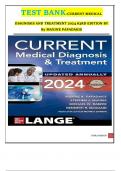
TEST BANK-CURRENT MEDICAL DIAGNOSIS AND TREATMENT 2024 63RD EDITION BY MAXINE PAPADAKIS/Complete Guide
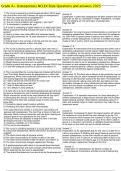
Chapter 1. Disease Prevention & Health Promotion 1. Which of the following behaviors indicates the highest potential for spreading infections among clients? The nurse: 1) disinfects dirty hands with antibacterial soap. 2) allows alcohol-based rub to dry for 10 seconds. 3) washes hands only after leaving each room. 4) uses cold water for medical asepsis. 2. What is the most frequent cause of the spread of infection among institutionalized patients? 1) Airborne microbes from other patients 2) Contact with contaminated equipment 3) Hands of healthcare workers 4) Exposure from family members 3. Which of the following nursing activities is of highest priority for maintaining medical asepsis? 1) Washing hands 2) Donning gloves 3) Applying sterile drapes 4) Wearing a gown 4. A patient infected with a virus but who does not have any outward sign of the disease is considered a: 1) pathogen. 2) fomite. 3) vector. 4) carrier. 5. A patient is admitted to the hospital with tuberculosis. Which precautions must the nurse institute when caring for this patient? 1) Droplet transmission 2) Airborne transmission 3) Direct contact 4) Indirect contact antibiotics to treat a systemic infection. Which type of infection has the patient developed? 1) Endogenous nosocomial 2) Exogenous nosocomial 3) Latent 4) Primary 7.The nurse assists a surgeon with central venous catheter insertion. Which action is necessary to help maintain sterile technique? 1) Closing the patients door to limit room traffic while preparing the sterile field 2) Using clean procedure gloves to handle sterile equipment 3) Placing the nonsterile syringes containing flush solution on the sterile field 4) Remaining 6 inches away from the sterile field during the procedure 8.A patient admitted to the hospital with pneumonia has been receiving antibiotics for 2 days. His condition has stabilized, and his temperature has returned to normal. Which stage of infection is the patient most likely experiencing? 1) Incubation 2) Prodromal 3) Decline 4) Convalescence 5) 8. 9. A patient develops localized heat and erythema over an area on the lower leg. These findings are indicative of which secondary defense against infection? 1) Phagocytosis 2) Complement cascade 3) Inflammation 4) Immunity 10. The patient suddenly develops hives, shortness of breath, and wheezing after receiving an antibiotic. Which antibody is primarily responsible for this patients response? 1) IgA 2) IgE 3) IgG 4) IgM 11. What type of immunity is provided by intravenous (IV) administration of immunoglobulin G? 1) Cell-mediated 2) Passive 3) Humoral 4) Active response by the nurse is correct? 1) The virus mutates too rapidly to develop a vaccine. 2) Vaccines are developed only for very serious illnesses. 3) Researchers are focusing efforts on an HIV vaccine. 4) The virus for the common cold has not been identified. 1 . A patient who has a temperature of 101F (38.3C) most likely requires: 1) acetaminophen (Tylenol). 2) increased fluids. 3) bedrest. 4) tepid bath. 14. Why is a lotion without petroleum preferred over a petroleum-based product as a skin protectant? It: 1) Prevents microorganisms from adhering to the skin. 2) Facilitates the absorption of latex proteins through the skin. 3) Decreases the risk of latex allergies. 4) Prevents the skin from drying and chaffing. 15. For which range of time must a nurse wash her hands before working in the operating room? 1) 1 to 2 minutes 2) 2 to 4 minutes 3) 2 to 6 minutes 4) 6 to 10 minutes 16. How should the nurse dispose of the breakfast tray of a patient who requires airborne isolation? 1) Place the tray in a specially marked trash can inside the patients room. Place the tray in a special isolation bag held by a second healthcare worker at the 2) patients door. Return the tray with a note to dietary services so it can be cleaned and reused for the 3) next meal. Carry the tray to an isolation trash receptacle located in the dirty utility room and 4) dispose of it there. 1 . How much liquid soap should the nurse use for effective hand washing? At least: 1) 2 mL 2) 3 mL 3) 6 mL 4) 7 mL over all surfaces of the hands? 1) When fingers feel sticky 2) After 5 to 10 seconds 3) When leaving the clients room 4) Once fingers and hands feel dry 19. A patient is admitted to the hospital for chemotherapy and has a low white blood cell count. Which precaution should the staff take with this patient? 1) Contact 2) Protective 3) Droplet 4) Airborne 20. While donning sterile gloves, the nurse notices the edges of the glove package are slightly yellow. The yellow area is over 1 inch away from the gloves and only appears to be on the outside of the glove package. What is the best action for the nurse to take at this point? 1) Continue using the gloves inside the package because the package is intact. 2) Remove gloves from sterile field and use a new pair of sterile gloves. 3) Throw all supplies away that were to be used and begin again. 4) Use the gloves and make sure the yellow edges of the package do not touch the client. 21. The nurse is removing personal protective equipment (PPE). Which item should be removed first? 1) Gown 2) Gloves 3) Face shield 4) Hair covering 22. A nurse is splashed in the face by body fluid during a procedure. Prioritize the nurses actions, listing the most important one first. A. Contact employee health B. Complete an incident report C. Wash the exposed area D. Report to another nurse that she is leaving the immediate area. 1) 1, 2, 3, 4 2) 2, 3, 4, 1 3) 3, 4, 1, 2
Written for
- Institution
- Medical diagnosis
- Course
- Medical diagnosis
Document information
- Uploaded on
- January 14, 2024
- Number of pages
- 456
- Written in
- 2023/2024
- Type
- Exam (elaborations)
- Contains
- Questions & answers
Subjects
-
current medical diagnosis 63rd ed
-
3washes hands only after leaving each room
-
the most frequent cause of the spread of infection
-
current medical diagnosis and treatment latest

Also available in package deal