AHA ACLS written test Correct Questions & Answers(SCORED A+)
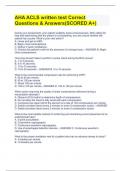
AHA ACLS written test Correct Questions & Answers(SCORED A+) AHA ACLS written test Correct Questions & Answers(SCORED A+) AHA ACLS written test Correct Questions & Answers(SCORED A+) AHA ACLS written test Correct Questions & Answers(SCORED A+) AHA ACLS written test Correct Questions & Answers(SCORED A+) AHA ACLS written test Correct Questions & Answers(SCORED A+) AHA ACLS written test Correct Questions & Answers(SCORED A+) During your assessment, your patient suddenly loses consciousness. After calling for help and determining that the patient is not breathing, you are unsure whether the patient has a pulse. What is your next action? A. Leave and get an AED. B. Begin chest compressions. C. Deliver 2 quick ventilations. D. Checks the patient's moth for the presence of a foreign body. - ANSWER B. Begin chest compressions. How long should it take to perform a pulse check during the BLS survey? A. 1 to 5 seconds. B. 5 to 10 seconds. C. 10 to 15 seconds. D. 15 to 20 seconds. - ANSWER B. 5 to 10 seconds. What is the recommended compression rate for performing CPR? A. 60 to 80 per minute. B. 80 to 100 per minute. C. About 100 per minute. D. 100 to 120 per minute - ANSWER D. 100 to 120 per minute. Which action improves the quality of chest compressions delivered during a resuscitation attempts? A. Observe ECG rhythm to determine depth of compressions. B. Do not allow the chest to fully recoil with each compression. C. Compress the upper half of the sternum at a rate of 150 compressions per minute. D. Switch providers about every 2 minutes or every 5 compression cycles. - ANSWER D. Switch providers about every 2 minutes or every 5 compression cycles. What is the most reliable method of confirming and monitoring correct placement of an endotracheal tube? A. 5-point auscultation. B, Colorimetric capnography. C. Continuous waveform capnography. D, Use of esophageal detection devices. - ANSWER C. Continuous waveform capnography. What is the proper ventilation rate for a patient who has an advance airway in place? A. 4 breaths per minute. B. 10 breaths per minute. C. 12 breaths per minute. D. 16 breaths per minute. - ANSWER B, 10 breaths per minute. which of the following is a sign of effective CPR? A. PETCO2 >= 10 mm Hg (1.33 kPa). B. Measure urine output of 1 mL/kg per hour. C. Patient temperature > 32 degree C D. Diastolic intra-arterial pressure <20 mm Hg. - ANSWER A. PETCO2 >= 10 mm Hg (1.33 kPa)
Written for
- Institution
- AHA ACLS written
- Course
- AHA ACLS written
Document information
- Uploaded on
- January 10, 2024
- Number of pages
- 2
- Written in
- 2023/2024
- Type
- Exam (elaborations)
- Contains
- Questions & answers
Subjects
-
aha acls written test correct questions answers
-
aha acls written test correct stuvia2024

Also available in package deal