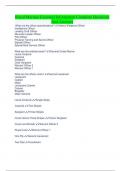
OpenStax Microbiology Test Bank Chapter 23: Urogenital System Infections
OpenStax Microbiology Test Bank Chapter 23: Urogenital System Infections * = Correct answer Multiple Choice 1. What is a glomerulus? A. a capillary bed that contacts a nephron* B. a connecting duct in the urinary system C. a part of the urinary bladder D. the part of the nephron that drains into the ureter Difficulty: Easy ASM Standard: N/A 2. Urine leaves the urinary bladder through which structure? A. collecting duct B. meatus C. ureter D. urethra* Difficulty: Easy ASM Standard: N/A TESTBANKSELLER.COM 3. What tube(s) in the male reproductive system transfer(s) sperm to the vas deferens? A. the epididymis* B. the prostate C. the seminal tubules D. the seminal vesicles Difficulty: Easy ASM Standard: N/A 4. Which of the following refers to inflammation of the bladder? A. cystitis* B. glomerulonephritis C. orchitis D. pyelonephritis Difficulty: Easy ASM Standard: N/A 5. Which of the following is typically true of the kidneys? A. They are colonized by Candida spp. B. They are colonized by lactobacilli. C. They are colonized by staphylococci. D. They are colonized by no normal microbiota.* Difficulty: Easy ASM Standard: 23, 24 6. Which refers to dysuria? A. bladder pain B. painful urination* C. production of urine that contains blood D. production of urine that contains pus Difficulty: Easy ASM Standard: N/A 7. In the United States, which sexually transmitted infection is especially common in individuals between the ages of 15 and 24 years? A. chlamydia B. gonorrhea* C. HIV/AIDs D. syphilis Difficulty: Easy ASM Standard: 23 8. Which condition occurs whenTtEheSnToBrmAaNlKvaSgEinLaLl mEiRcr.oCbiOoMta is unbalanced but there is no inflammation? A. bacterial vaginitis B. bacterial vaginosis* C. chancroid D. pelvic inflammatory disease Difficulty: Easy ASM Standard: 22 23, 24 9. Which of the following STIs is caused by a protozoan? A. chlamydia B. genital warts C. herpes D. trichomoniasis* Difficulty: Easy ASM Standard: 23 10. Which of the following is not a function of the urinary system? A. excreting wastes B. filtering blood C. producing urea* D. regulating the balance of salt and water in the body Difficulty: Moderate ASM Standard: 23, 24 11. In most women, which is the most common acid-producing bacterial genus in the vagina? A. Lactobacillus* B. Megasphaera C. Pseudomonas D. Staphylococcus Difficulty: Moderate ASM Standard: 23, 24 12. Which of the following does not contribute to nonspecific immune defense against vaginal infections? A. The normal microbiota decreases estrogen levels that enhance microbial growth.* B. The normal microbiota outcompetes other microbes for binding sites and nutrients. C. The normal microbiota produces an acidic environment that inhibits microbial growth. D. The normal microbiota produces hydrogen peroxide and bacteriocins. Difficulty: Moderate ASM Standard: 22 23, 24 TESTBANKSELLER.COM 13. What are the two most common causative agents of pelvic inflammatory disease? A. Escherichia coli and Proteus vulgaris B. Group B Streptococcus and Neisseria gonorrhoeae C. Lactobacillus spp. and Escherichia coli D. Neisseria gonorrhoeae and Chlamydia trachomatis* Difficulty: Moderate ASM Standard: 23 14. If a urinary dipstick shows the presence of nitrite, which bacteria would most likely be present because of their ability to convert nitrate to nitrite? A. Escherichia coli or Klebsiella pneumoniae* B. Klebsiella pneumoniae or Staphylococcus saprophyticus C. Neisseria gonorrhoeae or Streptococcus agalactiae D. Streptococcus pyogenes or Chlamydia trachomatis Difficulty: Moderate ASM Standard: N/A 15. Half of all cases of leptospirosis in the United States are found in which state? A. Alaska B. Florida C. Hawaii* D. Texas Difficulty: Moderate ASM Standard: N/A 16. Which of the following is not a major cause of nongonococcal urethritis? A. Chlamydia trachomatis B. Mycoplasma genitalium C. Treponema pallidum* D. Ureaplasma urealyticum Difficulty: Moderate ASM Standard: 23 17. The most common treatment for nongonococcal urethritis involves which of the following? A. azithromycin and penicillins B. azithromycin and tetracyclines, unless resistance is present* C. cephalosporins and tetracyclines, unless resistance is present D. fluoroquinolones and trimethoprim/sulfamethoxazole Difficulty: Moderate ASM Standard: 14, 23 TESTBANKSELLER.COM 18. Vaginolysin, a toxin that damages red blood cells and vaginal epithelial cells, is produced by which pathogen? A. Bacteroides sp. B. Fusobacterium sp. C. Gardnerella vaginalis* D. Lactobacillus sp. Difficulty: Moderate ASM Standard: 23 19. Which of the following describes clue cells? A. epithelial cells with attached bacterial cells; associated with bacterial vaginosis* B. epithelial cells with damaged cell membranes; associated with nongonococcal urethritis C. lysed epithelial cells; associated with nongonococcal urethritis D. lysed epithelial cells found within the urinary tract during urinary tract infections Difficulty: Moderate ASM Standard: 23 20. Which symptom is not commonly associated with chronic gonorrhea in women? A. amenorrhea (lack of menstruation)* B. increased menstrual flow
Written for
- Institution
-
University Of Colorado Denver
- Course
-
OpenStax Microbiology
Document information
- Uploaded on
- January 10, 2024
- Number of pages
- 16
- Written in
- 2023/2024
- Type
- Exam (elaborations)
- Contains
- Questions & answers
Subjects
-
openstax microbiology test bank chapter 23 urogen