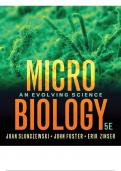
OpenStax Microbiology Test Bank Chapter 8: Microbial Metabolism
OpenStax Microbiology Test Bank Chapter 8: Microbial Metabolism * = Correct answer Multiple Choice 1. Which of the following refers to the term metabolism? A. all the reactions in a cell or organism* B. all the reactions in a cell that break down molecules only C. all the reactions in a cell that build new molecules only D. all the reactions in a cell that decompose molecules only Difficulty: Easy ASM Standard: N/A 2. Which of the following best describes an endergonic reaction? A. absorbs energy from the environment* B. is coupled with another reaction C. is involved in biosynthesis D. releases energy into the environment Difficulty: Easy ASM Standard: N/A 3. Chemotrophs obtain their energy from which of the following? A. inorganic chemical reactions only B. light energy C. organic chemical reactions only D. organic and inorganic chemical reactions* Difficulty: Easy ASM Standard: 11 4. Which of the following describes a molecule that had an electron removed? A. anabolized B. electronated C. oxidized* D. reduced Difficulty: Easy ASM Standard: N/A 5. Which of the following best describes the subcomponents of pyrophosphate? A. two inorganic phosphate molecules* B. two organic phosphate molecules C. three inorganic phosphate molecules D. three organic phosphate molecules Difficulty: Easy ASM Standard: N/A Which molecule is often called the cell’s energy currency? A. adenosine triphosphate* B. flavin adenine dinucleotide C. nicotinamide adenine dinucleotide D. nicotinamide adenine dinucleotide phosphate Difficulty: Easy ASM Standard: N/A 6. Which site on an enzyme is where substrates bind? A. the activation site B. the active site* C. the catalyst site D. the lock and key site Difficulty: Easy ASM Standard: N/A 7. Which of the following are inorganic molecules that bind to enzymes? A. apoenzymes B. coenzymes C. cofactors* D. holoenzymes Difficulty: Easy ASM Standard: N/A 8. Which of the following best describes catabolic pathways? A. They always absorb energy. B. They break down large molecules into smaller components.* C. They build up large molecules from smaller components. D. They must be coupled with the breakdown of ATP. Difficulty: Moderate ASM Standard: N/A 9. Which group comprises all lithotrophs? A. algae B. autotrophs C. microbes* D. plants Difficulty: Moderate ASM Standard: 11, 20, 22 10. Which is a common electron acceptor in catabolic reactions? A. ATP B. FADH2 C. NAD+* D. NADPH Difficulty: Moderate ASM Standard: N/A 11. The reaction that breaks down ATP to form ADP and inorganic phosphate is classified as which of the following? A. endergonic B. exergonic* C. nonspontaneous D. reduction Difficulty: Moderate ASM Standard: N/A 12. Which of the following is an inhibitor that binds to the active site of an enzyme? A. a competitive inhibitor* B. a noncompetitive inhibitor C. an allosteric inhibitor D. an uncompetitive inhibitor Difficulty: Moderate ASM Standard: N/A 13. Glycolysis produces a net gain of which of the following? A. two ATP, two NADH, and two pyruvates* B. two ATP, two NADH, and four pyruvates C. two ATP, four NADH, and two pyruvates D. four ATP, two NADH, and two pyruvates Difficulty: Easy ASM Standard: N/A 14. Which of the following is a pathway that breaks down glucose in some microbes? A. the Calvin cycle B. the Entner-Doudoroff pathway* C. the Krebs cycle D. the tricarboxylic acid cycle Difficulty: Moderate ASM Standard: 11, 22 15. Which of the following best describes a transition reaction? A. a reaction that converts pyruvate to acetyl CoA with the release of carbon dioxide* B. a series of reactions that convert citric acid to oxaloacetate C. an optional reaction that transports pyruvate into the mitochondrion D. the reaction that converts glucose to glucose-6-phosphate in glycolysis Difficulty: Moderate ASM Standard: N/A 16. Which of the following is not a product of the Krebs cycle? A. carbon dioxide B. GTP, which is converted to ATP C. NADH D. pyruvate* Difficulty: Moderate ASM Standard: 20, 22 17. The Krebs cycle begins with the addition of acetyl CoA to which of the following? A. citric acid B. oxaloacetate* C. ribulose bisphosphate D. succinate dehydrogenase Difficulty: Moderate ASM Standard: NA 18. Which of the following is the step in which CO2 enters the light-independent reactions (Calvin cycle)? A. fixation* B. reduction C. regeneration D. transition Difficulty: Moderate ASM Standard: 20, 22 19. Carotenoids are pigments that are which of the following colors? A. blue/green B. green/orange C. orange/yellow/red* D. purple/blue Difficulty: Moderate ASM Standard: N/A 20. Which of the following are enzymes that break down proteins? A. amylases B. oxidases C. oxygenases D. proteases* Difficulty: Easy ASM Standard: N/A 21. Fatty acids are often degraded using which set of reactions? A. β-oxidation* B. glycolysis C. photophosphorylation D. the tricarboxylic acid cycle Difficulty: Moderate ASM Standard: N/A 22. Triglycerides are broken down by which of the following? A. lipases* B. nitrogenases C. phospholipases D. proteases Difficulty: Moderate ASM Standard: N/A 23. During the Krebs cycle, FAD is reduced to which of the following? A. FADH B. FADH2* C. NADH D. NADH2 Difficulty: Moderate ASM Standard: N/A 24. Which of the following is the purpose of fermentation? A. to produce carbon dioxide B. to produce large quantities of additional energy C. to regenerate NAD+* D. to regenerate oxygen
Written for
Document information
- Uploaded on
- January 10, 2024
- Number of pages
- 21
- Written in
- 2023/2024
- Type
- Exam (elaborations)
- Contains
- Questions & answers
Subjects
-
openstax microbiology test bank chapter 8 microb