

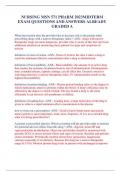
NURSING MSN 571 PHARM 2023MIDTERM EXAM QUESTIONS AND ANSWERS ALREADY GRADED A
NURSING MSN 571 PHARM 2023MIDTERM EXAM QUESTIONS AND ANSWERS ALREADY GRADED A What intervention does the provider take to decrease risk to the patient when prescribing drugs with a narrow therapeutic index? -ANS-- drugs with narrow therapeutic range are more dangerous, provider who is aware of this fact can focus additional attention on monitoring these patients for signs and symptoms of toxicity definition of onset of action -ANS-- Onset of Action: the time it takes a drug to reach the minimum effective concentration after a drug is administered. definition of bioavailability -ANS-- Bioavailability: the amount of an active drug that reaches the systemic circulation from its site of administration. Disintegration time, extended release, capsule coatings, can all effect this. Greatest concern is with drugs that have a narrow therapeutic index. IV administration results in the highest bioavailability. definition of protein binding -ANS-- Plasma protein binding refers to the degree to which medications attach to proteins within the blood. A drug's efficiency may be affected by the degree to which it binds. The less bound a drug is, the more efficiently it can traverse cell membranes or diffuse. definition of loading dose -ANS-- Loading dose: a large initial dose of the drug is given to achieve a rapid minimum effect concentration in the plasma. how to write out a prescription -ANS-- Good to know brand name and generic name (generic is most important), route, dose, frequency. If it is an as needed drug, what is it being prescribed for? A patient is prescribed digoxin. Which screening will the provider order to monitor for potential adverse effects from this drug? -ANS-- digoxin: treats HF and supraventricular dysrhythmias. Heart rate and rhythm should be monitored with periodic ECGs to assess desired effects and signs of toxicity. Baseline and periodic serum creatinine. Periodically monitor electrolytes (potassium, magnesium, calcium) especially if on diuretics. Because this drug has a narrow therapeutic range (0.5-0.8). Monitor plasma drug levels in patients with unchanged symptoms of heart failure after initiation or patient with signs of toxicity- altered heart rate or rhythm, visual or GI disturbances). Patient should be taught to monitor their pulse and know signs of toxicity. What is pharmacodynamic tolerance? -ANS-- Pharmacodynamic tolerance: a state in which a particular dose elicits a smaller response than it did with initial use, results from regular drug use. -intrinsic responsivity of the receptor system diminishes over time What is a side effect of a nonselective b agonist medication? -ANS-- Beta 1: tachycardia, dysrhythmias, angina Beta 2: hyperglycemia, tremor Which assessment finding would be of greatest concern for a provider who is attempting to determine the appropriateness of prescribing the patient a nonselective b agonist? -ANS-- Cardiac disease- any dysrhythmias or previous MI, angina, tachycardia. Because it can cause dysrhythmias and tachycardia. For what purpose will a provider prescribe pilocarpine? -ANS-- Pilocarpine: Muscarinic agonist used mainly for the topical treatment of glaucoma because it reduces intraocular pressure. Second-line drug for open angle glaucoma. Can also treat dry mouth from Sjogren's syndrome. What condition would be contraindicated in using Bethanechol? -ANS-- Bethanechol is a direct acting muscarinic agonist that is used to cause bradycardia, and increases secretions, in GI tract and lungs it causes constriction. Treats non obstructive urinary retention. Contraindications: ASTHMA, because of activation of muscarinic receptors in the lungs cause bronchoconstriction. Also, bowel obstruction. The prescriber has ordered neostigmine for a patient with myasthenia gravis. What physiological process would be assessed to best assure patient safety and the longterm effectiveness of the medication therapy? -ANS-- ANSWER: the patient's current swallowing ability. Many patients hospitalized for myasthenia gravis do not have the muscle strength to swallow well and need a parenteral form of the medication, assessing swallowing ability is an important initial safety measure. When prescribing an anticholinergic drug, what would be a concerning preexisting conditions demonstrates the provider's understanding of possible contraindications to this therapy? And what education would you want to give the patient? -ANS-- Anticholinergic drugs are the same thing as muscarinic antagonists!! These drugs increase heart rate, decrease secretions, relax the bronchi, bladder, and GI tract. Ex. Atropine, oxybutynin, ipratropium. Anticholinergic toxicity- hot as a hare, dry as a bone, red as a beet, blind as a bat, mad as a hatter. Contraindications: glaucoma, intestinal atony, urinary tract obstruction, and tachycardia. Use with caution in patients with asthma. Patient education: void before taking the medication, you can wear sunglasses outdoors for the photosensitivity and avoid hazardous activities if vision is impaired, consume lots of fiber to prevent constipation, avoid exercise in the heat, suck on candy for the dry mouth, stay hydrated. Dopamine is administered to a patient who has hypotension. Other than an increase in blood pressure, which indicator would the provider use to evaluate a successful response? -ANS-- Dopamine is an adrenergic agonist, that mainly effects beta-1 and also alpha-1 at high doses. A successful response would cause an increase in cardiac output, improving tissue perfusion, and an increased heart rate. Dopamine receptors in the kidneys are activated which dilates blood vessels and improves renal perfusion. The provider is discussing home management with a patient who will begin taking an a-adrenergic antagonist for hypertension, how will you educate the patient on this medication? -ANS-- These drugs usually end in -osin, also treat hypertension and BPH.
Document information
- Uploaded on
- January 9, 2024
- Number of pages
- 41
- Written in
- 2023/2024
- Type
- Exam (elaborations)
- Contains
- Questions & answers


