

NMTCB PET Exam Study Guide Questions & Answers 100% Correct
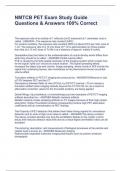
Quantitative bias that refers to the underestimation of counts density which differs from what they should be is called: - ANSWER-Partial-volume effect PVE is caused by the finite spatial resolution of the imaging system which reveals how far the signal "spills out" around its actual location. The signal spreading falsely increases the object size and volume. Image sampling, where voxels in ROI include the signal from underlying tissues, also contributes to the phenomenon known as partial-volume effect. Truncation artifacts in PET/CT imaging are produced by - ANSWER-Difference in size of FOV between PET and the CT Discrepancy between fields of view (FOVs) in a PET/CT scanner—70 cm causes a truncation artifact when imaging extends beyond the CT FOV-50 cm; as a result no attenuation correction values for the truncated anatomy are being applied. Dental fillings, hip prosthetics, or chemotherapy port are examples of PET/CT imaging artifacts described as: - ANSWER-Metallic implants artifacts Metallic implants create streaking artifacts on CT images because of their high photon absorption. Higher Hounsfield numbers consequently produce high PET attenuation coefficients and an overestimation of PET findings. The Property of PET detectors that allows them faster timing signals for coincidence detection and to work at high count rates is called: - ANSWER-The decay constant The decay constant decides how long the scintillation flashes in the crystal; a short decay time reduces detector dead time and as a result higher annihilation rates can be accepted.
Document information
- Uploaded on
- January 7, 2024
- Number of pages
- 33
- Written in
- 2023/2024
- Type
- Exam (elaborations)
- Contains
- Questions & answers


