

ISP 203 A Exam 2 Hernandez || Questions & Answers (Graded A+)
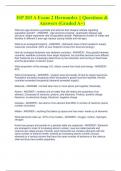
ISP 203 A Exam 2 Hernandez || Questions & Answers (Graded A+) ISP 203 A Exam 2 Hernandez || Questions & Answers (Graded A+) What are age-structure pyramids and what do their shapes indicate regarding population growth? - ANSWER - Age structure pyramid - graphically displays age structure; shape represents rate of population growth. Represents number of males and females in different 5 year age classes (young middle and old-age). What is an ecological footprint - ANSWER - (Demand) Area of land needed to supply resources consumed. (83% of your footprint comes from food and energy) How do ecological footprints vary between countries - ANSWER - Very greatly between countries, wealthier countries have larger footprints. As countries become more affluent, their footprints are increasingly determines by the extraction and burning of fossil fuels and the generation of electric power. What proportion of the average U.S. citizen comes from food and energy - ANSWER - 83% What is biocapacity - ANSWER - (supply) area and quality of land to supply resources. Population exceeds biocapacity when ecosystem's goods must be imported. World's countries exceeded biocapacity (demand exceeded supply). Molecule - ANSWER - formed when two or more atoms join together chemically. Atoms - ANSWER - smallest unit of matter that still retains the properties of an element..Composed of neutrons, protons, and electrons. Protons, positive charge. Neutrons: no electrical charge. Electrons: negative charge isotopes - ANSWER - two atoms of an element that differ in number of neutrons (same number of protons) Matter - ANSWER - anything that takes up space and has mass- made up of elements What elements make up ~97% of our bodies - ANSWER - Oxygen, carbon, hydrogen, nitrogen Know how groups and periods in a periodic table are organized - ANSWER - Elements are arranged in order of increasing atomic number, rows are called periods and columns are called groups. Periods: each horizontal row contains elements with the same number of electron shells, ordered by increasing atomic number.Groups: elements in a vertical column that have the same number of electrons in the valence shell and thus have similar properties
Document information
- Uploaded on
- January 6, 2024
- Number of pages
- 9
- Written in
- 2023/2024
- Type
- Exam (elaborations)
- Contains
- Questions & answers


