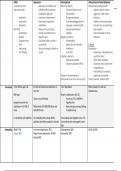
ADHD Depression Schizophrenia An3social and criminal behaviour
-a disorder of brain - Depressed or irritable mood Posi3ve symptoms An3social personality disorder:
matura3on delay - Anhedoniaà less pleasure - Psychosis (delusions and - Apparent lack of remorse
- Significant weight loss hallucina3on) - Aggressive, oWen violent
- Ina7en3on - Insomnia or hypersomnia - Disorganized speech behaviour
- Hyperac3ve - Psychomotor agita3on or - Distor3ons/exaggera3ons in - Inability to tolerate boredom
- Impulsivity retarda3on language + communica3on - Lack of access to own feelings
BUT ALSO - Fa3gue or loss of energy - disorganized behaviour and emo3ons
- Spontaneous - Feeling of worthlessness or - agita3on - Severe disrup3on in moral
- Crea3ve execu3ve guilt Nega3ve symptoms behaviour
- Divergent mind - Diminished ability to think or - blunted affect
- Vital concentrate - dysfunc3on of mo3va3on Subtypes
- High energy - Recurrent thoughts of death or - Anhedonia Psychopathy
- Fast thinking suicide - A-sociality - Callousness, manipula3veness,
Cogni3ve symptoms superficial charm
- A7en3onal problems - OWen highly intelligent
- Execu3ve dysfunc3on (PFC) - Grandiose sense of self-worth
(megalomania)
- Have ability but a reduced
Delusion= misinterpreta3on propensity for empathy
Hallucina3on= too much sensory input Conduct disorder: children ASPD
Prevalence 2-5% children age 6-16 10-20% will experience depression in 1% of populaAon More prevalent in male sex
their life (testosterone)
80% boys Onset in adolescence (15-25)
Twice as much females - Due to no LTP as NMDA-R
Symptoms persist into hypofuncAon
adulthood in 30-50% of Netherlands: 5%=800.000 adults and - More synapse pruning (starAng
cases 160.000 chronic in adolescence)
Co-morbidity with addicAon Co-morbidity with anxiety, ADHD, Concordance rate dizygoAc twins 17%
addicAon and other psychiatric diseases Concordance rate monozygoAc twins:
48%
Heritability ADHD: 75% Less severe depression: 25% Schizophrenia: 80% ASPD: 40-50%
AuAsm: 80% Major/chronic depression: 40-50% Personality: 50%
Bipolar:80%
, Brain area’s ¯PFC ¯PFC (BUT no performance deficit) ¯NMDA-receptor Decrease in moral judgement tasks
¯Cerebellum Amygdala ¯corAco-brainstem projecAon - PFC
¯Caudate nucleus (possibly normally: PFC inhibits (glutamate) - Amygdala
¯Corpus callosum amygdala) - Less tonic excitaAon of - cingulate
¯Amygdala ¯Hippocampus mesocorAcal pathway - Angular gyrus
¯Accumbens - Tail and headà risk - Less GABA release from Increase rule breaking behaviour
¯Hippocampus - Bodyà current state interneuron and thus Less tonic - PFC
¯Basal ganglia HPA axis inhibiAon of the mesolimbic - Amygdala
- Subtype: insomnia, loss of pathway - Angular gyrus
appeAte, weight loss and. Loss Mesolimbic dopamine These areas are probably ¯
of libido - Too much dopamine in ventral
- Increased corAsol and CRH striatum ¯PFC
- Reduced glucocorAcoid - PosiAve symptoms ¯Amygdala
receptors hippocampus and ¯MesocorAcal dopamine ¯Hippocampus
hypothalamus - Too liale dopamine in PFC Angular gyrus
¯BDNF - NegaAve and cogniAve Cingulate
- PFC and hippocampus symptoms Temporal cortex
Cytokines ¯GABA in thalamus
- Interleukin-6 and TNFa - Excess dopamine from the Failure of fear condiAoning
- Subtype: hypersomnia and meso-limbic pathway inhibits - Causal role for crime
weight gain GABA striatal-thalamic neuron - Amygdala dysfuncAon
DisrupAon chronobiological model - NMDA-R hypofuncAon causes
- early awake hypofuncAon of the corAco- Cavum septum pellucidum
Bacterial species striatal pathway and less - Marker for fetal limbic
- ¯Bacterial species that secrete acAvaAon of GABA striatal- maldevelopment
anA-inflammatory cytokines thalamic neuron - Significantly higher probability
- Bacterial species that secret - Less filtering> sensory overload of anA-social personality,
pro-inflammatory cytokines psychopathy, criminal charges
Default mode network and convicAons
- HyperconnecAvity
- More introspecAon and self-
referenAal thinking
-a disorder of brain - Depressed or irritable mood Posi3ve symptoms An3social personality disorder:
matura3on delay - Anhedoniaà less pleasure - Psychosis (delusions and - Apparent lack of remorse
- Significant weight loss hallucina3on) - Aggressive, oWen violent
- Ina7en3on - Insomnia or hypersomnia - Disorganized speech behaviour
- Hyperac3ve - Psychomotor agita3on or - Distor3ons/exaggera3ons in - Inability to tolerate boredom
- Impulsivity retarda3on language + communica3on - Lack of access to own feelings
BUT ALSO - Fa3gue or loss of energy - disorganized behaviour and emo3ons
- Spontaneous - Feeling of worthlessness or - agita3on - Severe disrup3on in moral
- Crea3ve execu3ve guilt Nega3ve symptoms behaviour
- Divergent mind - Diminished ability to think or - blunted affect
- Vital concentrate - dysfunc3on of mo3va3on Subtypes
- High energy - Recurrent thoughts of death or - Anhedonia Psychopathy
- Fast thinking suicide - A-sociality - Callousness, manipula3veness,
Cogni3ve symptoms superficial charm
- A7en3onal problems - OWen highly intelligent
- Execu3ve dysfunc3on (PFC) - Grandiose sense of self-worth
(megalomania)
- Have ability but a reduced
Delusion= misinterpreta3on propensity for empathy
Hallucina3on= too much sensory input Conduct disorder: children ASPD
Prevalence 2-5% children age 6-16 10-20% will experience depression in 1% of populaAon More prevalent in male sex
their life (testosterone)
80% boys Onset in adolescence (15-25)
Twice as much females - Due to no LTP as NMDA-R
Symptoms persist into hypofuncAon
adulthood in 30-50% of Netherlands: 5%=800.000 adults and - More synapse pruning (starAng
cases 160.000 chronic in adolescence)
Co-morbidity with addicAon Co-morbidity with anxiety, ADHD, Concordance rate dizygoAc twins 17%
addicAon and other psychiatric diseases Concordance rate monozygoAc twins:
48%
Heritability ADHD: 75% Less severe depression: 25% Schizophrenia: 80% ASPD: 40-50%
AuAsm: 80% Major/chronic depression: 40-50% Personality: 50%
Bipolar:80%
, Brain area’s ¯PFC ¯PFC (BUT no performance deficit) ¯NMDA-receptor Decrease in moral judgement tasks
¯Cerebellum Amygdala ¯corAco-brainstem projecAon - PFC
¯Caudate nucleus (possibly normally: PFC inhibits (glutamate) - Amygdala
¯Corpus callosum amygdala) - Less tonic excitaAon of - cingulate
¯Amygdala ¯Hippocampus mesocorAcal pathway - Angular gyrus
¯Accumbens - Tail and headà risk - Less GABA release from Increase rule breaking behaviour
¯Hippocampus - Bodyà current state interneuron and thus Less tonic - PFC
¯Basal ganglia HPA axis inhibiAon of the mesolimbic - Amygdala
- Subtype: insomnia, loss of pathway - Angular gyrus
appeAte, weight loss and. Loss Mesolimbic dopamine These areas are probably ¯
of libido - Too much dopamine in ventral
- Increased corAsol and CRH striatum ¯PFC
- Reduced glucocorAcoid - PosiAve symptoms ¯Amygdala
receptors hippocampus and ¯MesocorAcal dopamine ¯Hippocampus
hypothalamus - Too liale dopamine in PFC Angular gyrus
¯BDNF - NegaAve and cogniAve Cingulate
- PFC and hippocampus symptoms Temporal cortex
Cytokines ¯GABA in thalamus
- Interleukin-6 and TNFa - Excess dopamine from the Failure of fear condiAoning
- Subtype: hypersomnia and meso-limbic pathway inhibits - Causal role for crime
weight gain GABA striatal-thalamic neuron - Amygdala dysfuncAon
DisrupAon chronobiological model - NMDA-R hypofuncAon causes
- early awake hypofuncAon of the corAco- Cavum septum pellucidum
Bacterial species striatal pathway and less - Marker for fetal limbic
- ¯Bacterial species that secrete acAvaAon of GABA striatal- maldevelopment
anA-inflammatory cytokines thalamic neuron - Significantly higher probability
- Bacterial species that secret - Less filtering> sensory overload of anA-social personality,
pro-inflammatory cytokines psychopathy, criminal charges
Default mode network and convicAons
- HyperconnecAvity
- More introspecAon and self-
referenAal thinking