

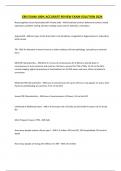
CBIS EXAM 100% ACCURATE REVIEW EXAM SOLUTION 2024
CBIS EXAM 100% ACCURATE REVIEW EXAM SOLUTION 2024 Nuerocognitive Issues Assoicated with Frontal Lobe - ANS-Emotional control, behavioral control, verbal expression, problem solving, decision making, social control, attention, motivation Acquired BI - ANS-An injury to the brain that is not hereditary, congenital or degenerative or induced by birth trauma TBI - ANS-An alteration in brain function or other evidence of brain pathology, casused by an external force Mild TBI Characteristics - ANS-Brief or no loss of consciousness for 0-30mins, altered state of consciousness is most common and must be 24 hours, account for 75% of TBIs, 13-15 on the GCS, normal imaging, highest prevalence of maltreatment as 16-25% never seek care, often considered a concussion Moderate TBI Characteristics - ANS-Loss of consciousness for up to 24 hours, may appear on scans, skull fractures and bleeding are common, 9-12 on the GCS Severe TBI Characteristics - ANS-Loss of consciousness 24 hours, 3-8 on the GCS Likelihood of Additional Injury - ANS-1 BI increases risk of 2nd by 3x and 2nd BI increases risk of 3rd by 8x! Most Frequent Cause of TBI - ANS-Falls How many people sustain a BI per year? - ANS-2.5 million. 81% visit ED, 16% hsopitalized, 3% result in death How many people are living with effects of a TBI? - ANS-13.5 million Likelihood of BI by gender - ANS-Men are 1.4x more likely than women Most common cause of TBI and death by age - 75+ - ANS-Falls! Most common cause of TBI and death by age - 0-3 - ANS-AHT! Most common cause of TBI and death by age - 20-24 - ANS-MVAs and Firearms Most common cause of TBI and death by age - 16-19 - ANS-MVAs! CARF - ANS-Accreditation agency for post acute BI programs, residential, outpatient, vocational, home and community, stroke and pediatric programs - ensures quality of services through requirements for accreditation and surveys Joint Commission - ANS-Accreditation agency for hospital based programs, may accompany CARF accreditation, ensures quality of services through requirements for accreditation and surveys Olmsted Decison - ANS-Supreme court case stimulated by two women living in a nursing home in Georgia for community inclusion - resulted in federal and state initiatives to improve and normalize community living Model Systems of Care 1987 - ANS-Resulted in research projects for TBI by the NIDDR, established rehab facilities to provide care and complete clinical research in the process Symptoms of Mild TBI - ANS-Headache, fatigue, seizures, nausea, numbness, poor sleep, light sensitivity, noise sensitivity, impaired hearing, blurred vision, dizziness, loss of balance, neurological abnormality, in attentiveness, decreased concentration, poor memory, impaired judgment, slow proccessing speed, executive dysfunction, depression, anxiety, agitation, irritability, aggression, impulsivity Primary causes of Mild TBI - ANS-Traumatic intertial - brain moving inside skull Traumatic impact - head hits directly Early Treatment for Mild TBI - ANS-Relaxation techniques, rest, slow return to normal activity, and reduction of normal activity if symptoms recur Peristent Post Concussive Symptoms (PPCS) - ANS-Symptoms of Mild TBI last 1 month, occurs 10% of the time in Mild TBI cases Chronic Traumatic Encephalopathy (CTE) - ANS-Often cause by repeated blows to the head, is a progressive, degenerative condition characterized by broken nuerons which continually release tau protein cashing dementia over time Diffuse axonal injury - tau protein release - inflammation of the brain - progressive dementia Define Skull - ANS-Bony shell that protects the brain, has bony prominences inside which can worsen brain injury Cerebral Spinal Fluid (CSF) - ANS-Provides cushion to nerve tissue, produced by ventricles (4) which also store and circulation CSF through the brain Meninges - ANS-Pia Mater - molds around suclhi and gyri, deepest layer Arachnoid Mater - spiderweb-like, middle layer Dura Mater - hard plastic, top layer Nuerons vs Glial Cells CONTINUES....
Document information
- Uploaded on
- January 3, 2024
- Number of pages
- 32
- Written in
- 2023/2024
- Type
- Exam (elaborations)
- Contains
- Questions & answers


