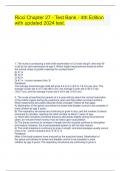
Ricci Chapter 27 - Test Bank - 4th Edition with updated 2024 test.
Ricci Chapter 27 - Test Bank - 4th Edition with updated 2024 test. 1. The nurse is conducting a well-child examination of a 5-year-old girl, who was 40 in tall at her last examination at age 4. Which height measurement would be within the normal range of growth expected for a preschooler? A) 41 in B) 43 in C) 45 in D) 47 in - correct answers.Ans: B Feedback: The average preschool-age child will grow 2.5 to 3 in (6.5 to 7.8 cm) per year. The average 3-year-old is 37 in tall (96.2 cm), the average 4-year-old is 40.5 in tall (103.7 cm), and the average 5-year-old is 43 in tall (118.5 cm). 2. The nurse is teaching the parents of a 4-year-old boy about the normal maturation of the child's organs during the preschool years and their effect on body functions. Which statements accurately describe these changes? Select all that apply. A) Myelination of the spinal cord allows for bowel and bladder control to be complete in most children by age 3 years. B) The respiratory structures are continuing to grow in size, and the number of alveoli continues to increase, reaching the adult number at about 7 years of age. C) Heart rate increases and blood pressure decreases slightly during the preschool years; an innocent heart murmur may be heard upon auscultation. D) The bones continue to increase in length and the muscles continue to strengthen and mature; however, the musculoskeletal system is still not fully mature. E) The small intestine is continuing to grow in length, and stool passage usually occurs once or tw - correct answers.Ans: A, B, D, E Feedback: Most of the body systems have matured by the preschool years. Myelination of the spinal cord allows for bowel and bladder control to be complete in most children by age 3 years. The respiratory structures are continuing to grow in size, and the number of alveoli continues to increase, reaching the adult number at about 7 years of age. The bones continue to increase in length and the muscles continue to strengthen and mature. However, the musculoskeletal system is still not fully mature. The small intestine is continuing to grow in length, and stool passage usually occurs once or twice per day in the average preschooler. The 4-year-old generally has adequate bowel control. Heart rate decreases and blood pressure increases slightly during the preschool years. An innocent heart murmur may be heard upon auscultation. The urethra remains short in both boys and girls, making them more susceptible to urinary tract infections than adults. 3. The nurse is assessing the psychosocial development of a preschooler. What are normal activities characteristic of the preschooler? Select all that apply. A) Plans activities and makes up games. B) Initiates activities with others. C) Acts out roles of other people. D) Engages in parallel play with peers. E) Classifies or groups objects by their common elements. F) Understands relationships among objects. - correct answers.Ans: A, B, C Feedback: The many activities of the preschooler include beginning to plan activities, making up games, initiating activities with others, and acting out the roles of other people (real and imaginary). Toddlers engage in parallel play; preschoolers engage in cooperative play. School-age children classify or group objects by common elements and understand relationships among objects. 4. The nurse is caring for a 5-year-old girl posttonsillectomy. The girl looks out the window and tells the nurse that it is raining and says, "The sky is crying because it is sad that my throat hurts." The nurse understands that the girl is demonstrating which mental process? A) Magical thinking B) Centration C) Transduction D) Animism - correct answers.Ans: A Feedback: The nurse understands that the girl is demonstrating magical thinking. Magical thinking is a normal part of preschool development. The preschool-age child believes her thoughts to be all-powerful. Transduction is reasoning by viewing one situation as the basis for another situation whether or not they are truly causally linked. Animism is attributing life-like qualities to inanimate objects. Centration is focusing on one aspect of a situation while neglecting others. 5. The parents of a 4-year-old ask the nurse when their child will be able to differentiate right from wrong and develop morals. What would be the best response of the nurse? A) "The preschooler has no sense of right and wrong." B) "The preschooler is developing a conscience." C) "The preschooler sees morality as internal to self." D) "The preschooler's morals are his or her own, right or wrong." - correct answers.Ans: B Feedback: The preschool child can understand the concepts of right and wrong and is developing a conscience. Preschool children see morality as external to themselves; they defer to power (that of the adult). The child's moral standards are those of their parents or other adults who influence them, not necessarily their own. 6. Which activity would the nurse least likely include as exemplifying the preconceptual phase of Piaget's preoperational stage? A) Displays of animism B) Use of active imaginations C) Understanding of opposites D) Beginning questioning of parents' values - correct answers.Ans: D Feedback: In the intuitive phase of Piaget's preoperational stage, the child begins to question parents' values. Animism, active imaginations, and an understanding of opposites would characterize the preconceptual phase of Piaget's preoperational stage. 7. The nurse is assessing the motor skills of a 5-year-old girl. Which finding would cause the nurse to be concerned? A) Can copy a square on another piece of paper B) Can dress and undress herself without help C) Draws a person with three body parts D) Is beginning to tie her own shoelaces - correct answers.Ans: C Feedback: By the age of 5 years, the child should be able to draw a person with a body and at least six body parts. She should also be able to copy triangles and other geometric patterns and dress and undress herself and should be learning to tie her shoelaces. 8. The school nurse is helping parents choose books for their preschoolers. What literacy skills present in the preschooler would the nurse consider when making choices? Select all that apply. A) Preschoolers enjoy books with pictures that tell stories. B) Preschoolers like stories with repeated phrases as they help keep their attention. C) Preschoolers like stories that describe experiences different from their own. D) Preschoolers demonstrate early literacy skills by reciting stories or portions of books. E) Preschoolers may retell the story from the book, pretend to read books, and ask questions about the story. F) Preschoolers do not have enough focus and expanded attention to notice when a page is skipped during reading. - correct answers.Ans: A, B, D, E Feedback:
Written for
- Institution
- Ricci Chapter 27 -
- Course
- Ricci Chapter 27 -
Document information
- Uploaded on
- December 31, 2023
- Number of pages
- 11
- Written in
- 2023/2024
- Type
- Exam (elaborations)
- Contains
- Questions & answers
Subjects
-
ricci chapter 27 test bank 4th edition

Also available in package deal