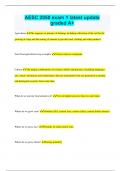
AESC 2050 exam 1 latest update graded A+
AESC 2050 exam 1 latest update graded A+ Agriculture The sequence or practice of farming, including cultivation of the soil for the growing of crops and the rearing of animals to provide food, clothing and other products Non-Food agricultural crop examples Cotton, tobacco, marijuana Culture The unique combinations of customs, beliefs and practices (including languages, arts, rituals, institutions and technologies) that are transmitted from one generation to another and distinguish societies from each other What do we and our food animals eat? Corn in highest percent, then rice and wheat Where do we grow corn? Northern USA, eastern Asia, eastern Africa, eastern South America Where do we grow rice? Primarily in south eastern Asia Where do we grow wheat? Europe primarily Battle of Cajamarca 169 Spaniards faced an army of 80,000 Inca soldiers. In first 10 minutes 7,000 Incas dead. When dust settled, not a single Spaniard was dead When did history begin? 3000 BC at the invention of writing What was the first indication of a conscious cultural act? Hominids began to chip and shape pieces of stone into rough-hewn tools 2 million years ago, marking the beginning of the Paleolithic Period Hominids vs other animals adaptation Hominids adjusted to their environment through biological evolution and also through cultural adaptation unlike other animals Early prehistoric hominids were Foragers: opportunistic eaters that scavenged for food from their immediate environment Key to emerging hominids Mobility: small groups (family as the central institution) with few permanent possessions Gender division of emerging hominids Not rigid- adult females often assisted in hunting and protection, while adult males assisted in gathering and childcare Wise humans Homo Sapiens Sapiens emerged in Central Africa about 200,000-150,000 years ago Agricultural Revolutions ~10,000 years ago Why did agriculture develop? End of the last ice age brought warmer climates and wider expanses of grasses and grains in the Fertile Crescent resulting in nomadic humans starting to settle in one location and developing new techniques to gather and process food Mobility vs Stability M: Small groups, few children, few possessions S: =growth, larger groups, more children, many possessions Slowly in many places on the globe in prehistoric agriculture -gathering is replaced by cultivation -hunting is replaced by domestication -nomadic tribes are replaced with farming villages Advantages/Disadvantages to Nomadic lifest
Written for
- Institution
- AESC 2050
- Course
- AESC 2050
Document information
- Uploaded on
- December 30, 2023
- Number of pages
- 18
- Written in
- 2023/2024
- Type
- Exam (elaborations)
- Contains
- Questions & answers
Subjects
-
aesc 2050 exam 1 latest update graded a

Also available in package deal