

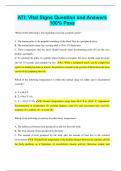
ATI: Vital Signs Question and Answers 100% Pass
Which of the following is true regarding assessing a patient's pulse? A. The human pulse is the palpable bounding of the blood flow in a peripheral artery. B. The normal pulse range for a resting adult is 50 to 110 beats/min. C. Three components that the nurse should include when documenting pulse (P) are the rate, rhythm, and depth. D. To calculate the pulse of a patient whose rhythm is irregular, the nurse should count the pulse rate for 30 seconds and multiply by two. A. When a peripheral artery can be compressed against an underlying bone or muscle, the pulsation created by the ejection of blood from the heart can be felt by palpating that site. Which of the following temperatures is within the normal range for adults and is documented correctly? A. T = 98.6º F B. T = 99.6º F (O) C. T = 101.0º F (O) B. Normal temperatures range from 96.8° F to 100.4° F. Appropriate documentation of temperature (T) includes degrees, scale (F), and assessment site: oral (O), tympanic (T), axillary (A), or rectal (R). Which of the following accurately describes body temperature? A. The difference between heat produced by and lost from the body B. The total amount of heat produced by the body C. The amount of heat produced by the body plus the amount of heat lost to the external environment A. Normal body temperature is the healthy balance between the amounts of heat the body produces as a byproduct of metabolism, muscle activity, thyroxine output, and
Document information
- Uploaded on
- December 27, 2023
- Number of pages
- 16
- Written in
- 2023/2024
- Type
- Exam (elaborations)
- Contains
- Questions & answers


