
CHEM133 Week 15 Lesson 7 Quiz Questions and Answer
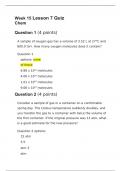
1. Question: A sample of oxygen gas has a volume of 3.52 L at 27°C and 800.0 torr. How many oxygen molecules does it contain? 2. Question: Consider a sample of gas in a container on a comfortable spring day. The Celsius temperature suddenly doubles, and you transfer the gas to a container with twice the volume of the first container. If the original pressure was 12 atm, what is a good estimate for the new pressure? 3. Question: Gas A and gas B are combined in a flask at initial pressures of 1.0 atm each. The flask is sealed and over time they react to completion to give gas C according to the following chemical equation: 4. Question: A pressure that will support a column of Hg to a height of 256 mm would support a column of water to what height? The density of mercury is 13.6 g/cm3; the density of water is 1.00 g/cm3. 5. Question: You have 30.4 g of O2 gas in a container with twice the volume as one with CO2 gas. The pressure and temperature of both containers are the same. Calculate the mass of carbon dioxide gas you have in the container. 6. Question: It is found that 250. mL of a gas at STP has a mass of 0.677 g. What is the molar mass? 7. Question: A physics experiment is conducted at a pressure of 14.0 kPa. What is this pressure in mmHg? 8. Question: The heat of vaporization of water at 100°C is 40.66 kJ/mol. Calculate the quantity of heat that is absorbed/released when 5.00 g of steam condenses to liquid water at 100°C. 9. Question: 30.0 mL of pure water at 282 K is mixed with 50.0 mL of pure water at 328 K. What is the final temperature of the mixture? 10. Question: How much heat is transferred per mole of NH3(g) formed in the reaction shown below? 11. Question: An endothermic reaction causes the surroundings to 12. Question: What temperature will the water reach when 10.1 g CaO is dropped into a coffee cup containing 157 g H2O at 18.0°C if the following reaction occurs? 13. Question: A 3.9 g sample of Colorado oil shale is burned in a bomb calorimeter, which causes the temperature of the calorimeter to increase by 5.0°C. The calorimeter contains 1.00 kg of water (heat capacity of H2O = 4.184 J/g°C) and the heat capacity of the empty calorimeter is 0.10 kJ/°C. How much heat is released per gram of oil shale when it is burned? 14. Question: `The air that we breathe is actually a mixture of several gases. Of those involved, which is the third most abundant component of the mixture? 15. Question: `Suppose you have a helium balloon that is holding 2.00 L of He at a pressure of 15.18 psi. If it's temperature started out as 310.15 K, but was heated to 331.15 K, resulting in an expansion of volume to 3.24 L, what is the final pressure in atm? 16. Question: `My kids love balloons. It's weird, really. If one of their He balloons contained exactly 1 mol of He, and I also gave them a balloon containing exactly 1 mol of oxygen gas (I know, great parenting, right?), and the atmospheric conditions were equal to standard temperature and pressure (STP), which of these statements about the balloons is true? 17. Question: Suppose a balloons was laying by the window at night. The next day, when the sun came up, it warmed the gas (air) that was in the balloon. What would be true about the density of the air in the balloon? 18. Question: If a balloon contains 3.00 L of air that has a pressure of 36.74 psi, what is the gas volume (the volume of the balloon) once it floats to the surface? 19. Question: Which of these is not a correct statement based on what you know about the kinetic molecular theory as it relates to gases? 20. Question: One way to produce methanol: 21. Question: Magnesium oxidizes via the reaction: 22. Question: Combustion of hydrogen releases 142 J/g of hydrogen reacted. How many kJ of energy are released by the combustion of 16.0 oz of hydrogen? 23. Question: N2 is non-reactive, however, if you can get it to react with H2, it does so in a 1:3 mole ratio (N2:H2) and releases 92.0 kJ of thermal energy. That means which if these statements are true? 24. Question: Methanol is an ingredient in windshield washer fluid and ingesting as little as 4 mL can cause blindness in humans 25. Question: How much heat is released when 6.00 g of methane is combusted using the reaction below?
Document information
- Uploaded on
- December 25, 2023
- Number of pages
- 19
- Written in
- 2022/2023
- Type
- Exam (elaborations)
- Contains
- Questions & answers


