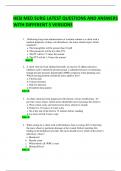
HESI EXIT ADULT HEALTH QUESTIONS AND ANSWERS WITH VERIFIED ANSWERS
ENDOCRINE DISORDERS 1. Nurse Ronn is assessing a client with possible Cushing’s syndrome. In a client with Cushing’s syndrome, the nurse would expect to find: a. Hypotension. b. Thick, coarse skin. c. Deposits of adipose tissue in the trunk and dorsocervical area. d. Weight gain in arms and legs. 1. Answer C. Because of changes in fat distribution, adipose tissue accumulates in the trunk, face (moonface), and dorsocervical areas (buffalo hump). Hypertension is caused by fluid retention. Skin becomes thin and bruises easily because of a loss of collagen. Muscle wasting causes muscle atrophy and thin extremities. 2. A male client with primary diabetes insipidus is ready for discharge on desmopressin (DDAVP). Which instruction should nurse Lina provide? a. “Administer desmopressin while the suspension is cold.” b. “Your condition isn’t chronic, so you won’t need to wear a medical identification bracelet.” c. “You may not be able to use desmopressin nasally if you have nasal discharge or blockage.” d. “You won’t need to monitor your fluid intake and output after you start taking desmopressin.” 2. Answer C. Desmopressin may not be absorbed if the intranasal route is compromised. Although diabetes insipidus is treatable, the client should wear medical identification and carry medication at all times to alert medical personnel in an emergency and ensure proper treatment. The client must continue to monitor fluid intake and output and receive adequate fluid replacement. 3. Nurse Wayne is aware that a positive Chvostek’s sign indicate? a. Hypocalcemia b. Hyponatremia c. Hypokalemia d. Hypermagnesemia a. Hypocalcemia b. Hyponatremia c. Hypokalemia d. Hypermagnesemia 3. Answer A. Chvostek’s sign is elicited by tapping the client’s face lightly over the facial nerve, just below the temple. If the client’s facial muscles twitch, it indicates hypocalcemia. Hyponatremia is indicated by weight loss, abdominal cramping, muscle weakness, headache, and postural hypotension. Hypokalemia causes paralytic ileus and muscle weakness. Clients with hypermagnesemia exhibit a loss of deep tendon reflexes, coma, or cardiac arrest. 4. In a 29-year-old female client who is being successfully treated for Cushing’s syndrome, nurse Lyzette would expect a decline in: a. Serum glucose level. b. Hair loss. c. Bone mineralization. d. Menstrual flow. a. Serum glucose level. b. Hair loss. c. Bone mineralization. d. Menstrual flow. 4. Answer A. Hyperglycemia, which develops from glucocorticoid excess, is a manifestation of Cushing’s syndrome. With successful treatment of the disorder, serum glucose levels decline. Hirsutism is common in Cushing’s syndrome; therefore, with successful treatment, abnormal hair growth also declines. Osteoporosis occurs in Cushing’s syndrome; therefore, with successful treatment, bone mineralization increases. Amenorrhea develops in Cushing’s syndrome. With successful treatment, the client experiences a return of menstrual flow, not a decline in it. 5. A male client has recently undergone surgical removal of a pituitary tumor. Dr. Wong prescribes corticotropin (Acthar), 20 units I.M. q.i.d. as a replacement therapy. What is the mechanism of action of corticotropin? a. It decreases cyclic adenosine monophosphate (cAMP) production and affects the metabolic rate of target organs. b. It interacts with plasma membrane receptors to inhibit enzymatic actions. c. It interacts with plasma membrane receptors to produce enzymatic actions that affect protein, fat, and carbohydrate metabolism. d. It regulates the threshold for water resorption in the kidneys. 5. Answer C. Corticotropin interacts with plasma membrane receptors to produce enzymatic actions that affect protein, fat, and carbohydrate metabolism. It doesn’t decrease cAMP production. The posterior pituitary hormone, antidiuretic hormone, regulates the threshold for water resorption in the kidneys. 6. Capillary glucose monitoring is being performed every 4 hours for a female client diagnosed with diabetic ketoacidosis. Insulin is administered using a scale of regular insulin according to glucose results. At 2 p.m., the client has a capillary glucose level of 250 mg/dl for which he receives 8 U of regular insulin. Nurse Vince should expect the dose’s: a. Onset to be at 2 p.m. and its peak to be at 3 p.m. b. Onset to be at 2:15 p.m. and its peak to be at 3 p.m. c. Onset to be at 2:30 p.m. and its peak to be at 4 p.m. d. Onset to be at 4 p.m. and its peak to be at 6 p.m. 6. Answer C. Regular insulin, which is a short- acting insulin, has an onset of 15 to 30 minutes and a peak of 2 to 4 hours. Because the nurse gave the insulin at 2 p.m., the expected onset would be from 2:15 p.m. to 2:30 p.m. and the peak from 4 p.m. to 6 p.m. 7. A female client with Cushing’s syndrome is admitted to the medical-surgical unit. During the admission assessment, nurse Tyzz notes that the client is agitated and irritable, has poor memory, reports loss of appetite, and appears disheveled. These findings are consistent with which problem? a. Depression b. Neuropathy c. Hypoglycemia d. Hyperthyroidism 7. Answer A. Agitation, irritability, poor memory, loss of appetite, and neglect of one’s appearance may signal depression, which is common in clients with Cushing’s syndrome. Neuropathy affects clients with diabetes mellitus — not Cushing’s syndrome. Although hypoglycemia can cause irritability, it also produces increased appetite, rather than loss of appetite. Hyperthyroidism typically causes such signs as goiter, nervousness, heat intolerance, and weight loss despite increased appetite. 8. Nurse Ruth is assessing a client after a thyroidectomy. The assessment reveals a. Tetany b. Hemorrhage 8. Answer A. Tetany may result if the parathyroid glands are excised or damaged during thyroid muscle twitching and tingling, along with numbness in the fingers, toes, and mouth area. The nurse should suspect which complication? c. Thyroid storm d. Laryngeal nerve damage surgery. Hemorrhage is a potential complication after thyroid surgery but is characterized by tachycardia, hypotension, frequent swallowing, feelings of fullness at the incision site, choking, and bleeding. Thyroid storm is another term for severe hyperthyroidism — not a complication of thyroidectomy. Laryngeal nerve damage may occur postoperatively, but its signs include a hoarse voice and, possibly, acute airway obstruction. 9. After undergoing a subtotal thyroidectomy, a female client develops hypothyroidism. Dr. Smith prescribes levothyroxine (Levothroid), 25 mcg P.O. daily. For which condition is levothyroxine the preferred agent? a. Primary hypothyroidism b. Graves’ disease c. Thyrotoxicosis d. Euthyroidism 9. Answer A. Levothyroxine is the preferred agent to treat primary hypothyroidism and cretinism, although it also may be used to treat secondary hypothyroidism. It is contraindicated in Graves’ disease and thyrotoxicosis because these conditions are forms of hyperthyroidism. Euthyroidism, a term used to describe normal thyroid function, wouldn’t require any thyroid preparation. 10. Which of these signs suggests that a male client with the syndrome of inappropriate antidiuretic hormone (SIADH) secretion is experiencing complications? a. Tetanic contractions b. Neck vein distention c. Weight loss d. Polyuria 10. Answer B. SIADH secretion causes antidiuretic hormone overproduction, which leads to fluid retention. Severe SIADH can cause such complications as vascular fluid overload, signaled by neck vein distention. This syndrome isn’t associated with tetanic contractions. It may cause weight gain and fluid retention (secondary to oliguria). 11. A female client with a history of pheochromocytoma is admitted to the hospital in an acute hypertensive crisis. To reverse hypertensive crisis caused by pheochromocytoma, nurse Lyka expects to administer: a. phentolamine (Regitine). b. methyldopa (Aldomet). c. mannitol (Osmitrol). d. felodipine (Plendil). 11. Answer A. Pheochromocytoma causes excessive production of epinephrine and norepinephrine, natural catecholamines that raise the blood pressure. Phentolamine, an alpha-adrenergic blocking agent given by I.V. bolus or drip, antagonizes the body’s response to circulating epinephrine and norepinephrine, reducing blood pressure quickly and effectively. Although methyldopa is an antihypertensive agent available in parenteral form, it isn’t effective in treating hypertensive emergencies. Mannitol, a diuretic, isn’t used to treat hypertensive emergencies. Felodipine
Written for
- Institution
- Hesi exit
- Course
- Hesi exit
Document information
- Uploaded on
- December 19, 2023
- Number of pages
- 125
- Written in
- 2023/2024
- Type
- Exam (elaborations)
- Contains
- Questions & answers
Subjects
- hesi exit
- hesi exit adult health
-
hesi exit adult health questions and answers
-
adult health questions and answers