

Diabetes Mellitus NCLEX Questions and Answers
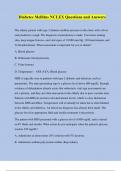
Diabetes Mellitus NCLEX Questions and Answers The elderly patient with type 2 diabetes mellitus presents to the clinic with a fever and productive cough. The diagnosis of pneumonia is made. You notice tenting skin, deep tongue furrows, and vital signs of 110/80 mm Hg, 120 beats/minute, and 24 breaths/minute. What assessment is important for you to obtain? A. Blood glucose B. Orthostatic blood pressures C. Urine ketones D. Temperature - ANS ️️ A. Blood glucose HHS is typically seen in patients with type 2 diabetes and infection, such as pneumonia. The main presenting sign is a glucose level above 600 mg/dL. Enough evidence of dehydration already exists that orthostatic vital sign assessments are not a priority, and they are often inaccurate in the elderly due to poor vascular tone. Patients with HHS do not have elevated ketone levels, which is a key distinction between HHS and DKA. Temperature will eventually be taken but is often blunted in the elderly and diabetics. An infectious diagnosis has already been made. The glucose level for appropriate fluid and insulin treatment is the priority. The patient with HHS presented with a glucose level of 800 mg/dL and is started on IV fluids and insulin. What action do you anticipate when the patient's glucose reaches 250 mg/dL? A. Administer an intravenous (IV) solution with 5% dextrose. B. Administer sodium polystyrene sulfate (Kayexalate). C. Slow the IV infusion rate to 40 mL/hour. D. Assess cardiac monitoring for peaked T waves. - ANS ️️ A. Administer an intravenous (IV) solution with 5% dextrose. When blood glucose levels fall to approximately 250 mg/dL, IV fluids containing glucose are administered to prevent hypoglycemia. Kayexalate (for cation exchange) is used in the treatment of hyperkalemia, which causes peaked T waves on cardiac monitoring. In HHS hypokalemia may result from insulin moving the potassium intracellularly. Fluid replacement remains a priority, but it is given with dextrose. The infusion rate of 40 mL/hour keeps the vein open, but it is not the appropriate replacement rate. What is a typical finding of hyperosmolar hyperglycemic syndrome (HHS)? A. Occurs in type 1 diabetes as the presenting symptom B. Slow onset resulting in a blood glucose level greater than 600 mg/dL C. Ketone bodies higher than 4+ in urine D. Signs and symptoms of diabetes insipidus - ANS ️️ B. Slow onset resulting in a blood glucose level greater than 600 mg/dL HHS has a slower onset than diabetic ketoacidosis. HHS is often related to impaired thirst sensation, inadequate fluid intake, or functional inability to replace fluids. Because of the slower onset, the blood glucose levels can be quite high (more than 600 mg/dL) before diagnosis. HHS is seen in type 2 diabetics, and there is enough circulating insulin to prevent ketoacidosis. Diabetes insipidus is related to inadequate antidiuretic hormone secretion or kidney response with dilute, frequent urination. It is not related to H
Document information
- Uploaded on
- December 17, 2023
- Number of pages
- 14
- Written in
- 2023/2024
- Type
- Exam (elaborations)
- Contains
- Questions & answers


