Nr 304 Chapter 28: ImmobilityPotter et al.: Fundamentals of Nursing, 9th Edition MULTIPLE CHOICE THE study guide for funds.
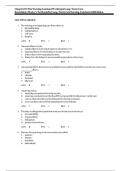
Nr 304 Chapter 28: ImmobilityPotter et al.: Fundamentals of Nursing, 9th Edition MULTIPLE CHOICE THE study guide for funds. Chapter 28: Immobility Chapter 28: ImmobilityPotter et al.: Fundamentals of Nursing, 9th Edition MULTIPLE CHOICE 2. A nurse is providing range of motion to the shoulder and must perform external rotation. Which action will the nurse take? a. Moves patient’s arm in a full circle b. Moves patient’s arm cross the body as far as possible c. Moves patient’s arm behind body, keeping elbow straight d. Moves patient’s arm until thumb is upward and lateral to head with elbow flexed ANS: D 4. A nurse is performing passive range of motion (ROM) and splinting on an at-risk patient. Which finding will indicate goal achievement for the nurse’s action? a. Prevention of atelectasis b. Prevention of renal calculi c. Prevention of pressure ulcers d. Prevention of joint contractures ANS: D 8. A nurse reviews an immobilized patient’s laboratory results and discovers hypercalcemia. Which condition will the nurse monitor for most closely in this patient? a. Hypostatic pneumonia b. Renal calculi c. Pressure ulcers d. Thrombus formation ANS: B 9. A nurse is caring for an immobile patient. Which metabolic alteration will the nurse monitor for in this patient? a. Increased appetite b. Increased diarrhea c. Increased metabolic rate d. Altered nutrient metabolism ANS: D 14. A nurse is assessing the body alignment of a standing patient. Which finding will the nurse report as normal? a. When observed laterally, the spinal curves align in a reversed “S” pattern. b. When observed posteriorly, the hips and shoulders form an “S” pattern. c. The arms should be crossed over the chest or in the lap. d. The feet should be close together with toes pointed out. ANS: A 15. The nurse is evaluating the body alignment of a patient in the sitting position. Which observation by the nurse will indicate a normal finding? a. The edge of the seat is in contact with the popliteal space. b. Both feet are supported on the floor with ankles flexed. c. The body weight is directly on the buttocks only. d. The arms hang comfortably at the sides. ANS: B 16. The nurse is assessing body alignment for a patient who is immobilized. Which patient position will the nurse use? a. Supine position b. Lateral position c. Lateral position with positioning supports d. Supine position with no pillow under the patient’s head ANS: B 19. A nurse is assessing the skin of an immobilized patient. What will the nurse do? a. Assess the skin every 4 hours. b. Limit the amount of fluid intake. c. Use a standardized tool such as the Braden Scale. d. Have special times for inspection so as to not interrupt routine care. ANS: C 21. A patient has damage to the cerebellum. Which disorder is most important for the nurse to assess? a. Imbalance b. Hemiplegia c. Muscle sprain d. Lower extremity paralysis ANS: A 22. Which patient will cause the nurse to select a nursing diagnosis of Impaired physical mobility for a care plan? a. A patient who is completely immobile b. A patient who is not completely immobile c. A patient at risk for single-system involvement d. A patient who is at risk for multisystem problems ANS: B 23. The patient has the nursing diagnosis of Impaired physical mobility related to pain in the left shoulder. Which priority action will the nurse take? a. Encourage the patient to do self-care. b. Keep the patient as mobile as possible. c. Encourage the patient to perform ROM. d. Assist the patient with comfort measures. ANS: D 27. Which goal is most appropriate for a patient who has had a total hip replacement? a. The patient will ambulate briskly on the treadmill by the time of discharge. b. The patient will walk 100 feet using a walker by the time of discharge. c. The nurse will assist the patient to ambulate in the hall 2 times a day. d. The patient will ambulate by the time of discharge. ANS: B 29. A nurse is caring for a patient with osteoporosis and lactose intolerance. What will the nurse do? a. Encourage dairy products. b. Monitor intake of vitamin D. c. Increase intake of caffeinated drinks. d. Try to do as much as possible for the patient. ANS: B 31. The patient is immobilized after undergoing hip replacement surgery. Which finding will alert the nurse to monitor for hemorrhage in this patient? a. Thick, tenacious pulmonary secretions c. SCDs wrapped around the legs d. Elastic stockings (TED hose) ANS: B 32. The nurse needs to move a patient up in bed using a drawsheet. The nurse has another nurse helping. In which order will the nurses perform the steps, beginning with the first one? 1. Grasp the drawsheet firmly near the patient.2. Move the patient and drawsheet to the desired position.3. Position one nurse at each side of the bed.4. Place the drawsheet under the patient from shoulder to thigh.5. Place your feet apart with a forward-backward stance.6. Flex knees and hips and on count of three shift weight from the front to back leg. a. 1, 4, 5, 6, 3, 2 b. 4, 1, 3, 5, 6, 2 c. 3, 4, 1, 5, 6, 2 d. 5, 6, 3, 1, 4, 2 ANS: C 33. The nurse is caring for a patient who needs to be placed in the prone position. Which action will the nurse take? a. Place pillow under the patient’s abdomen after turning. b. Turn head toward one side with large, soft pillow. c. Position legs flat against bed. d. Raise head of bed to 45 degrees. ANS: A 36. The nurse is caring for a patient who is immobile and needs to be turned every 2 hours. The patient has poor lower extremity circulation, and the nurse is concerned about irritation of the patient’s toes. Which device will the nurse use? a. Hand rolls b. A foot cradle c. A trapeze bar d. A trochanter roll ANS: B 37. A nurse delegates a position change to a nursing assistive personnel. The nurse instructs the NAP to place the patient in the lateral position. Which finding by the nurse indicates a correct outcome? a. Patient is lying on side. b. Patient is lying on back. c. Patient is lying semiprone. d. Patient is lying on abdomen. ANS: A 39. A nurse is supervising the logrolling of a patient. To which patient is the nurse most likely providing care? a. A patient with neck surgery
Written for
- Institution
-
Chamberlain College Of Nursng
- Course
-
Nr 304
Document information
- Uploaded on
- December 10, 2023
- Number of pages
- 68
- Written in
- 2023/2024
- Type
- Exam (elaborations)
- Contains
- Questions & answers
Subjects
-
nr 304 chapter 28 immobilitypotter et al fundam