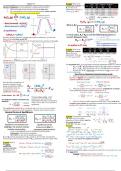
Chapter 15 Example: What is the
Physical equilibrium occurs an equilibrium is achieved between phases. equilibrium constant,
Chemical equilibrium is a sate reached by a chemical reaction where: Kc, for this set of
1. The forward and reverse reactions occur at the same rate. experiments? N2O4 (g) ⇌
2. The concentrations of the reactants and the products remain constant. 2 NO2 (g) @ 100C
The concentrations are not necessarily equal.
For many chemical reactions, reactants and produces continuously “go back and
forth over the activation energy hill”.
Equilibrium occurs when the rate of the forward and reverse reactions are the same.
Example: What is the
equilibrium constant,
Kp, for this set of
experiments? N2O4 (g)
⇌ 2 NO2 (g) @ 100C
Equilibrium is established regardless of the initial concentration of
reactants/products.
The magnitude of Keq gives information about the equilibrium mixture of a reaction.
- Keq >> 1 (K > 103) Equilibrium will lie to the right and favor products.
- Keq << 1 (K < 10-3) Equilibrium will lie to the left and favor reactants.
- Keq 1 (10-3 to 103) Appreciable concentrations of both reactants and
products are present.
Three Ways to Manipulate Chemical Equations and K:
1. When the equation for a reversible reaction is written in the opposite
direction (or flipped), the equilibrium constant becomes the reciprocal of the
original equilibrium constant.
Since the total concentrations of
reactant and product do not
change at equilibrium, the ratio
of concentration terms is a 2. When the equation for a reversible reaction is multiplied by an integer,
constant known as the n, the equilibrium constant is raised to the power of ‘n’.
equilibrium constant (Keq).
The law of mass action, which
expresses, for any reaction, the
relationship between the concentrations 3. If two (or more) reversible reactions with known K values result in an
of the reactants and products present at overall (or net) reaction, the equilibrium constant of the overall reaction is the
equilibrium. product of K values for individual steps.
The equilibrium constant (Keq) is a specific ratio of products to reactants that is
constant for a reaction at a given temperature. Using the same reaction as above:
Example: The following reaction has
a Kc value of 0.78 at a given
temperature. What is the Kc value for
the reverse direction?
SO2Cl2 (g) ⇌ SO2 (g) + Cl2 (g)
Example:
-
Can be written directly from the balanced chemical equation.
-
Independent of the reaction mechanism.
-
NO UNITS for any type of equilibrium constant.
Kc and Kp are basic designations for Keq specific to the way their concentrations
were measured. There are many names for Keq (sometimes referred to simply as K).
Example: What is
the correct
equilibrium
constant expression
(Kc or Kp) for the Homogeneous equilibria applies to reactions in which all reactants and products are
following reactions? in the same phase.
- Example: Dilution of acetic acid in a solvent
o CH3COOH (aq) + H2O (l) ⇌ CH3COO- (aq) + H3O+ (aq)
Physical equilibrium occurs an equilibrium is achieved between phases. equilibrium constant,
Chemical equilibrium is a sate reached by a chemical reaction where: Kc, for this set of
1. The forward and reverse reactions occur at the same rate. experiments? N2O4 (g) ⇌
2. The concentrations of the reactants and the products remain constant. 2 NO2 (g) @ 100C
The concentrations are not necessarily equal.
For many chemical reactions, reactants and produces continuously “go back and
forth over the activation energy hill”.
Equilibrium occurs when the rate of the forward and reverse reactions are the same.
Example: What is the
equilibrium constant,
Kp, for this set of
experiments? N2O4 (g)
⇌ 2 NO2 (g) @ 100C
Equilibrium is established regardless of the initial concentration of
reactants/products.
The magnitude of Keq gives information about the equilibrium mixture of a reaction.
- Keq >> 1 (K > 103) Equilibrium will lie to the right and favor products.
- Keq << 1 (K < 10-3) Equilibrium will lie to the left and favor reactants.
- Keq 1 (10-3 to 103) Appreciable concentrations of both reactants and
products are present.
Three Ways to Manipulate Chemical Equations and K:
1. When the equation for a reversible reaction is written in the opposite
direction (or flipped), the equilibrium constant becomes the reciprocal of the
original equilibrium constant.
Since the total concentrations of
reactant and product do not
change at equilibrium, the ratio
of concentration terms is a 2. When the equation for a reversible reaction is multiplied by an integer,
constant known as the n, the equilibrium constant is raised to the power of ‘n’.
equilibrium constant (Keq).
The law of mass action, which
expresses, for any reaction, the
relationship between the concentrations 3. If two (or more) reversible reactions with known K values result in an
of the reactants and products present at overall (or net) reaction, the equilibrium constant of the overall reaction is the
equilibrium. product of K values for individual steps.
The equilibrium constant (Keq) is a specific ratio of products to reactants that is
constant for a reaction at a given temperature. Using the same reaction as above:
Example: The following reaction has
a Kc value of 0.78 at a given
temperature. What is the Kc value for
the reverse direction?
SO2Cl2 (g) ⇌ SO2 (g) + Cl2 (g)
Example:
-
Can be written directly from the balanced chemical equation.
-
Independent of the reaction mechanism.
-
NO UNITS for any type of equilibrium constant.
Kc and Kp are basic designations for Keq specific to the way their concentrations
were measured. There are many names for Keq (sometimes referred to simply as K).
Example: What is
the correct
equilibrium
constant expression
(Kc or Kp) for the Homogeneous equilibria applies to reactions in which all reactants and products are
following reactions? in the same phase.
- Example: Dilution of acetic acid in a solvent
o CH3COOH (aq) + H2O (l) ⇌ CH3COO- (aq) + H3O+ (aq)