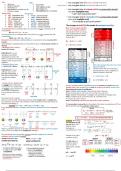
An Arrhenius acid is a substance that, when dissolved in water, it increases the H+ H3O+ is the strongest acid that
concentration. can exist in aqueous solution.
HA (aq) ⇌ H+ (aq) + A- (aq) All acids above H3O + are strong
An Arrhenius base is a substance that, when dissolved in water, increases the OH- acids, meaning that they ionize
concentration. completely in aqueous solution
MOH (aq) ⇌ M+ (aq) + OH- (aq) for form H3O+.
Brønsted-Lowry definition: acid/base behavior is described in terms of proton (H+)
transfer. HA + H2O ⇌ A- + H3O+
Lewis definition: acid/base behavior is described in terms of electron pair transfer or
Ka = [H3O+][A-] / [HA]
sharing.
A Brønsted-Lowry acid is a
proton (H+) donor:
IMPORTANT: Not all
hydrogens in molecular
compounds are acidic. The
ability of a proton to be donated
depends on the structure of the
substance.
A Brønsted-Lowry base OH- is the strongest base that can exist in
is a proton (H+) donor: aqueous solution.
All bases below OH- are strong bases,
IMPORTANT: A base meaning that they ionize completely in
will have one or more aqueous solution to form OH-.
lone pair of electrons. A
base can be neutral (NH3) A- + H2O ⇌ HA + OH-
or negatively charged
(OH-). Kb = [OH-][HA] / [A-]
A Lewis acid is a substance that
can accept a pair of electrons. In every acid-base reaction, equilibrium favors the transfer of a proton from the
A Lewis base is a substance that stronger acid to the stronger base to form the weaker acid and the weaker base.
can donate a pair of electrons to Determining direction of equilibrium:
form a bond. All Brønsted- Step 1: Identify which reactant is the acid and which is the base.
Lowry bases are also Lewis Reactant with larger Ka will be the acid (or larger Kb is the base).
bases. Step 2: Identify which product is conjugate vase and which is conjugate acid.
Step 3: Compare the Ka of reactant acid to Ka of produce acid.
Free metal ions in a solution Or compare Kb values of bases.
often act as Lewis acids. The products here are called complex ions. A complex ion Step 4: Equilibrium will favor the side of the weaker acid/base.
has a metal ion at its center with a number of other molecules or ions (with at least one
lone pair) surrounding it. The ion-product constant (Kw) is the product of the molar concentrations of H+ (or
Example: Cu2+ (aq) + 4 NH3 (aq) ⇌ Cu(NH3)42+ (aq) H3O+) and OH- ions at a particular temperature.
Every Brønsted acid has a conjugate base and every Brønsted base has a conjugate
acid.
Example: What is the
concentration of OH-
ions (in M) in a HCl
solution whose
Water is a substance that can act as either a proton donor (acid) or a proton acceptor hydrogen ion
(base). This is an example of an amphiprotic substance. concentration is 1.3 M?
The acid and the base are typically reactants while the conjugate base and the
conjugate acid are typically products. Strength of an acid is
a measure of [H+].
The pH scale was
defined to make it
easier to refer to
relative [H+] or [OH-]
values.
pH = - log [H+]
[H+] pH
concentration. can exist in aqueous solution.
HA (aq) ⇌ H+ (aq) + A- (aq) All acids above H3O + are strong
An Arrhenius base is a substance that, when dissolved in water, increases the OH- acids, meaning that they ionize
concentration. completely in aqueous solution
MOH (aq) ⇌ M+ (aq) + OH- (aq) for form H3O+.
Brønsted-Lowry definition: acid/base behavior is described in terms of proton (H+)
transfer. HA + H2O ⇌ A- + H3O+
Lewis definition: acid/base behavior is described in terms of electron pair transfer or
Ka = [H3O+][A-] / [HA]
sharing.
A Brønsted-Lowry acid is a
proton (H+) donor:
IMPORTANT: Not all
hydrogens in molecular
compounds are acidic. The
ability of a proton to be donated
depends on the structure of the
substance.
A Brønsted-Lowry base OH- is the strongest base that can exist in
is a proton (H+) donor: aqueous solution.
All bases below OH- are strong bases,
IMPORTANT: A base meaning that they ionize completely in
will have one or more aqueous solution to form OH-.
lone pair of electrons. A
base can be neutral (NH3) A- + H2O ⇌ HA + OH-
or negatively charged
(OH-). Kb = [OH-][HA] / [A-]
A Lewis acid is a substance that
can accept a pair of electrons. In every acid-base reaction, equilibrium favors the transfer of a proton from the
A Lewis base is a substance that stronger acid to the stronger base to form the weaker acid and the weaker base.
can donate a pair of electrons to Determining direction of equilibrium:
form a bond. All Brønsted- Step 1: Identify which reactant is the acid and which is the base.
Lowry bases are also Lewis Reactant with larger Ka will be the acid (or larger Kb is the base).
bases. Step 2: Identify which product is conjugate vase and which is conjugate acid.
Step 3: Compare the Ka of reactant acid to Ka of produce acid.
Free metal ions in a solution Or compare Kb values of bases.
often act as Lewis acids. The products here are called complex ions. A complex ion Step 4: Equilibrium will favor the side of the weaker acid/base.
has a metal ion at its center with a number of other molecules or ions (with at least one
lone pair) surrounding it. The ion-product constant (Kw) is the product of the molar concentrations of H+ (or
Example: Cu2+ (aq) + 4 NH3 (aq) ⇌ Cu(NH3)42+ (aq) H3O+) and OH- ions at a particular temperature.
Every Brønsted acid has a conjugate base and every Brønsted base has a conjugate
acid.
Example: What is the
concentration of OH-
ions (in M) in a HCl
solution whose
Water is a substance that can act as either a proton donor (acid) or a proton acceptor hydrogen ion
(base). This is an example of an amphiprotic substance. concentration is 1.3 M?
The acid and the base are typically reactants while the conjugate base and the
conjugate acid are typically products. Strength of an acid is
a measure of [H+].
The pH scale was
defined to make it
easier to refer to
relative [H+] or [OH-]
values.
pH = - log [H+]
[H+] pH