Chapter 14 (14.1 – 14.3)
Thermodynamics is the study of reaction favorability.
Kinetics is the study of reaction rate.
A reaction rate is the speed at which a chemical reaction occurs, or the speed at which
reactants are converted into products.
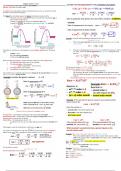
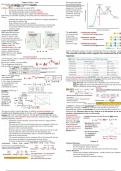
The higher the activation energy, the slower the chemical reaction will be.
- Molecules can only complete the reaction once they have reached the top of
the activation energy barrier.
- If energy is released, the reaction is exothermic (H < 0).
- If energy is absorbed, the reaction is endothermic (H > 0). FASTER
Example: Given the following balanced equation for this cycle:
2 O3 (g) → 3 O2 (g)
1. What is the rate expression for the reaction with respect to ozone (O3) and
oxygen (O2)?
1 [𝑂 ] 1 [𝑂 ]
Rate = − 2 𝑡3 = 3 𝑡2
The ability of a reaction to occur depends on some collision model basics. Molecules 2. If the rate of disappearance of ozone (O3) over a certain time interval is 9.00 x
must: 10-3 atm/s, what is the rate of appearance of oxygen (O2) during this same
- Collide to react. interval?
- Be in the correct orientation.
- Collide with sufficient energy.
What can affect the frequency of these molecule collisions, or the reaction rate?
1. The physical state/surface area of the reactants.
2. The concentration of the reactants.
a. Higher concentration = faster reaction
3. The temperature of the reaction. For the generic reaction: aA +bB → cC dD
4. The presence (or absence) of a catalyst. The rate law is written as: rate = k[A]m[B]n
- k is the rate constant which changes with temperature.
The reaction rate is typically expressed as the change in the concentration of a reactant - The exponents, m and n, are the reaction orders for the individual species
(or a product) over a change in time. (They are NOT stoichiometric coefficients but are most likely 0, 1, or 2 (very
rarely 3).
The reaction orders in a rate law must be determined experimentally!!!
Rates are always expressed as positive values.
Average Rate – determined by finding the slope between any two points.
Instantaneous Rate – determined by finding the slope of a tangent line where it
intersects the curve at the time of interest.
Instant Rate – the instantaneous rate at t = 0.
- Could also be an average rate taken during a short time period starting at t =
0.
What happens when the stoichiometric coefficients are not one?
2A→B
Two moles of A disappear for each mole of B that is formed. The rate of a reaction is
defined as the same value, regardless of which variable (A or B) is being studied.
Example: BrO3- (aq) + 5 Br- (aq) + 6 H+ (aq) → Br2 (aq) + H2O (l)
1. What is the correct rate law for the above reaction if the reaction is zero
order with respect to BrO3-, second order with respect to Br-, and first order
with respect to H+?
Rate = k [BrO3-]0 [Br-]2 [BH+]1 (zero order is left out of rate law)
Rate = k [Br-]2 [H+]
2. What is the overall order of the reaction?
Third order
For the generic reaction,
Example: 2 N2O (g) → 2 N2 (g) + O2 (g)
aA + bB → cC + dD
1. What is the reaction rate (in M/s) when [N2O] = 0.20 M?
the rate expression can be written as:
Rate = k [N2O]
Rate = (0.105 s-1) [N2O]
Rate = (0.105 s-1) (0.20 M)
Rate = 0.021 M • s-1
Thermodynamics is the study of reaction favorability.
Kinetics is the study of reaction rate.
A reaction rate is the speed at which a chemical reaction occurs, or the speed at which
reactants are converted into products.
The higher the activation energy, the slower the chemical reaction will be.
- Molecules can only complete the reaction once they have reached the top of
the activation energy barrier.
- If energy is released, the reaction is exothermic (H < 0).
- If energy is absorbed, the reaction is endothermic (H > 0). FASTER
Example: Given the following balanced equation for this cycle:
2 O3 (g) → 3 O2 (g)
1. What is the rate expression for the reaction with respect to ozone (O3) and
oxygen (O2)?
1 [𝑂 ] 1 [𝑂 ]
Rate = − 2 𝑡3 = 3 𝑡2
The ability of a reaction to occur depends on some collision model basics. Molecules 2. If the rate of disappearance of ozone (O3) over a certain time interval is 9.00 x
must: 10-3 atm/s, what is the rate of appearance of oxygen (O2) during this same
- Collide to react. interval?
- Be in the correct orientation.
- Collide with sufficient energy.
What can affect the frequency of these molecule collisions, or the reaction rate?
1. The physical state/surface area of the reactants.
2. The concentration of the reactants.
a. Higher concentration = faster reaction
3. The temperature of the reaction. For the generic reaction: aA +bB → cC dD
4. The presence (or absence) of a catalyst. The rate law is written as: rate = k[A]m[B]n
- k is the rate constant which changes with temperature.
The reaction rate is typically expressed as the change in the concentration of a reactant - The exponents, m and n, are the reaction orders for the individual species
(or a product) over a change in time. (They are NOT stoichiometric coefficients but are most likely 0, 1, or 2 (very
rarely 3).
The reaction orders in a rate law must be determined experimentally!!!
Rates are always expressed as positive values.
Average Rate – determined by finding the slope between any two points.
Instantaneous Rate – determined by finding the slope of a tangent line where it
intersects the curve at the time of interest.
Instant Rate – the instantaneous rate at t = 0.
- Could also be an average rate taken during a short time period starting at t =
0.
What happens when the stoichiometric coefficients are not one?
2A→B
Two moles of A disappear for each mole of B that is formed. The rate of a reaction is
defined as the same value, regardless of which variable (A or B) is being studied.
Example: BrO3- (aq) + 5 Br- (aq) + 6 H+ (aq) → Br2 (aq) + H2O (l)
1. What is the correct rate law for the above reaction if the reaction is zero
order with respect to BrO3-, second order with respect to Br-, and first order
with respect to H+?
Rate = k [BrO3-]0 [Br-]2 [BH+]1 (zero order is left out of rate law)
Rate = k [Br-]2 [H+]
2. What is the overall order of the reaction?
Third order
For the generic reaction,
Example: 2 N2O (g) → 2 N2 (g) + O2 (g)
aA + bB → cC + dD
1. What is the reaction rate (in M/s) when [N2O] = 0.20 M?
the rate expression can be written as:
Rate = k [N2O]
Rate = (0.105 s-1) [N2O]
Rate = (0.105 s-1) (0.20 M)
Rate = 0.021 M • s-1