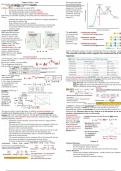
Chapter 14 (14.4 – 14.6) The reaction path graph
Most reaction rates increase as temperature increases. for a multistep reaction
as T , k and rate will have more than one
Collision Theory is a model used to explain WHY: energy peak. The number
1. In order for molecules to react, they must collide. of peaks corresponds to
2. The colliding molecules must be oriented correctly. the number of steps in the
3. The colliding molecules must collide with sufficient energy. mechanism. Each step
Other things to remember regarding a successful reaction as defined by Collision has its own activation
Theory: energy (Ea).
- Reactions that require four particles to collide are too highly improbable to
be an effective reaction step.
- Most collisions do not result in a reaction.
- Collisions can be defined as unimolecular, bimolecular, or termolecular.
- A successful collision must have energy equal to or greater than the
activation energy.
Svante Arrhenius (1859 –
1927) stated that molecules The molecularity
must possess a minimum of a reaction refers
amount of energy to react. to how many
To form products, chemical reactant molecules
bonds in the reactant(s) must be are involved in an
broken. Bond breakage elementary
requires energy. This bond reaction (or step).
breakage energy, the
Activation energy (Ea) is the
minimum energy required to
initiate a chemical reaction. Only for elementary reactions: rate laws written directly from rxn coefficients = orde
Often referred to as the energy
barrier for a reaction.
Arrhenius Equation:
A is the frequency factor, a measure of the probability of a favorable collision.
k is the rate constant.
R is the gas constant, 8.314 (J/(mol•K).
T is the temperature (in Kelvin).
Both A and Ea are specific to each given reaction.
- The larger the Ea, the smaller the k. Reaction rate decreases because fewer
reactants have the necessary KE to overcome Ea.
- The higher the T, the larger the k. Reaction rate increases because more
reactants have the necessary KE to overcome Ea.
Note: Ea does NOT change
with temperature. The rate-determining step is the SLOWEST step in the sequence of steps leading t
If we measure the rate constant, product formation. The rate-determining step should predict the same rate law for the
k, for a range of temperatures, overall reaction rate law that is determined experimentally.
we can determine Ea and - Slow first step: The overall rate law is dependent only on the first step.
A, graphically, be - Fast first step: The slowest step still limits the reaction rate, but the overa
rearranging the equation: rate law will still be written in terms of the first step.
Example: CH3NC (g) →
CH3CN (g)
Given the
experimental
data, what is
the activation
energy, Ea, (in
kj/mol) for
this reaction? A catalyst is a substance that INCREASES the rate of a chemical reaction without
itself being consumed. A catalyst is consumed in one step then regenerated in a
subsequent step; whereas an intermediate is formed in one step then consumed in a
The steps by which a reaction takes place is called the reaction mechanism. An subsequent step. Substances that are not a catalyst or an intermediate are the net
overall (or net) chemical reaction is often the result of two or more individual reactant(s) and product(s) in the overall reaction.
reactions that occur in a discrete sequence. The individual reactions that make up the In homogeneous
overall reaction are called elementary steps (reactions). Important things to remember catalysis, the reactants
regarding elementary reactions: and the catalysts are
- Elementary reactions describe a process that occurs by a single collision dispersed in the same
(molecular event). phase, usually liquid.
- When the rate law for an overall reaction does not correspond to the known In heterogeneous
rate-determining (slow) step, it usually means one or more fast steps catalysis, the reactants
precede it in the reaction mechanism. and the catalysts are in
- If the first step in a reaction mechanism is slow, the rate law for the overall different phases.
reaction will be the same as the rate law for that elementary step.
- The combination of all elementary steps in a reaction mechanism must
result in the overall reaction.
- The reaction mechanism must be consistent with all experimentally-derived
observations, including the experimentally-derived rate law.
- A reaction mechanism is a proposed sequence of elementary steps. Chapter 21
Chemical Reactions:
- Breaking/forming bonds between atoms.
- Involve changes in valence electrons.
- Do not change the identity of the element(s) involved in the reaction.
Nuclear Reactions:
- Atomic nuclei undergo transformations – usually results in new elements
(converted from one to another).
- Can release ENORMOUS amounts of energy.
Most reaction rates increase as temperature increases. for a multistep reaction
as T , k and rate will have more than one
Collision Theory is a model used to explain WHY: energy peak. The number
1. In order for molecules to react, they must collide. of peaks corresponds to
2. The colliding molecules must be oriented correctly. the number of steps in the
3. The colliding molecules must collide with sufficient energy. mechanism. Each step
Other things to remember regarding a successful reaction as defined by Collision has its own activation
Theory: energy (Ea).
- Reactions that require four particles to collide are too highly improbable to
be an effective reaction step.
- Most collisions do not result in a reaction.
- Collisions can be defined as unimolecular, bimolecular, or termolecular.
- A successful collision must have energy equal to or greater than the
activation energy.
Svante Arrhenius (1859 –
1927) stated that molecules The molecularity
must possess a minimum of a reaction refers
amount of energy to react. to how many
To form products, chemical reactant molecules
bonds in the reactant(s) must be are involved in an
broken. Bond breakage elementary
requires energy. This bond reaction (or step).
breakage energy, the
Activation energy (Ea) is the
minimum energy required to
initiate a chemical reaction. Only for elementary reactions: rate laws written directly from rxn coefficients = orde
Often referred to as the energy
barrier for a reaction.
Arrhenius Equation:
A is the frequency factor, a measure of the probability of a favorable collision.
k is the rate constant.
R is the gas constant, 8.314 (J/(mol•K).
T is the temperature (in Kelvin).
Both A and Ea are specific to each given reaction.
- The larger the Ea, the smaller the k. Reaction rate decreases because fewer
reactants have the necessary KE to overcome Ea.
- The higher the T, the larger the k. Reaction rate increases because more
reactants have the necessary KE to overcome Ea.
Note: Ea does NOT change
with temperature. The rate-determining step is the SLOWEST step in the sequence of steps leading t
If we measure the rate constant, product formation. The rate-determining step should predict the same rate law for the
k, for a range of temperatures, overall reaction rate law that is determined experimentally.
we can determine Ea and - Slow first step: The overall rate law is dependent only on the first step.
A, graphically, be - Fast first step: The slowest step still limits the reaction rate, but the overa
rearranging the equation: rate law will still be written in terms of the first step.
Example: CH3NC (g) →
CH3CN (g)
Given the
experimental
data, what is
the activation
energy, Ea, (in
kj/mol) for
this reaction? A catalyst is a substance that INCREASES the rate of a chemical reaction without
itself being consumed. A catalyst is consumed in one step then regenerated in a
subsequent step; whereas an intermediate is formed in one step then consumed in a
The steps by which a reaction takes place is called the reaction mechanism. An subsequent step. Substances that are not a catalyst or an intermediate are the net
overall (or net) chemical reaction is often the result of two or more individual reactant(s) and product(s) in the overall reaction.
reactions that occur in a discrete sequence. The individual reactions that make up the In homogeneous
overall reaction are called elementary steps (reactions). Important things to remember catalysis, the reactants
regarding elementary reactions: and the catalysts are
- Elementary reactions describe a process that occurs by a single collision dispersed in the same
(molecular event). phase, usually liquid.
- When the rate law for an overall reaction does not correspond to the known In heterogeneous
rate-determining (slow) step, it usually means one or more fast steps catalysis, the reactants
precede it in the reaction mechanism. and the catalysts are in
- If the first step in a reaction mechanism is slow, the rate law for the overall different phases.
reaction will be the same as the rate law for that elementary step.
- The combination of all elementary steps in a reaction mechanism must
result in the overall reaction.
- The reaction mechanism must be consistent with all experimentally-derived
observations, including the experimentally-derived rate law.
- A reaction mechanism is a proposed sequence of elementary steps. Chapter 21
Chemical Reactions:
- Breaking/forming bonds between atoms.
- Involve changes in valence electrons.
- Do not change the identity of the element(s) involved in the reaction.
Nuclear Reactions:
- Atomic nuclei undergo transformations – usually results in new elements
(converted from one to another).
- Can release ENORMOUS amounts of energy.