

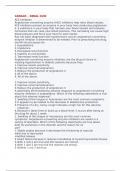
CARDAIC – RENAL QUIZ
CARDAIC – RENAL QUIZ ACE Inhibitors Angiotensin-converting enzyme (ACE) inhibitors help relax blood vessels. ACE inhibitors prevent an enzyme in your body from producing angiotensin II, a substance in your body that narrows your blood vessels and releases hormones that can raise your blood pressure. This narrowing can cause high blood pressure and force your heart to work harder. Ray has been diagnosed with hypertension and an angiotensin-converting enzyme inhibitor is determined to be needed. Prior to prescribing this drug, the NP should assess for: 1. Hypokalemia 2. Impotence 3. Decreased renal function 4. Inability to concentrate 3. Decreased renal function Angiotensin-converting enzyme inhibitors are the drug of choice in treating hypertension in diabetic patients because they: 1. Improve insulin sensitivity 2. Improve renal hemodynamics 3. Reduce the production of angiotensin II 4. All of the above 4. All of the above 1. Improve insulin sensitivity 2. Improve renal hemodynamics 3. Reduce the production of angiotensin II A potentially life-threatening adverse response to angiotensin-converting enzyme inhibitors is angioedema. Which of the following statements is true about this adverse response? 1. Swelling of the tongue or hoarseness are the most common symptoms. 2. It appears to be related to the decrease in aldosterone production. 3. Presence of a dry, hacky cough indicates a high risk for this adverse response. 4. Because it takes time to build up a blood level, it occurs after being on the drug for about 1 week. 1. Swelling of the tongue or hoarseness are the most common symptoms. Angiotensin-converting enzyme inhibitors are useful in a variety of disorders. Which of the following statements are true about both its usefulness in the disorder and the reason for its use? 1. Stable angina because it decreases the thickening of vascular walls due to decreased modified release. 2. Heart failure because it reduces remodeling of injured myocardial tissues. 3. Both 1 and 2 are true and the reasons are correct. 4. Both 1 and 2 are true but the reasons are wrong. 5. Neither 1 nor 2 are true. 3. Both 1 and 2 are true and the reasons are correct. 1. Stable angina because it decreases the thickening of vascular walls due to decreased modified release. 2. Heart failure because it reduces remodeling of injured myocardial tissues. Despite good blood pressure control, an NP might change a patient's drug from an angiotensin-converting enzyme (ACE) inhibitor to an angiotensin II receptor blocker (ARB) because the ARB: 1. Is stronger than the ACE inhibitor 2. Does not produce a dry, hacky cough 3. Has no effect on the renal system 4. Reduces sodium and water retention 2. Does not produce a dry, hacky cough While taking an angiotensin II receptor blocker (ARB), patients need to avoid certain over-the-counter drugs without first consulting the provider because: 1. Cimetidine is metabolized by the CYP 3A4 isoenzymes 2. Nonsteroidal anti-inflammatory drugs reduce prostaglandin levels 3. Both 1 and 2 4. Neither 1 nor 2 3. Both 1 and 2 1. Cimetidine is metabolized by the CYP 3A4 isoenzymes 2. Nonsteroidal anti-inflammatory drugs reduce prostaglandin levels Laboratory monitoring for patients on angiotensin-converting enzyme inhibitors or angiotensin II receptor blockers should include: 1. White blood cell counts with the drug dosage increased for elevations above 10,000 feet 2. Liver function tests with the drug dosage stopped for alanine aminotransferase values twice that of normal 3. Serum creatinine levels with the drug dosage reduced for values greater than 2.5 mg/dL 4. Serum glucose levels with the drug dosage increased for levels greater than 120 mg/ dL 3. Serum creatinine levels with the drug dosage reduced for values greater than 2.5 mg/dL Jacob has hypertension, for which a calcium channel blocker has been prescribed. This drug helps control blood pressure because it: 1. Decreases the amount of calcium inside the cell 2. Reduces stroke volume 3. Increases the activity of the Na+/K+/ATPase pump indirectly 4. Decreases heart rate
Document information
- Uploaded on
- December 2, 2023
- Number of pages
- 11
- Written in
- 2023/2024
- Type
- Exam (elaborations)
- Contains
- Questions & answers


