

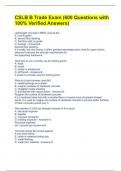
CSLB B Trade Exam (600 Questions with 100% Verified Answers)
Lightweight concrete is BEST used at the: A. curb & gutter B. second floor decking C. first floor slab on grade D. footings - Answers-B. Second floor decking. It is costly, but very strong. It offers greatest advantage when used for upper stories because it reduces the strength requirements for the supporting framework. What tool do you normally use for striking joints? A. haulk B. trowel C. jointer or jointing tool D. stiff brush - Answers-B. A trowel is normally used for striking joints. What is a bush-hammer used for? A. install bushings on a wheel B. roughen surfaces of hardened concrete C. straighten metai sheeting D. pull objects with impact action - Answers-B. Roughen the surface of hardened concrete. It is a hardened steel tool with a serrated face or several rows of pyramid-shaped points. It is used to roughen the surface of hardened concrete to provide better bonding of fresh concrete poured over it. Who decides if 3,000 psi strength concrete is fit to pour? A. structural engineer B. supplier C. concrete contractor D. building inspector - Answers-A. Structural engineer. psi = pounds per square inch Concrete should be poured against: A any wood siding B. cedar or redwood siding only C. metal flashing D. metal form material - Answers-D. Metal form material. When metal forms are not used, only "Form Grade" plywood, not siding, should be used in the wood forms. How soon should you pour concrete after you have mixed it without additives? A. 1/2 hour B. 1 hour C. 4 hours D. 8 hours - Answers-A. 1/2 hour. You should begin placing concrete within 30 minutes of mixing, and it MUST be placed within 90 minutes to prevent the concrete from becoming too stiff and difficult to place and finish. In cold climates, you cover freshly poured concrete to: A. prevent hydration B. prevent discoloration C. prevent warping D. prevent freezing - Answers-D. Prevent freezing. In order to hold in the heat, long enough for curing. When should you trowel concrete? A. when just poured B. 1 hour after pouring C. when concrete becomes firm, several hours after pour D. after 24 hours - Answers-C. You should trowel concrete several hours after pour when concrete becomes firm. A vapor barrier might not be needed between wood and concrete:
Document information
- Uploaded on
- November 25, 2023
- Number of pages
- 107
- Written in
- 2023/2024
- Type
- Exam (elaborations)
- Contains
- Questions & answers


