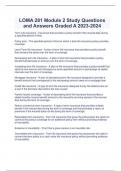
LOMA 281 Module 2 Study Questions and Answers Graded A
Term Life insurance - Insurance that provides a policy benefit if the insured dies during a specified period of time. Policy term - The specified period of time for which a term life insurance policy provides coverage. Level Term life insurance - A plan of term life insurance that provides a policy benefit that remains the same over the term of coverage. Decreasing term life insurance - A plan of term life insurance that provides a policy benefit that decrease in amount over the term of coverage. Increasing term life insurance - A plan of life insurance that provides a policy benefit that starts at one amount and increases by some specified amount or percentage at stated intervals over the term of coverage. Mortgage insurance - A plan of decreasing term life insurance designed to provide a benefit amount that corresponds to the decreasing amount owed on a mortgage loan Credit life insurance - A type of term life insurance designed to pay the balance due on a loan if the borrower dies before the loan is paid Family income coverage - A plan of decreasing term life insurance that provides a stated monthly income benefit amount to the insured's surviving spouse if the insured dies during the term of coverage. Return of premium term insurance - A type of term insurance that provides a death benefit if the insured dies during the term of coverage and that promises a return of premiums if the insured does not die during the term of coverage. Renewable term insurance - Term life insurance that gives the policyowner the option to continue the policy's coverage for an additional policy term without providing evidence of insurability. Evidence of insurability - Proof that a given person is an insurable risk. Convertible term insurance - Term life insurance that gives the policyowner the right to convert the term policy to a cash value life insurance policy without providing evidence of insurability. Conversion period - The specified period of time following policy issue during which the owner of a convertible term life insurance policy can convert the coverage to cash value life insurance. Original age conversion - A conversion of a term life insurance policy to a cash value life insurance policy in which the renewal premium rate is based on the insured's age when the original term life insurance policy was issued. Cash value life insurance - Insurance that provides life insurance coverage throughout the insured's lifetime and also provides a savings element. Cash value - The savings element of a cash value life insurance policy, which represents the policyowner's ownership interest in the policy. Policy loan - A loan a policyowner receives from an insurer using the cash value of a life insurance policy as security. Cash surrender value - The amount, after adjustments for factors such as policy loans, that the owner of a cash value life insurance policy is entitled to receive upon surrendering the policy. Single premium payment - A type of limited-payment whole life insurance policy that requires only one premium payment. Limited premium payment - A whole life insurance policy for which premiums are payable only until some stated period expires or until the insured's death, whichever occurs first. Continuous premium payment - A whole life insurance policy for which premiums are payable for the life of the policy. AKA straight life or ordinary life. Modified premium whole life insurance - A whole life insurance policy that functions in the same manner as a traditional whole life policy except that the policy's annual premium changes after a specified initial period, such as 5,10,15,20 years. Modified coverage whole life insurance - A whole life insurance policy under which the amount of insurance decreases by specific percentages or amounts either when the insured reaches certain stated ages or at the end of stated time periods. Joint whole life insurance - A plan of whole life insurance that has the same features and benefits as individual whole life, except that it insures two lives under the same policy; the death benefit is payable when the first insured dies. Last survivor life insurance - A variation of joint whole life insurance under which the policy benefit is paid only after both people insured by the policy have died.
Written for
- Institution
- LOMA 281
- Course
- LOMA 281
Document information
- Uploaded on
- November 25, 2023
- Number of pages
- 6
- Written in
- 2023/2024
- Type
- Exam (elaborations)
- Contains
- Questions & answers
Subjects
-
loma 281 module 2 study questions and answers

Also available in package deal