
Economics revision
Microeconomics
Scarcity and choice:
Factors of production:
- Land. Natural resources.
- Labour. Quantity and quality or workers
- Capital. Man made aids to production.
- Enterprise. Someone who organises the FOP.
- The maximum a country can produce is dependent upon FOP.
Labour productivity is output per worker per period. Labour specialisation can lead to an increase in
labour productivity and increase in production.
If an economy has limited amount of resources they wont be able to produce everything they want.
They will have to choose what they can produce with their FOP, the quantity and who will get what
is produced.
Different economic systems:
- Centrally planned. Decisions are made by the state/government.
- Free market. Decided by price mechanism. Supply and demand.
- Mixed economy. Decided by government and price mechanism.
Opportunity cost – next best alternative foregone.
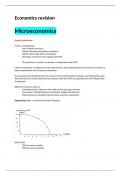
Shift in PPF:
- FOP increase in quality.
- FOP increase in quantity
, Demand and supply in product markets:
Utility – satisfaction
Types of demand:
- Derived. Demand for a good or service that results from demand of something else. Eg
mobile phones and lithium batteries. Eg fish and chips
- Joint. Demand for complement goods. Goods that go together.
- Composite demand. Demand for a product that has multiple uses eg eggs
- Competitive. Demand for goods that are in competition. Eg substitutes
Supply – quantity of goods that firms are able and willing to provide at various prices.
- Taxes decrease supply
- Subsidies increase supply
Demand and supply in labour markets:
Wage determination
- Demand curve for labour shows how many workers will be hired at any given wage rate over
a given period of time.
- Firms base their decision of number of employees on the extra revenue they gain for hiring
an extra employee
- MRP = marginal revenue product
- MP = marginal product
- MR = marginal revenue
- MRP = MP X MR
- MRP is also the demand curve for labour
- MRP will start to decrease because of diseconomies of scale and lower productivity
- The firm should hire the number of employees where wage rate intersects MRP curve
Microeconomics
Scarcity and choice:
Factors of production:
- Land. Natural resources.
- Labour. Quantity and quality or workers
- Capital. Man made aids to production.
- Enterprise. Someone who organises the FOP.
- The maximum a country can produce is dependent upon FOP.
Labour productivity is output per worker per period. Labour specialisation can lead to an increase in
labour productivity and increase in production.
If an economy has limited amount of resources they wont be able to produce everything they want.
They will have to choose what they can produce with their FOP, the quantity and who will get what
is produced.
Different economic systems:
- Centrally planned. Decisions are made by the state/government.
- Free market. Decided by price mechanism. Supply and demand.
- Mixed economy. Decided by government and price mechanism.
Opportunity cost – next best alternative foregone.
Shift in PPF:
- FOP increase in quality.
- FOP increase in quantity
, Demand and supply in product markets:
Utility – satisfaction
Types of demand:
- Derived. Demand for a good or service that results from demand of something else. Eg
mobile phones and lithium batteries. Eg fish and chips
- Joint. Demand for complement goods. Goods that go together.
- Composite demand. Demand for a product that has multiple uses eg eggs
- Competitive. Demand for goods that are in competition. Eg substitutes
Supply – quantity of goods that firms are able and willing to provide at various prices.
- Taxes decrease supply
- Subsidies increase supply
Demand and supply in labour markets:
Wage determination
- Demand curve for labour shows how many workers will be hired at any given wage rate over
a given period of time.
- Firms base their decision of number of employees on the extra revenue they gain for hiring
an extra employee
- MRP = marginal revenue product
- MP = marginal product
- MR = marginal revenue
- MRP = MP X MR
- MRP is also the demand curve for labour
- MRP will start to decrease because of diseconomies of scale and lower productivity
- The firm should hire the number of employees where wage rate intersects MRP curve


