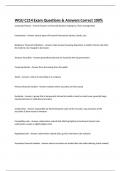
WGU C214 Exam Questions & Answers Correct 100%
Corporate Finance - Answer focuses on financial decision making by a firms management Investments - Answer various types of financial instruments (stocks, bonds, etc) Banking or Financial Institutions - Answer make money by paying depositors a smaller interest rate than the interest rate charged to borrowers Treasury Securities - Answer generally bonds that are issued by the US government Corporate Bonds - Answer firms borrowing from the public Stocks - Answer a share of ownership in a company Primary financial markets - Answer markets where securities are first issued Syndicate - Answer a group that is temporarily formed to handle a bond or stock issue: generally large investment bank or institutional investors Underwriter - Answer responsible for determining the value of the security; may purchase all the securities & then resale to investors Competitive sale - Answer underwriters submit bids offering highest price/lowest interest rate; underwriter resales a slightly higher price Negotiated sale - Answer underwriters submit bids, go thru interview to be selected Secondary financial markets - Answer where securities are traded after the initial offering (stock market) Auction market - Answer has a physical location & prices are determined by the highest price an investor is willing to pay (New York Stock Exchange) Dealer market - Answer no physical location- securities are bought & sold thru a network of dealers that trade for themselves; multi dealers per stock (NASDAQ) Role of financial markets - Answer they reduce the cost of borrowing from the public or selling ownership to the public Role of Specialist (NYSE) or Dealers - Answer provide liquidity for a fair & orderly market; may increase the spread to do so (charge a lower price to seller and a higher price to buyer) Financial market liquidity - Answer the ease of trading in the market (high frquency traders) Market orders - Answer time sensitive; sales at current bid price/buys at current asking price when order is placed-immediately Limited orders - Answer price sensitive; sell occurs when price of stock matches order price Role of price - Answer convet information to consumers; affect incentives &affect the distribution of income Dollar Returns - Answer Pt - Pt-1 + CFt (Pt= sold price, Pt-1=bought price, CFt=cash flow-coupons for bonds/dividians for stocks) Percentage Returns - Answer Pt - Pt-1/Pt-1 + CFt/Pt-1 x 100 (1.2) (figure for dollar return and divide into bought price) Goal of company/firm - Answer to maximize shareholder value or maximize profit Agency costs - Answer costs that are incurred when management doesn't act in the best interests of shareholders Profit maximizarion - Answer the potential effect of focusing soley on profits Accounting - Answer is backward-looking and risk free Finance - Answer is forward-looking and involes massive uncertainty Income Statement - Answer show results of operation over time; revenues - expenses = net income Balance Sheet - Answer a "snap shot" of a firm's assests & financing at a paticular point in time; Assets= Liabilities + Owner's Equity Statement of Cash Flows - Answer tracks all cash in and out of the firm Cash Accounting - Answer cash in =revenue; cash out=expense Accrual Accounting - Answer revenues are recognized when the earnings process is complete; expenses are "matched" to recongized revenues Cash-based income - Answer an informal metric based on cash in & cash out of the firm Income for tax purposes - Answer based on the government's definition of income, this is the amount of income the government will tax Accounting income - Answer the income calculated using accrual accounting (aka, GAAP); best & most complicated metric for understanding the operations of the firm On the Income statement - Answer Revenues- Cost of goods sold= Gross profit - Operating expenses= earning before interest & taxes - interest expenses, - taxes= Net income Revenue - Answer recognized when "earned" Cost of Goods Sold - Answer direct costs of materials & labor Gross profit - Answer revenue - cost of goods sold Operating Expenses - Answer expenses not directly associated with production (office expenses, administrative expenses, depreciation, research & development) EBIT - Answer Earnings before interest & tax; Gross profit - operating expenses (also known as operating income) Net Income on balance sheet - Answer EBIT - interest - taxes Current Assets - Answer cash marketable securities, A/R, inventory Fixed Assests - Answer gross fixed assets- accumulated depreciation Current Liabilities - Answer A/P, accruals, notes payable Equity - Answer Commonstock, paid-in capital, retained earnings Accumulated depreciation - Answer total of all depreciation claimed against the firms fixed assets Net PP&E - Answer original cost (Gross PP&E) - accumulated depreciation Net Income (linking balance sheet & income statement) - Answer income statement) dividends + change in retained earnings New Retained earnings - Answer 0d retained earnings + change in retained earnings or old retained earnings + net income - dividends Gross PP&E - Answer orginal cost of property, plant & equipment Statement of Cash Flows - Answer cash flow reveals the true health of a company; explains cash in & cash out from operations, investing & financing CFO + CFI + CFF = change in cash - beginning cash = end cash Operational - Answer decisions on what/how/whom to sell & buy from Investing - Answer decisions on purchasing & selling of long term assets Financing - Answer decision on debt & equity, repayment of debts, repurchasing stock & payment of dividends Core activities - Answer firm's core activities will impact the way cash flows are catagorized Cash flow management - Answer some managers will "manage" (increase/decrease) reporting of cash flows Market pressure - Answer pressures to manipulate cash flow categorization in the market place Differences in CFO & Net Income - Answer 1. revenue is not the same as cash 2. gains/losses are only seen in net income 3. depreciation is only seen in net income Calculating CFO from balance sheet - Answer Net income + non-cash expenses (depreciation) + decrease in operating asset accounts (other than cash) - increase in operating asset accounts (other than cash) + increase in operating liability accounts (other than notes payable) - decrease in operating liability accounts (other than notes payable Increase in assets (A/R, inventory) - Answer out flow of cash Increase in liabilities (A/P, accrued wage) - Answer increases cash Calculating CFI - Answer Change in Gross PP&E or change in Net PP&E + depreciation Dividends - Answer (Old RE + NI)- New RE Change in RE - Answer Net income - dividends Calculating CFF - Answer change in equity + change in debt - new RE Free Cash Flow (FCF) - Answer distributable cash Free Cash Flow Firm (FCFF) - Answer Net Operating Profit after taxes (NOPAT) + depreciation - capital expenditures on PP&E (CFI) - increases in Net working capital (current assets- current liability) Free Cash Flow Equity holders (FCFE) - Answer Net income + depreciation - capital expenditures on PP&E (CFI) - increases in Net working capital (current assets- current liability) + increase in debt (new borrowings-repayment of old debt) Standardization - Answer to gain insight when comparing companies & finance Flexibility - Answer ratio analysis is not governed by GAAP; best analysts achieve the greatest benefits Focus - Answer ratios allow for quick discover of area that need investigation Liquidity - Answer ability to meet short-tem obligations Current Ratio (liquidity) - Answer Current assets/current liabilities higher ratio= likelyhood of ability to meet short term obligations Quick Ratio (liquidity) - Answer Current assets - inventory/current liabilities higher ratio= greater ability to meet short term obligations Accounts Recievable Turnover (liquidity) - Answer (liquidity) Credit sales/AR ratio of 12= company collects entire AR 12 times per year Average Collection Period/ACP (liquidity) - Answer 365/AR turnover # indicates the number of times per year receivables are turned Inventory Turnover (liquidity) - Answer COGS/Inventory # of times company turns it receivalbes in a year Days on Hand/DOH (liquidity) - Answer 365/Inventory Turnover how many days of inventory the company has on hand Efficiency Ratios - Answer measure how effectively a company uses assets to generate sales or profit Fixed Asset Turnover/FAT (efficiency) - Answer Sales/Fixed Assets sales generated per dollar of fixed assets Operating Income Return on Investment/OIROI (efficiency) - Answer EBIT/Total Assets operating profit generated per dollar of assets
Written for
- Institution
- WGU C214
- Course
- WGU C214
Document information
- Uploaded on
- November 14, 2023
- Number of pages
- 28
- Written in
- 2023/2024
- Type
- Exam (elaborations)
- Contains
- Questions & answers
Subjects
- wgu c214 stuvia
-
wgu c214 exam questions answers correct 100
-
corporate finance focuses on financial decision ma
-
investments various types of financial instruments

Also available in package deal