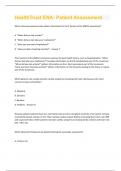
HealthTrust ENA: Patient Assessment Questions and Answers with complete solution
Which interview question helps obtain information for the P portion of the AMPLE assessment? A. "When did you last urinate?" B. "When did you last take your medication?" C. "Have you ever been hospitalized?" D. "Have you been traveling recently?" - Answer C The P portion of the AMPLE mnemonic assesses the past health history, such as hospitalization. "When did you last take your medication?" provides information on the M (medications) part of the mnemonic. "When did you last urinate?" gathers information on the L (last meal eaten) part of the mnemonic. "Have you been traveling recently?" obtains information on the E (events leading to the illness or injury) part of the mnemonic. Which patients can usually maintain cardiac output by increasing the heart rate because the heart cannot increase contractility? A. Obstetric B. Geriatric C. Bariatric D. Pediatric - Answer D Because pediatric patients have less contractile mass and less compliant ventricles, they cannot increase contractility (stroke volume or SV). They maintain cardiac output (CO) by increasing their heart rate (HR) and vasoconstriction. Other patients maintain cardiac output by increasing stroke volume and heart rate (CO = HR x SV). Which abnormal finding can be detected during the secondary assessment? A. Friction rubB. Paradoxical chest wall motion C. Open wound of the chest D. Weak, thready pulse - Answer A
Written for
- Institution
- HealthTrust ENA: Patient Assessment
- Course
- HealthTrust ENA: Patient Assessment
Document information
- Uploaded on
- November 8, 2023
- Number of pages
- 11
- Written in
- 2023/2024
- Type
- Exam (elaborations)
- Contains
- Questions & answers
Subjects
-
healthtrust ena patient assessment

Also available in package deal