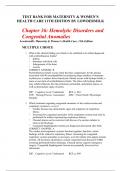
Chapter 36: Hemolytic Disorders and Congenital Anomalies Lowdermilk: Maternity & Women’s Health Care, 11th Edition
TEST BANK FOR MATERNITY & WOMEN’S HEALTH CARE 11TH EDITION BY LOWDERMILK Chapter 36: Hemolytic Disorders and Congenital Anomalies Lowdermilk: Maternity & Women’s Health Care, 11th Edition MULTIPLE CHOICE 1. What is the clinical finding most likely to be exhibited in an infant diagnosed with erythroblastosis fetalis? a. Edema b. Immature red blood cells c. Enlargement of the heart d. Ascites CORRECT ANSWER: B Erythroblastosis fetalis occurs when the fetus compensates for the anemia associated with Rh incompatibility by producing large numbers of immature erythrocytes to replace those hemolyzed. Edema occurs with hydrops fetalis, a more severe form of erythroblastosis fetalis. The fetus with hydrops fetalis may exhibit effusions into the peritoneal, pericardial, and pleural spaces, as well as demonstrate signs of ascites. DIF: Cognitive Level: Understand REF: p. 883 TOP: Nursing Process: Assessment MSC: Client Needs: Physiologic Integrity 2. Which statement regarding congenital anomalies of the cardiovascular and respiratory systems is correct? a. Cardiac disease may demonstrate signs and symptoms of respiratory illness. b. Screening for congenital anomalies of the respiratory system need only be performed for infants experiencing respiratory distress. c. Choanal atresia can be corrected with the use of a suction catheter to remove the blockage. d. Congenital diaphragmatic hernias are diagnosed and treated after birth. CORRECT ANSWER: A The cardiac and respiratory systems function together; therefore, initial findings will be related to respiratory illness. Screening for congenital respiratory system anomalies is necessary, even for infants who appear normal at birth. All newborns should have critical congenital heart disease (CCHD) screening performed before discharge. Choanal atresia requires emergency surgery. Congenital diaphragmatic hernias are prenatally discovered on ultrasound. DIF: Cognitive Level: Understand REF: p. 889 TOP: Nursing Process: Assessment MSC: Client Needs: Physiologic Integrity 3. When attempting to screen and educate parents regarding the treatment of developmental dysplasia of the hip (DDH), which intervention should the nurse perform? a. Be able to perform the Ortolani and Barlow tests. b. Teach double or triple diapering for added support. c. Explain to the parents the need for serial casting. d. Carefully monitor infants for DDH at follow-up visits. CORRECT ANSWER: D Because DDH often is not detected at birth, infants should be carefully monitored at follow-up visits. The Ortolani and Barlow tests must be performed by experienced cliniciCORRECT ANSWER to prevent fracture or other damage to the hip. Double or triple diapering is not recommended because it promotes hip extension, thus worsening the problem. Serial casting is recommended for clubfoot, not DDH. DIF: Cognitive Level: Apply REF: p. 899 TOP: Nursing Process: Planning MSC: Client Needs: Health Promotion and Maintenance
Written for
- Institution
- Maternity & Women’s Health Care
- Course
- Maternity & Women’s Health Care
Document information
- Uploaded on
- November 3, 2023
- Number of pages
- 8
- Written in
- 2023/2024
- Type
- Exam (elaborations)
- Contains
- Questions & answers
Subjects
- chapter 36
-
hemolytic disorders and congenital anomalies

Also available in package deal