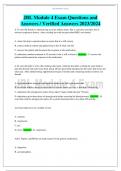
JBL Module 4 Exam Questions and Answers / Verified Answers 2023/2024
JBL Module 4 Exam Questions and Answers / Verified Answers 2023/2024 Most treatments provided in the prehospital setting are intended to _________. A. address the patient's symptoms B. correct the patient's underlying problem C. reduce the need for transport to the hospital D. confirm the patient's diagnosis (Answer: - A. address the patient's symptoms The BEST way to prevent infection from whooping cough is to: A. ask all patients if they have recently traveled abroad. B. get vaccinated against diphtheria, tetanus, and pertussis. C. routinely place a surgical mask on all respiratory patients. D. wear a HEPA mask when treating any respiratory patient. (Answer: - B. get vaccinated against diphtheria, tetanus, and pertussis. The determination of whether a medical patient is a high-priority or low-priority transport is typically made: A. after the primary assessment has been completed. B. upon completion of a detailed secondary assessment. C. as soon as the patient voices his or her chief complaint. D. once the patient's baseline vital signs are known. (Answer: - A. after the primary assessment has been completed. When assessing a patient with a medical complaint, which of the following would MOST likely reveal the cause of the problem? A. Baseline vital signs B. Primary assessment C. Medical history D. Index of suspicion (Answer: - C. Medical history When caring for a patient with an altered mental status and signs of circulatory compromise, you should: A. limit your time at the scene to 10 minutes or less, if possible. B. perform a detailed secondary assessment prior to transporting the patient. C. transport immediately and begin all emergency treatment en route to the hospital. D. have a paramedic unit respond to the scene if it is less than 15 minutes away. (Answer: - A. limit your time at the scene to 10 minutes or less, if possible. When forming your general impression of a patient with a medical complaint, it is important to remember that: A. most serious medical conditions do not present with obvious symptoms. B. it is during the general impression that assessment of the ABCs occurs. C. the conditions of many medical patients may not appear serious at first. D. the majority of medical patients you encounter are also injured. (Answer: - C. the conditions of many medical patients may not appear serious at first Which of the following conditions is NOT categorized as a psychiatric condition? A. Depression B. Alzheimer disease C. Substance abuse D. Schizophrenia (Answer: - C. Substance abuse Which of the following is bacterium resistant to most antibiotics and causes skin abscesses? A. Whooping cough B. H1N1 C. Avian flu D. MRSA (Answer: - D. MRSA Which of the following patients is at greatest risk for complications caused by the influenza virus? A. 68-year-old woman with type 2 diabetes B. 12-year-old child with a fractured arm C. 39-year-old man with mild hypertension D. 50-year-old woman moderate obesity (Answer: - A. 68-year-old woman with type 2 diabetes You and your EMT partner arrive at the residence of a 50-year-old man who complains of weakness. Your primary assessment reveals that he is critically ill and will require aggressive treatment. The closest hospital is 25 miles away. You should: A. administer oxygen via nonrebreathing mask and obtain as much of his medical history as possible. B. load him into the ambulance, begin transport, and perform all treatment en route to the hospital. C. manage all threats to airway, breathing, and circulation and consider requesting an ALS unit. D. perform a detailed secondary assessment, assess his vital signs, and then transport rapidly. (Answer: - C. manage all threats to airway, breathing, and circulation and consider requesting an ALS unit.
Written for
- Institution
- EMT
- Course
- EMT
Document information
- Uploaded on
- November 1, 2023
- Number of pages
- 25
- Written in
- 2023/2024
- Type
- Exam (elaborations)
- Contains
- Questions & answers
Subjects

Also available in package deal