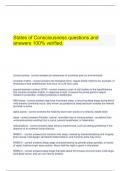
States of Consciousness questions and answers 100% verified.
States of Consciousness questions and answers 100% verified. consciousness - correct awareness of ourselves and our environments circadian rhythm - correct biological clock; regular bodily rhythms (for example, of temperature and wakefulness) that occur on a 24-hour cycle suprachiasmatic nucleus (SCN) - correct answers.a pair of cell clusters in the hypothalamus that controls circadian rhythm. In response to light, it causes the pineal gland to adjust melatonin production, modifying feelings of sleepiness. REM sleep - correct eye movement sleep, a recurring sleep stage during which vivid dreams commonly occur; also known as paradoxical sleep because muscles are relaxed but body is active alpha waves - correct relatively slow brain waves of a relaxed, awake state sleep - correct answers.Periodic, natural, reversible loss of consciousness - as distinct from unconsciousness resulting from a coma, general anesthesia, or hibernation hallucinations - correct sensory experiences, such as seeing something in the absence of an external visual stimulus NREM-1 - correct transition into sleep, marked by slowed breathing and irregular brain waves; hypnagogic sensations/hallucinations, and myclonic jerks may occur NREM-2 - correct answers.Sleep stage characterized by its periodic sleep spindles, or bursts of rapid, rhythmic brain-wave activity. About half the night is spent in this phase. NREM-3 - correct stage that lasts about 30 minutes and your brain emits large, slow delta waves, and you are hard to awaken. delta waves - correct large, slow brain waves associated with deep sleep sleep spindles - correct s of rapid, rhythmic brain wave activity characteristic of stage 2 sleep paradoxical sleep - correct er term for REM sleep; refers to the constrast between high amounts of brain activity and low amounts of bodily (muscle) activity insomnia - correct disorder characterized by recurring problems in falling or staying asleep narcolepsy - correct answers.a sleep disorder characterized by uncontrollable sleep attacks. The sufferer may lapse directly into REM sleep, often at inopportune times sleep apnea - correct answers.a sleep disorder characterized by temporary cessations of breathing during sleep and repeated momentary awakenings night terrors - correct answers.a sleep disorder characterized by high arousal and an appearance of being terrified; unlike nightmares, night terrors occur during NREM-3 sleep, within two or three hours of falling asleep, and are seldom remembered somnambulism - correct condition of walking or performing some other activity without awakening; also known as sleepwalking - occurs during NREM-3 REM Sleep Disorder - correct answers.a neurological disorder in which the person does not become paralyzed during REM sleep and thus acts out dreams dreams - correct most often during REM sleep; may be caused by activation-synthesis, or may be a way of cementing memories manifest content - correct ding to Freud, the remembered story line of a dream latent content - correct ding to Freud, the underlying meaning of a dream (as distinct from its manifest content). Freud believed that a dream's latent content functions as a safety valve. information processing model (of dreams) - correct f by some researchers that the function of dreams is to help us sift, sort, and fix the day's experiences in our memory activation-synthesis theory - correct idea that dreams are the brain's attempt to make sense of random neural activity REM rebound - correct tendency for REM sleep to increase following REM sleep deprivation (created by repeated awakenings during REM sleep) psychoactive drugs - correct answers.a chemical substance that alters perceptions and mood tolerance - correct diminishing effect with regular use of the same dose of a drug, requiring the user to take larger and larger doses before experiencing the drug's effect withdrawal - correct discomfort and distress that follow discontinuing the use of an addictive drug
Document information
- Uploaded on
- October 27, 2023
- Number of pages
- 3
- Written in
- 2023/2024
- Type
- Exam (elaborations)
- Contains
- Questions & answers