Biology Exam Study Guide (2023/2024) Graded A+
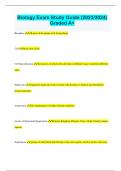
Biology Exam Study Guide (2023/2024) Graded A+ Biosphere All parts of the planet with living things Cell Basic unit of life Cell Specialization the process in which cells develop in different ways to perform different tasks Eukaryotes organisms made up of one or more cells that have a nucleus and membrane-bound organelles homeostasis the maintenance of stable internal conditions Levels of Structural Organization Domain, Kingdom, Phylum, Class, Order, Family, Genus, Species Populations groups of individuals that belong to the same species and live in the same area Prokaryotes single-celled organisms that do not have a membrane-bound nucleus Species group of similar organisms that can breed and produce fertile offspring Themes of Biology energy/ system and interactions/structure and function / unity with diversity/ evalution/ homeostasis/ cooperation Controlled Experiments an experiment in which only one variable is manipulated at a time. Data information gathered from observations Hypothesis possible explanation for a set of observations or a suggested answer to a scientific question Conclusion Restates hypothesis, says if it was correct, why/why not, and what you would have done differently Inference logical conclusion Theory well-tested explanation that unifies a broad range of observations Variables factors that can change in an experiment Atomic Mass total mass of the protons and neutrons in an atom, measured in atomic mass units Atomic Number the number of protons in the nucleus of an atom Chemical Reactions breaking of old and formation of new chemical bonds that result in new substances Compounds combination of 2 or more elements Ions electrically charged atoms that have gained or lost electrons. Isotopes atoms of the same element that have different numbers of neutrons Nonpolar molecules A molecule that has an equal distribution of electrical charge across all its constituent atoms. pH measure of how acidic or basic a solution is Polar molecules molecules in which the charges are unevenly distributed; they can attract each other Products the elements or compounds produced by a chemical reaction Radioactive Isotopes Atoms that are unstable, meaning they decay, or break down, to form stable atoms of a different element Reactants the elements or compounds that enter into a chemical reaction Solute the dissolved substance in a solution Solution a mixture in which one substance is dissolved in another Solvent a liquid substance capable of dissolving other substances Subatomic particles and their characteristics proton (+), neutron (o), electron (-) Types of Chemical Bonds hydrogen, covalent, ionic Amino Acids Simple forms of protein normally used to build tissues or, under some conditions, burned for energy Carbohydrates main source of energy for the body Catalyst substance that speeds up the rate of a chemical reaction Enzyme specialized proteins that speed up chemical reactions Inorganic Molecules non-carbon based molecules Lipids nonpolar molecules that are not soluble or mostly insoluble in water Nucleic Acids very long organic compounds made up of carbon, hydrogen, nitrogen, and phosphorous, contain instructions that cells need to carry out all the functions of life Organic Molecules molecules that contain carbon Proteins nutrients that help build and maintain body cells and tissues Active Transport the movement of materials through a cell membrane using energy Cell Theory The theory that cells form the fundamental structural and functional units of all living organisms Cell Wall a thin membrane around the cytoplasm of a cell Chloroplast plastid containing chlorophyll and other pigments Cytoskeleton a microscopic network of actin filaments and microtubules in the cytoplasm of many living cells that gives the cell shape and coherence Differences between plant and animal cells Animal cells do not have rigid cell walls, plant cells have chloroplasts and contain chlorophyl, and plant cells have a larger central vacuole Diffusion process by which molecules tend to move from an area where they are more concentrated to an area where they are less concentrated Equilibrium a state of balance Golgi Apparatus stack of membranes in the cell that modifies, sorts, and packages proteins from the endoplasmic reticulum Hypertonic solution in cells, solution in which the concentration of dissolved substances outside the cell is higher than the concentration inside the cell; causes a cell to shrink as water leaves the cell Hypotonic solution in cells, solution in which the concentration of dissolved substances is lower in the solution outside the cell than the concentration inside the cell; causes a cell to swell and possibly burst as water enters the cell Isotonic solution a solution in which the concentration of solutes is essentially equal to that of the cell which resides in the solution Lysosome membrane-bound sac containing digestive enzymes that can break down proteins, nucleic acids, and polysaccharides Mitochondria Powerhouse of the cell, organelle that is the site of ATP (energy) production Nucleus a part of the cell containing DNA and RNA and responsible for growth and reproduction Osmosis diffusion of molecules through a semipermeable membrane from a place of higher concentration to a place of lower concentration until the concentration on both sides is equal Passive Transport The movement of materials through a cell membrane without using energy Path of a Protein Rough E.R. - Vesicle - Golgi - Vesicle - Plasmic membrane Plasma membrane characteristics primarily phospholipid bilayer, hydrophilic with a polar head consisting of a phosphate group and glycerol, hydrophobic with a non polar tail consisting of fatty acids, not very rigid (eukaryotic plasma membranes contain sterols and are more rigid with the exception of mycoplasm) protein molecules throught the membrane. Ribosome An organelle that functions in the synthesis of proteins Rough Endoplasmic Reticulum System of internal membranes within the cytoplasm. Membranes are rough due to the presence of ribosomes. functions in transport of substances such as proteins within the cytoplasm Smooth Endoplasmic Reticulum no ribosomes are found on surface; contains collection of enzymes that perform special tasks that include the synthesis of membrane lipids and detoxification; the liver contains a lot of smooth er Aerobic Chemical reactions that require the presence of oxygen. More ATP Anaerobic process that does not require oxygen. Makes less ATP ATP adenosine triphosphate, an organic molecule that acts as the main energy source for cell processes; composed of a nitrogenous base, a sugar, and three phosphate groups Autotrophs organisms that use energy from sunlight or from chemical bonds in inorganic substances to make organic compounds Cellular Respiration the metabolic processes whereby certain organisms obtain energy from organic molecules Consumers an organism that obtains energy and nutrients by feeding on other organisms or their remains. Fermentation a process in which an agent causes an organic substance to break down into simpler substances. Releasing ATP Glycolysis a metabolic process that breaks down carbohydrates and sugars through a series of reactions to either pyruvic acid or lactic acid and release energy for the body in the form of ATP Heterotrophs consumers, they rely on other organisms for their energy and food supply Krebs Cycle second stage of cellular respiration, in which pyruvic acid is broken down into carbon dioxide in a series of energy-extracting reactions Producers organisms that make their own food Calvin Cycle reactions of photosynthesis in which energy from ATP and NADPH is used to build high-energy compounds such as sugars Chlorophyll any of a group of green pigments found in photosynthetic organisms Photosynthesis process by which plants and some other organisms use light energy to convert water and carbon dioxide into oxygen and high-energy carbohydrates such as sugars and starches Cancer any malignant growth or tumor caused by abnormal and uncontrolled cell division Cell Cycle series of events that cells go through as they grow and divide Centromere a specialized condensed region of each chromosome that appears during mitosis where the chromatids are held together to form an X shape Chromosomes threadlike structures made of DNA molecules that contain the genes. Crossing Over the interchange of sections between pairing homologous chromosomes during the prophase of meiosis Cytokinesis organic process consisting of the division of the cytoplasm of a cell following karyokinesis bringing about the separation into two daughter cells Diploid an organism or cell having two sets of chromosomes or twice the haploid number Haploid an organism or cell having only one complete set of chromosomes Meiosis cell division that produces reproductive cells in sexually reproducing organisms Mitosis cell division in which the nucleus divides into nuclei containing the same number of chromosomes Phases of Mitosis Prophase, prometaphase, metaphase, anaphase, telophase Sister Chromatids Replicated forms of a chromosome joined together by the centromere and eventually separated during mitosis or meiosis II. Codominance situation in which both alleles of a gene contribute to the phenotype of the organism Dihybrid Cross hybridization using two traits with two alleles each Dominant Traits Traits that always show in a person even if only one gene of the pair is inherited for the trait Heterozygous having dissimilar alleles at corresponding chromosomal loci Homozygous having identical alleles at corresponding chromosomal loci Independent assortment the random distribution of the pairs of genes on different chromosomes to the gametes Monohybrid cross hybridization using a single trait with two alleles (as in Mendel's experiments with garden peas) Polygenic Inheritance combined effect of two or more genes on a single character Probability a measure of how likely it is that some event will occur Punnett Square a chart that shows all the possible combinations of alleles that can result from a genetic cross Recessive Traits traits that typically do not show in a person unless both genes for the trait are inherited
Written for
- Institution
- Biology
- Course
- Biology
Document information
- Uploaded on
- October 25, 2023
- Number of pages
- 15
- Written in
- 2023/2024
- Type
- Exam (elaborations)
- Contains
- Questions & answers
Subjects
-
biology exam study guide graded a

Also available in package deal