NBCMI Final Exam Review Interpreter Course Questions & Answers
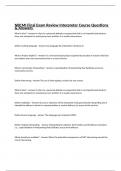
What is bias? - Answer It refers to a personal attitude or perspective that is not impartial and tends to favor one viewpoint or social group over another. It is usually unconscious. Define working language - Answer Any language the interpreter interprets in What is Project Implicit? - Answer It's a Harvard-based project suported by decades of research that lets you explore your own unconscious bias in a series of tests. What is community interpreting? - Answer A specialization of interpreting that facilitates access to community services. Define intervening - Answer The act of interrupting a session for any reason. What is bias? - Answer It refers to a personal attitude or perspective that is not impartial and tends to favor one viewpoint or social group over another. It is usually unconscious. Define mediation - Answer Any act or utterance of the interpreter that goes beyond interpreting and is intended to address a barrier to communication or service delivery (or access to the service). Define Source language - Answer The language your interpret FROM Define medical interpreting. - Answer Interpreting for patients, their families and healthcare providers, i.e., a specialization of interpreting that facilitates access to healthcare. When should you mediate? - Answer When the potential consequences of NOT intervening exceed the risk of intervening. What is a mediation script? - Answer It is a mental statement that helps prepare you to mediate effectively. You can write them down. What is Project Implicit? - Answer It's a Harvard-based project suported by decades of research that lets you explore your own unconscious bias in a series of tests. Why should you have mediation scripts? - Answer They will make you more efficient mediators! Define Target language - Answer The language you interpret INTO What is a good guideline for mediation? - Answer When in doubt, stay out! Are medical interpreters community interpreters? - Answer YES!!!!!!!!!! Do interpreters need to report or interpret (for the other party) what they say when they intervene? - Answer YES! Transparency is required under the NCIHC (and the textbook) ethics and standards. You have to interpret EVERYTHING — including what you say! Define intervening - Answer The act of interrupting a session for any reason. Why is transparency is so important when you mediate? - Answer If you are not transparent you undermined communicative autonomy and direct communication as well as trust. Some interpreters who are not transparent can be patronizing or paternalistic... List the 3 stages of the encounter - Answer Pre-encounter, Encounter, Post-Encounter What are the five steps for mediation? Must know them in order. - Answer 1. interpret what you just said 2. identify yourself as the interpreter 3. mediate briefly 4. report your mediation to the other party 5. resume interpreting What is the purpose of interpreting? - Answer To facilitate communication between 2 or more parties who do not share a common language. How would you handle a term you don't know if it comes up during the session? - Answer Request a clarification. Use a dictionary. Check an electronic glossary. Clarify that you don't know how to interpret the term. Request that the speaker/signer offer another term. Etc. Define mediation - Answer Any act or utterance of the interpreter that goes beyond interpreting and is intended to address a barrier to communication or service delivery (or access to the service). Why shouldn't you explain a cultural misunderstanding yourself? - Answer You could be wrong. You are taking away that person's voice. You undermined communicative autonomy. You might be patronizing or paternalistic. You could lead the other party to mentally stereotype that culture based on your information. When should you mediate? - Answer When the potential consequences of NOT intervening exceed the risk of intervening. Describe communicative autonomy. - Answer The capacity of each party in the encounter to be RESPONSIBLE FOR AND IN CONTROL OF HER OR HER OWN COMMUNICATION. What does it mean to identify or point out a cultural misunderstanding without explaining it? - Answer You IDENTIFY a cultural barrier by stating what you see is causing the misunderstanding. For example, you could say, the interpreter senses a misunderstanding about what hot and cold foods are to both parties and let the doctor ask what the patient thinks about hot and cold foods. In other words you facilitate a cultural discussion. You don't explain anything or speak for the patient or client.
Written for
- Institution
- NBCMI
- Course
- NBCMI
Document information
- Uploaded on
- October 21, 2023
- Number of pages
- 11
- Written in
- 2023/2024
- Type
- Exam (elaborations)
- Contains
- Questions & answers
Subjects
-
nbcmi final exam review stuvia
-
nbcmi final exam review interpreter course questio
-
what is bias it refers to a personal attitude or
-
define working language any language the interpret

Also available in package deal