Praxis 5205 (2023/2024) Rated A+
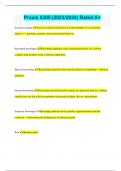
Praxis 5205 (2023/2024) Rated A+ Social knowledge Social conventions passed down within members of a community behavior → greetings, manners, and conversational behavior Procedural knowledge Knowledge applied to carry out procedural tasks (ex. Solving complex math problem using a multistep algorithm) Physical knowledge Knowledge learned by observing the features of something → physical properties Domain knowledge Knowledge and skills used by experts in a particular field (ex. Student explains how she did a division problem using terms dividend, divisor, and quotient) Empirical knowledge Knowledge obtained from scientific experimentation and data collection → determining the boiling point of different liquids Rate Reading speed Accuracy Decoding words correctly without errors when reading Prosody Reading expression (phrasing and intonation) Rapid word identification and automaticity The quick, effortless, and accurate recognition of individual words when reading Semantic Cues Use of prior knowledge from personal experiences along with meaning contained in the text and pictures to make sense of what they are reading Syntactic Cues Knowledge about correct oral language structures of the ways sentences are put together to decode and make meaning Graphophonic Cues When readers are using letter sounds and thier poistion in word sto help decode a word Phonological awareness Broad term that refers to the ability to identify and manipulate sounds in spoken language → word, syllable, or phoneme level Phonemic awareness The ability to identify and manipulate sounds at the phoneme level only Phonemes smallest unit of sound in spoken langauge Phoneme isolation The ability to identify specific phonemes in spoken words → beginning (initial), middle (medial), and ending (final) sounds Phoneme identification Identifying common sound in a list of words that have either the same beginning, middle, or ending sound Phoneme characterization Students are given a set of words in which all but one have the same beginning, middle, or ending phoneme, and they must identify the word that doesn't belong Blending Students are given the phonemes that make up a word in isolation and they must identify the whole word formed by putting the phonemes together (more complex skill) Segmentation Students are given the whole word and they must identify the individual phonemes that make up the word Phoneme deletion Removing one phoneme from a word and identifying what new word was formed Phoneme substitution Changing one phoneme in a spoken word and identifying what new word was formed Phonics The relationship between letters and the sounds they make Elkonin Boxes A strategy for segmenting sounds in a word that involves drawing a box to represent each sound in a word. Students listen to a word and slide a penny or other token into a box each time they hear a new sound → used for blending and segmenting Decoding Using knowledge of letter-sound relationships to figure out unfamiliar words when reading (translating print to speech → graphemes into phonemes) Encoding Using knowledge of letter-sound relationship to write words (speech to print → phonemes to graphemes) Fluency Reading accurately with the appropriate speed and intonation Closed Syllables Syllables that end in a consonant and usually have a short vowel sound (ex. rabbit) Open Syllables Syllables that end in a vowel and usually have a long vowel sound (ex. beagle) R-controlled vowels The letter r affects the sound of the vowel(s) that precedes it (er, ir, ur, ar, or) → ex. carpet Vowel digraph pairs The "ai" in the word detain Vowel-consonant-silent-e syllables Syllables that usually have a long vowel sound (ex. athlete) Consonant-le words Words usually found at the end of a word, ending in "le" (ex. maple) Consonant blends Group of two or three consonants that blend together to make a sound, but each individual letter sound is still heard (ex. Bl, fr, and sw) Consonant digraphs Two consonant letters that together stand for a single sound (sh, th, wh) Explicit instruction Phonics lessons are purposely planned to address specific skills rather than waiting until problems arise with decoding words while reading Systematic instruction The lessons follow a carefully planned scope and sequence, with phonics lessons progressing from basic to advanced Implicit instruction Phonics instruction that is provided in the moment to address unknown words (natural exposure) Progresses from whole (unknown words encountered in text) to part (breaking down the words in order to decode them) Alphabetic Principle an understanding that letters and letter patterns represent the sounds of spoken words (predictable sounds) Concepts of print The conventions used to convey meaning in printed text → developed through shared reading experiences with others and interactions with printed materials Homographs Words that are spelled the same but may be pronounced different and have different meanings (ex. Baseball bat and animal bat) Compound words Words formed by combining two or more words to form one word with a new, unique meaning (ex. Basketball = basket + ball) Cognates Words in different languages that share the same roots (ex. English word directions and the Spanish word direcciones are cognates) Definition clue Type of context clue where a definition for
Written for
- Institution
- Praxis 5205
- Course
- Praxis 5205
Document information
- Uploaded on
- October 19, 2023
- Number of pages
- 44
- Written in
- 2023/2024
- Type
- Exam (elaborations)
- Contains
- Questions & answers
Subjects

Also available in package deal