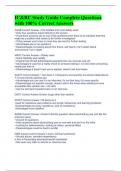
IC&RC Study Guide Complete Questions with 100% Correct Answers
CAGE Correct Answer • The briefest and most widely used. • Only four questions asked directly to the person. • If someone answers yes to one of the questions then there is an indicator that their might be a problem that needs to be further investigated. • If they answer yes to two or more they are sent for further testing. • Advantages-yes or no questions • Disadvantages-not asking about time frame, self report, not in depth about environment, not in depth MAST Correct Answer • Widely used • Good reliability and validity • Original had 25 self administered questions the one now has only 22. • Advantages-it could be a reality check to someone taking it, not very time consuming, simple yes and no • Disadvantage-it doesn't ask you to explain, doesn't ask time frame AUDIT Correct Answer • Ten items 1-3 frequency and quantity 4-6 alcohol dependence 7-10 how harmful alcohol use. • Advantages-you can use it in an interview, it's not that long, it's more specific • Disadvantage-not specific enough, doesn't add in the times when drinking is more acceptable like vacation etc., not valid • Can be self report questionnaire or an interview DAST Correct Answer Screen drugs other than alcohol POSIT Correct Answer 139 items on it Used for substance use problems and social, behavioral, and learning problems Disadvantages-too long, repetitious, lack of consistency Advantages-more detailed SASSI Correct Answer • Doesn't directly question about alcohol/drug use (not like the previous ones) • Around 50 questions • Asks questions about alcohol/drug use on one side and don't on the other • Looking for defensiveness, looking at others, personal affect • Disadvantages-could be hard to profile DSM Axises Correct Answer o Axis I-Clinical syndromes • Alcohol abuse, cannabis dependency o Axis II-Personality disorders/mental retardation • Not used very often in alcohol or chemical use o Axis III-Medical Conditions • Psuerosis of the liver o Axis IV-Psychosocial/environmental stressors • Losing kids because of substance abuse, lacks good social support system o Axis V-Global assessment of functioning • 0-100 how the person is functioning overall Narcotics possible effects Correct Answer Euphoria, drowsiness, respiratory depression, constricted pupils, nausea Narcotics effects of OD Correct Answer Slow/shallow breathing, clammy skin, convulsions, coma, and possible death Narcotics withdrawal syndrome Correct Answer Water eyes, runny nose, yawning, loss of appetite, irritability, tremors, panic, cramps, nausea, chills, sweating. Narcotics Correct Answer Heroin, Morphine, Hydrocodone, Hydro-morphone, Oxycodone, Codeine Depressants Correct Answer Hydroxybutyric Acid, gamma, Benzodiazepines etc. Depressant effects Correct Answer slurred speech, disorientation, drunken behavior without odor of alc., imparired membory of events, interacts with alc. Depressant overdose Correct Answer shallow respiration, clammy skin, dilated pupils, weak and rapid pulse, coma, and possible death. Depressant withdrawal Correct Answer Anxiety, insomnia, tremors, delirium, convulsions, possible death. Stimulants Correct Answer Cocaine half life=one hour, Amphetamine=6-12 hours, Methylphenidate=2 hours Stimulant effects Correct Answer Increased alertness, excitation, euphoria, increased pulse rate, increased blood pressure, insomnia, and loss of appetite, dialated pupils. Stimulant OD Correct Answer Agitation, increased body temperature, hallucinations, convulsions, and possible death Stimulant withdrawal Correct Answer Apathy, long periods of sleep, irritability, depression (possible with suicidal potential), and disorientation, increased appetite, anhedonia (absence of pleasure) and craving. Hallucinogens Correct Answer MDMA and Analogs, LSD, Phencyclidine,
Document information
- Uploaded on
- October 7, 2023
- Number of pages
- 98
- Written in
- 2023/2024
- Type
- Exam (elaborations)
- Contains
- Questions & answers