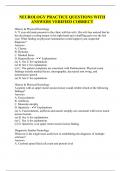
NEUROLOGY PRACTICE QUESTIONS WITH ANSWERS VERIFIED CORRECT
History & Physical/Neurology A 73 year-old male presents to the clinic with his wife. His wife has noticed that he has developed a resting tremor in his right hand and a shuffling gait over the last year. What finding on physical examination would support your suspected diagnosis? Answers A. Chorea B. Dystonia C. Masked facies D. Hyperreflexia - Explanations (u) A. See C for explanation. (u) B. See C for explanation. (c) C. The patient symptoms are consistent with Parkinsonism. Physical exam findings include masked facies, micrographia, decreased arm swing, and monotonous speech. (u) D. See C for explanation. History & Physical/Neurology A patient with an upper motor neuron lesion would exhibit which of the following findings? Answers A. Fasciculations B. Areflexia C. Muscular atrophy D. Spasticity - Explanations (u) A. Fasciculations, areflexia and muscle atrophy are consistent with lower motor neuron lesions. (u) B. See A for explanations. (u) C. See A for explanation. (c) D. Spasticity is an upper motor neuron lesion finding. Diagnostic Studies/Neurology What test is the single most useful test in establishing the diagnosis of multiple sclerosis? Answers A. Cerebral spinal fluid cell count and protein level B. Cerebral spinal fluid immunoglobulin studies C. Evoked potentials D. Magnetic Resonance Imaging - Explanations (u) A. While cerebral spinal fluid cell count, protein levels, and immunoglobins may be abnormal they are not specific for multiple sclerosis. (u) B. See A for explanation. (u) C. Evoked potentials are most useful in the detection of subclinical involvement of neuropathways in MS, but does not establish the diagnosis. (c) D. The presence of plaques on MRI is a key finding in establishing the diagnosis of MS. Diagnostic Studies/Neurology A 22 year-old male presents to the clinic complaining of excessive daytime somnolence and strong desires to sleep at inappropriate times. He came in today because he had an episode of "feeling paralyzed" as he was falling asleep yesterday. What is the most appropriate diagnostic test to confirm this patient's diagnosis? Answers A. MRI of the brain B. Electroencephalogram C. Multiple sleep latency test D. Overnight polysomnography - Explanations (u) A. See C for explanation. (u) B. See C for explanation. (c) C. Multiple sleep latency test is required to observe the abrupt transition to REM sleep and establish the diagnosis of narcolepsy. (u) D. See C for explanation. Diagnosis/Neurology A 54 year-old male smoker presents to the clinic complaining of frequent vague headaches with associated vomiting that awaken him from sleep occasionally and have been present upon awakening for about two weeks. The headache typically resolves about an hour into his morning routine. The patient is afebrile. What is the most likely cause of this patient's headaches? Answers A. Cluster headaches B. Depression C. Glioblastoma D. Giant cell arteritis - Explanations (u) A. Cluster headaches can awaken patients, but are not usually "vague". (u) B. See C for explanation. (c) C. Morning headaches associated with vomiting are indicative of increased intracranial pressure and raise concern of a CNS tumor such as a glioblastoma. (u) D. Giant cell arteritis presents in the older patient with headache in the temporal region and loss of vision. Diagnosis/Neurology A 28 year-old female presents to the clinic complaining of a "prickly sensation" that started bilaterally in her feet two days ago and difficulty walking. She now has the dysesthesia from her mid-thigh down to her toes. On physical examination she has diminished pain and temperature sensation, absent reflexes, loss of proprioception in her legs bilaterally, and muscle strength is 1+/5+ in the lower extremities and 5+/5+ in the upper extremities. What is the most likely diagnosis? A. Guillain-Barré syndrome B. Multiple sclerosis C. Myasthenia gravis D. Spinal cord compression - Explanations (c) A. The pattern of sensory, motor and reflex findings is consistent with the pathophysiology of peripheral nerve demyelination that occurs in Guillain-Barré syndrome. (u) B. Multiple sclerosis does not present as a symmetrical ascending paralysis. (u) C. Patients with myasthenia gravis tend to have intermittent symptoms that affect proximal and extraocular muscles most notably and it also lacks sensory involvement. (u) D. Although the exact type of cord transection can alter the pattern of motor and sensory findings a patient with spinal cord compression who is not in spinal shock would have hyperreflexia instead of areflexia. Diagnosis/Neurology A 51 year-old female presents to the clinic complaining of intermittent sharp pain that originates at the corner of her mouth and radiates toward her ipsilateral eye. She notes "everything makes it worse" including touching the area, talking and eating. What is the most likely diagnosis? Answers A. Bell's palsy B. Cluster headache C. Post-herpetic neuralgia D. Trigeminal neuralgia - Explanations (u) A. See D for explanation. (u) B. See D for explanation. (u) C. See D for explanation. (c) D. This is the classic presentation for trigeminal neuralgia (tic douloureux).
Written for
- Institution
- NEURO
- Course
- NEURO
Document information
- Uploaded on
- October 5, 2023
- Number of pages
- 35
- Written in
- 2023/2024
- Type
- Exam (elaborations)
- Contains
- Questions & answers
Subjects
- neurology practice
-
neurology practice questions

Also available in package deal