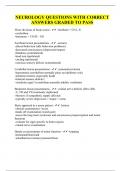
NEUROLOGY QUESTIONS WITH CORRECT ANSWERS GRADED TO PASS
Three divisions of brain lesion - -forebrain + CN I, II -cerebellum -brainstem + CN III - XII Forebrain lesion presentations - -seizures -altered behaviour (ddx behaviour problems) -decreased conciousness (depression/stupor) -blindness (contralateral) -head turn (ipsilateral) -circling (ipsilateral) -concious sensory deficits (contralateral) Cerebellar lesion presentations - -symmetrical ataxia -hypermetria (cerebellum normally plays an inhibitory role) -intention tremors (especially head) -bilateral menace deficits? -vestibular signs? (cerebellum normally inhibits vestibular) Brainstem lesion presentations - -cranial nerve deficits (III to XII) -V, VII and VII commonly implicated -Horner's if sympathetic supply affected -typically severe depression stupor coma Basic approach to a neuro patient - -history -clinical examination (+eyes) -hands off examination (watch gait) -assess the long tracts (concious and unconscious proprioception and motor function) -evaluate for signs specific to brain regions -cranial nerve examination Hands on assessments of motor function - -hopping -hemistand/hemiwalk -wheelbarrow/extensor postural thrust Hands on assessment of sensory function - -paw position testing -hip sway -reflex step Optic nerve (CN II) assessment - -obstacle course in dim light -drop cotton-wool ball -menace response (learned behaviour, absent in young animals) -pupillary light reflex (may be present in forebrain diz) Head tilt implies... - vestibular disease Head turn implies... - asymmetrical forebrain disease Assessment of oculomotor (CN III), trochlear (CN IV) and abducent (CN VI) nerves - -pupillary light reflex (absent constriction in CN III deficit) -assess for strabismus (squint) -assess for normal eyeball movement (induce physiological nystagmus) Trigeminal nerve (CN V) assessment - -assess facial and corneal sensation -assess jaw tone -assess for masticory muscle atrophy Facial nerve (CN VII) assessment - -palpebral reflex - able to blink? -look for facial movement -schrimer tear test Vestibulochochlear nerve (CN VIII) assessment - -assess for nystagmus and strabismus -vestibular eye movements (physiological nystagmus) -hearing test (cochlear portion) Definition of strabismus (squint) - abnormal deviation of the visual axis of the eye that the animal cannot overcome Definition of nystagmus - rhythmical, involuntary movements of the eyeball with either fast and slow phases (jerk nystagmus) or less commonly equal oscillations (pendular nystagmus) Vertical nystagmus implies... - lesion is in the brain (central vestibular) How is nystagmus like checking out a cute girl? - typically the slow phase is towards the lesion (hottie) and the fast escape phase is away from the lesion (when she notices you) Differentiating central/peripheral vestibular disease - Assessment of glossopharyngeal (CN IX) and vagus (CN X) nerves - gag reflex Hypoglossal nerve (CN XII) assessment - -assess tongue for paralysis -is it atrophied/deviating to one side? Horner's syndrome - -miosis -enophthalmos -protrusion of the third eyelid -ptosis -decreased sweating (increased in horses) -erythema, increased skin temperature -assess: resolution following phenylephrine administration to the eye -confirm: show that small pupil does not dilate in the dark and large pupil constricts normally in light Baseline tests for investigating intracranial and cranial nerve disease - -routine haematology and biochemistry -thoracic and abdominal radiographs -ophthalmologic examination -(serology for infectious diseases) -(abdominal ultrasound) Indications for CSF collection - -multifocal CNS disease -intracranial disease -prior to myelography -no abnormalities on survey radiographs or advanced imaging Contraindications for CSF collection - -general anaesthesia -increased intracranial pressure -pathology or instability at collection site (cisterna magna) GME - granulomatous meningoencephilitis -typical in younger small breed dogs (terriers) -progressive neuro dysfunction -diagnose by MRI, CSF and signalment Asymmetrical forebrain signs implies... - lesion is intracranial Symmetrical forebrain signs implies... - lesion is intracranial or extracranial (exclude metabolic causes) Some extracranial forebrain diseases - -porto-systemic shunts or other hepatopathies -electrolyte disturbances -hypoglycaemia (secondary to insulinoma) -hypo/hyper -thyroidism -hyperadrenocorticism (pituitary macroadenomas) -toxic diseases Major intracranial forebrain diseases - -NEOPLASIA (old dogs) -immune mediated CNS inflammatory disease (GME, steroid responsive meningitis) -infectious disease (especially cats) -cerebrovascular disease (stroke) -trauma -congential diz. (hydrocephalus) Treatment of intracranial neoplasia - -manage raised ICP -palliative prednisolone to reduce peri-tumour edema -anticonvulsants? Treatment of GME - -immunosuppressive tapering dose of prednisolone -cytarabine (cytotoxic) tapering dose -GIT protectants Why is head injury uncommon in dogs? - they have lots of cranial musculature and a thick skull Consequences of raised intracranial volume - -collapse of extracellular space
Written for
- Institution
- NEURO
- Course
- NEURO
Document information
- Uploaded on
- October 5, 2023
- Number of pages
- 17
- Written in
- 2023/2024
- Type
- Exam (elaborations)
- Contains
- Questions & answers
Subjects
- neurology questions
-
neurology questions with correct answers

Also available in package deal